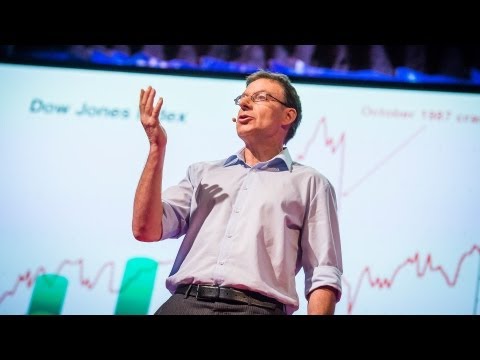
Didier Sornette: How we can predict the next financial crisis
New Section
This section introduces the concept of the Great Moderation and the subsequent Great Recession, leading to the establishment of the Financial Crisis Observatory. The theory of "dragon-kings" is introduced as a means to understand extreme events in financial markets.
The Great Moderation and Great Recession
- The Great Moderation was a period characterized by robust GDP growth, low inflation, low unemployment, and controlled financial volatility.
- The Great Recession in 2007-2008 shattered the belief in never-ending growth and prosperity, resulting in significant losses in the financial sector and global GDP.
- The Financial Crisis Observatory was established to diagnose financial bubbles and predict critical times.
Dragon-Kings Theory
- Dragon-kings represent extreme events that are outliers and have specific mechanisms that may make them predictable.
- Peak-to-valley analysis is used as a measure of risk in financial markets.
- Most peak-to-valleys follow a universal power law distribution, but there are outliers that occur more frequently than predicted by this distribution.
- These outliers are due to trenchant dependencies where losses lead to further losses.
- Standard risk management tools often miss these dependencies.
New Section
This section explores the root mechanism of dragon-kings, which is slow maturation towards instability. It also discusses how extreme events like crashes cannot be predicted using standard techniques.
Slow Maturation Towards Instability
- A dragon-king's root mechanism is a slow maturation towards instability, similar to a bubble reaching its climax before a crash.
- This process is non-linear and cannot be predicted by standard techniques.
- Tiny perturbations can trigger this instability due to an inner instability within the system.
Dragon-King vs. Black Swan Concept
- The black swan concept is often associated with extreme events that are fundamentally unknowable and unpredictable.
- The dragon-king concept, on the other hand, suggests that most extreme events are knowable and predictable.
- Early warning signals predicted by the dragon-kings theory can empower us to make predictions about extreme events.
New Section
This section focuses on one early warning signal predicted by the dragon-kings theory - super-exponential growth with positive feedback. It explains how this growth pattern can lead to finite-time singularities and critical times.
Super-Exponential Growth with Positive Feedback
- During bubbles, there can be positive feedbacks that enhance previous growth and lead to super-exponential growth.
- Super-exponential growth is not sustainable and exhibits finite-time singularities.
- The critical time where the system will break or change regime is contained in the early development of this super-exponential growth.
Application of Dragon-Kings Theory
- The dragon-kings theory has been successfully applied to diagnose the rupture of key elements in an iron rocket using acoustic emission analysis.
Timestamps have been associated with bullet points as requested.
The Application of Theory in Various Fields
In this section, the speaker discusses how a particular theory applies to different fields such as biology, medicine, and finance.
Theory Application
- The same theory applies to biology and medicine, specifically in understanding parturition (the act of giving birth) and epileptic seizures. Precursory contractions during pregnancy can be identified as signs of maturation. Epileptic seizures also have varying sizes and can be predicted when the brain reaches a super-critical state.
- The theory has been applied to various systems including landslides, glacier collapse, prediction of success in blockbusters, YouTube videos, movies, and more. However, its most significant application is in finance. It sheds light on the deep reasons behind financial crises by analyzing historical bubbles that started in 1980.
- The theory challenges the notion of a perpetual money machine thinking that emerged after the global bubble broke in 2007. Quantitative easing and austerity measures are not effective solutions unless the core structural cause of this thinking is addressed.
Predicting Bubbles: Chinese Market Example
This section focuses on predicting market bubbles using the example of the Chinese stock market.
Chinese Market Bubble Prediction
- The speaker shares an experience where he predicted a change in regime for the Chinese stock market bubble by the end of 2007 during a macro hedge fund management conference. Despite warnings from smart and informed managers about government control over the economy due to upcoming events like Beijing Olympic Games, the market lost 20 percent three weeks after his presentation and experienced further volatility throughout the year with a total loss of 70 percent.
- In another instance, a smaller bubble was identified as unsustainable in 2009, and a prediction was made that the market would correct by August 2009. Critics dismissed the prediction, believing in government control and growth. However, the crisis did occur, proving the accuracy of the prediction.
The Challenge of Developing a Science of Economics
This section explores the challenges faced in developing a science of economics due to human anticipation and self-fulfilling prophesies.
Challenges in Economic Science
- Anticipating and influencing markets poses challenges for developing a science of economics. The speaker introduces the Financial Bubble Experiment as an innovative approach to address this issue. The experiment involves monitoring markets, identifying bubbles, making predictions in advance, encrypting reports, and releasing them after authentication to avoid accusations of biased reporting.
- Self-fulfilling prophesies contribute to collective misreadings or ignorance of scientific facts related to market instabilities and control limitations. The speaker highlights the importance of understanding these factors for advancing economic science.
Conclusion
The transcript covers various applications of a theory in different fields such as biology, medicine, and finance. It emphasizes predicting market bubbles using examples from the Chinese stock market and discusses challenges in developing a science of economics due to human anticipation and self-fulfilling prophesies.
New Section
This section discusses the concept of bubbles and unsustainable trajectories in various systems, such as the biosphere, atmosphere, and ocean. It introduces the idea of a phase transition and highlights the presence of bubbles everywhere.
The Nature of Bubbles
- Bubbles are not crashes but rather acts within a larger bubble.
- Various systems on Earth exhibit super-exponential trajectories indicating an unsustainable path.
- A diagram suggests the possibility of a nonlinear transition in the next few decades.
New Section
This section explores the idea of "slaying dragons" or addressing challenges within complex systems. It discusses a study on controlling dynamical systems to remove disruptive elements.
Slaying Dragons
- The speaker is often referred to as someone who chases bubbles and slays dragons.
- A dynamical system study reveals the presence of disruptive elements called "dragon-kings."
- By applying small perturbations at specific times, these dragon-kings can be controlled and removed.
New Section
This section reflects on governance and its role in planning for sustainability. It introduces the concept of "gouverner, c'est prévoir" (governing is planning) and highlights the need for better prediction capabilities.
Governing Towards Sustainability
- Governance involves planning and predicting for sustainable development.
- Mankind faces challenges in steering societies and the planet towards sustainability.
- The dragon-king theory provides hope by revealing pockets of predictability within most systems.
New Section
This section emphasizes the importance of advance diagnostics in crisis management. It mentions taking responsibility and being prepared to avoid being caught off guard by extreme events like economic recessions or crises.
Advance Diagnostics for Crisis Management
- Systems often have pockets of predictability.
- Advance diagnostics can help identify and prepare for crises.
- Taking responsibility and being prepared can prevent surprises caused by extreme events.
The transcript is already in English, so there is no need to translate the content.
Turn any video into a summary like this
YouTube links, meetings, lectures. With transcripts, search, and chat.