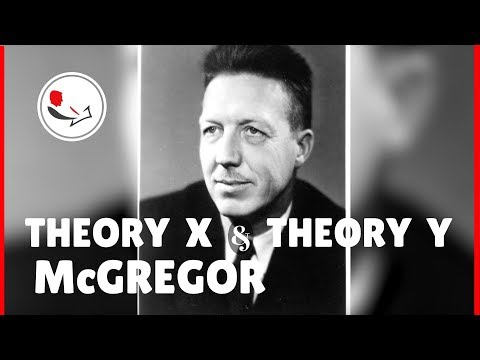
Douglas McGregor's Theory X and Theory Y
Douglas McGregor's Theories on Management
Introduction to Douglas McGregor
- Douglas McGregor was a significant figure in organizational communication and management, known for advocating the human relations approach as a counterpoint to classical management styles.
- He served as a professor at MIT and focused on understanding what motivates people to work hard, particularly examining beliefs about motivation.
Theory X: Traditional Views of Employees
- McGregor articulated Theory X, which reflects the dominant belief system of his time regarding employees' nature.
- Key premises of Theory X include the belief that most employees are inherently lazy, lack ambition, dislike responsibility, and require strict control from management.
- This theory suggests that without active intervention by management—through rewards or punishments—employees will be passive and resistant to organizational needs.
- Managers with Theory X beliefs often create a negative cycle where controlling practices lead to employee resistance, ultimately resulting in poor productivity.
Theory Y: A More Positive Perspective
- In contrast, McGregor proposed Theory Y, which posits that working hard is as natural as play or rest; people can find enjoyment in their work.
- According to Theory Y, individuals will exercise self-direction and self-control when they are committed to organizational objectives.
- Commitment is influenced by the rewards associated with achieving goals; if employees see value in their work, they will exert effort towards it.
Human Potential and Motivation
- McGregor emphasized that under proper conditions, average individuals can learn not only to accept but also seek responsibility within organizations.
- He argued that creativity and ingenuity are widely distributed among employees—not just among top performers—and should be harnessed effectively.
Connection with Maslow's Hierarchy of Needs
- McGregor’s theories align closely with Maslow's hierarchy of needs; he believed many managerial philosophies only addressed physiological and safety needs while neglecting higher-level psychological needs like belongingness and self-esteem.
Understanding McGregor's Theory X and Theory Y
The Continuum of Needs
- McGregor's perspective on Theory X and Theory Y is not about opposites but rather a continuum aligned with Maslow's hierarchy of needs.
- He emphasizes the importance of engaging higher-level needs and desires in employees to enhance their work performance and enjoyment.
- McGregor’s theories have had a significant impact, being cited over 12,000 times according to Google Scholar, indicating their relevance in organizational behavior studies.
- The distinction between the two theories highlights different managerial approaches towards employee motivation and engagement.