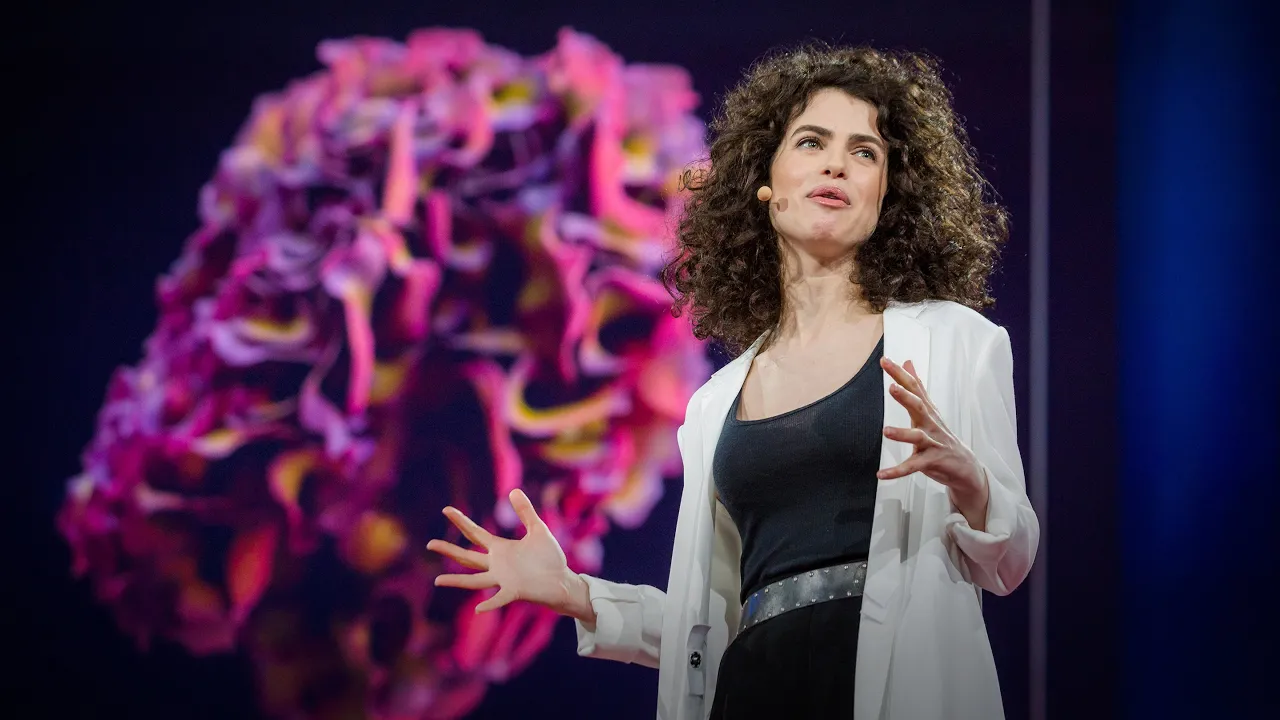
Design at the Intersection of Technology and Biology | Neri Oxman | TED Talks
Designing with Nature: A New Paradigm
Contrasting Design Philosophies
- The speaker introduces two contrasting design cultures represented by twin domes: one made of steel parts and the other from a single silk thread, highlighting the difference between synthetic and organic designs.
- Emphasizes that living things grow rather than being chiseled, as seen in cells which contain all necessary information for function and replication. This suggests tools have significant consequences on design.
Historical Context of Design
- Discusses how since the Industrial Revolution, design has been dominated by manufacturing processes, leading to a focus on discrete parts with specific functions.
- Uses human skin as an example to illustrate that nature does not consist of homogeneous material assemblies; instead, it varies functionality through elasticity without distinct parts.
The Designer's Dilemma
- Presents a metaphorical split screen representing the duality in designers' mindsets—between traditional assembly methods (the chisel) and natural growth processes (the gene).
- The speaker aims to unite these worldviews, advocating for a shift from assembly-based thinking towards growth-oriented design.
Technological Advancements Enabling Change
- Identifies four converging fields—computational design, additive manufacturing, materials engineering, and synthetic biology—that provide unprecedented tools for designers today.
- Introduces projects created by students that range from large-scale robotic arms capable of printing buildings to nanoscale graphics using genetically engineered microorganisms.
Innovative Applications in Design
- Describes reimagining ancient Arabic architecture through a modern mashrabiya screen designed to manipulate light and heat via uniquely sized apertures.
- Highlights collaboration with fashion designer Iris van Herpen to create seamless garments resembling second skin using 3D printing technology.
Nature-Inspired Functional Designs
- Discusses designing a helmet that integrates stiff and soft materials at microscopic resolution for better fit and comfort.
- Explains an acoustic chair designed with irregular surface patterns inspired by nature to absorb sound while varying material properties based on pressure points.
Philosophical Reflections on Creation
- Questions whether nature is ideal or if it contains parts; reflects on biblical stories about creation influencing his views on holistic versus segmented design.
- Ponders what design would look like if objects were made from single materials rather than multiple components.
Exploring Biopolymer Potential
- Introduces chitin as a biopolymer found abundantly in nature; discusses its potential for creating multifunctional structures from single materials.
Exploring Biodegradable Design and Synthetic Biology
The Shift from Plastics to Natural Materials
- Discusses the use of 100% recyclable materials that dry and form naturally upon exposure to air, questioning the continued reliance on plastics.
- Highlights the innovative use of air bubbles in printing processes to house ancient photosynthetic microorganisms, emphasizing collaboration with Harvard and MIT for carbon capture.
Transforming Structures with Nature
- Describes how shrimp shell structures were transformed into tree-like architectures using synthetic biology and water.
- Introduces biodegradable objects designed to nourish marine life when placed in the sea or assist tree growth when buried in soil.
Interplanetary Life-Sustaining Clothing
- Explains the creation of life-sustaining clothing for space travel by embedding bacteria within controlled microfluidic channels.
- Details the combination of cyanobacteria and E. coli, engineered to interact within clothing, representing a new form of evolution through design rather than natural selection.
Wearable Digestive Systems
- Describes a channel resembling a digestive tract created to facilitate bacterial flow and function alteration.
- Unveils a photosynthetic wearable at TED, showcasing liquid channels filled with living organisms as part of clothing design.
Material Ecology: A New Age of Symbiosis
- Proposes creating personal microbiomes that can repair tissue and sustain human bodies, framing this as edited biology.
- Emphasizes returning to nature's principles for design, contrasting traditional additive manufacturing with nature’s sophisticated growth processes.
Understanding Silkworm Architecture
- Analyzes how silkworm cocoons are built using two proteins in varying concentrations for structure and adhesion.
- Discusses experiments visualizing silkworm cocoon architecture through magnetic sensors, revealing environmental influences on cocoon shape.
Designing Environments for Silkworm Growth
- Explores how different environments affect silk production without harming silkworms, allowing them to metamorphosize healthily.
Silkworms and Design: A New Age of Creation
The Lifecycle of Silkworms in Design
- The speaker discusses the arrival of 6,500 silkworms ordered from an online silk farm, emphasizing their readiness to spin silk after four weeks of feeding.
- As the silkworms pupate and mate, they lay eggs, initiating a new life cycle that mirrors human experiences but occurs at a much faster pace.
- Bucky Fuller’s concept that "tension is the great integrity" is highlighted as essential for the structural integrity provided by biological silk compared to robotic methods.
- Over two to three weeks, these silkworms produce 6,500 kilometers of silk, which interestingly matches the length of the historical Silk Road.
- After hatching, moths generate 1.5 million eggs, indicating potential for creating 250 additional pavilions in future designs.
Uniting Two Worldviews in Design
- The speaker contrasts two design approaches: one utilizing robotic arms for silk production and another relying on natural processes to fill gaps in design.
- Emphasizing a need for unity between these worldviews suggests that designers should integrate both nature-inspired and design-inspired elements into their work.
- This integration calls for a transformative approach to design that respects and mimics natural processes while innovating through technology.
Turn any video into a summary like this
YouTube links, meetings, lectures. With transcripts, search, and chat.