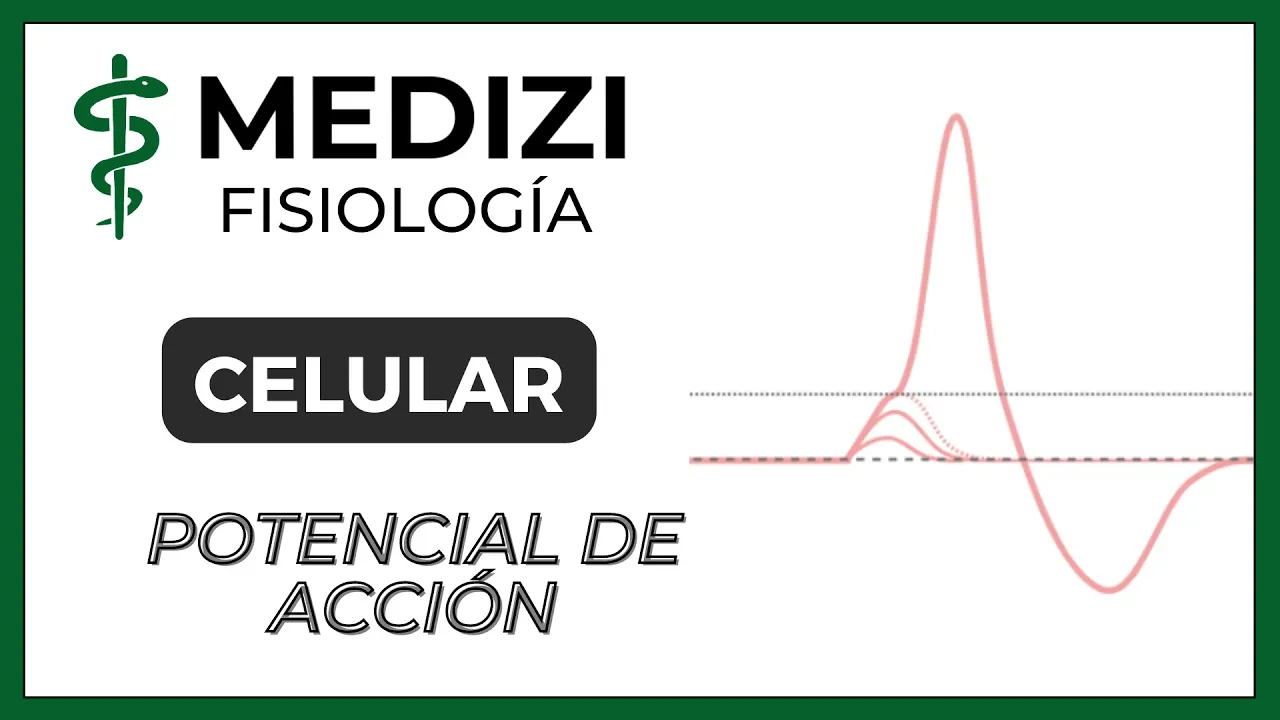
Clase 5 Fisiología - Potencial de acción (IG:@doctor.paiva)
New Section
The instructor introduces the topic of action potential in physiology, discussing generalities such as stages of action potential, excitability threshold, depolarization, repolarization, and hyperpolarization.
General Introduction to Action Potential
- The cell is initially at a resting state of -90 millivolts with sodium inside and potassium outside.
- Upon sodium entry into the cell, it becomes less negative (e.g., from -90 to -85 millivolts).
- If chloride enters negatively after sodium, the cell becomes more negative (e.g., from -90 to -95 millivolts).
New Section
The instructor delves into the rapid changes in membrane potential during action potentials and discusses the phases involved.
Phases of Action Potential
- Action potentials are rapid changes in membrane potential that propagate along the membrane.
- Resting state is at -90mV while excitability threshold is at -65mV.
- Stages include resting state, excitation through sodium channels reaching threshold (-65mV), and initiation of "all or nothing" response.
New Section
Detailed explanation on how sodium channels open during action potential initiation through chemical or voltage-dependent mechanisms.
Sodium Channel Activation
- Sodium channels can be voltage-dependent or chemically dependent.
- Acetylcholine example illustrates ligand binding opening sodium channels.
- Entry of sodium leads to polarity change from -90mV to -65mV triggering channel activation.
New Section
Discussion on the law of "all or nothing" regarding action potentials and the importance of reaching the excitability threshold for channel activation.
Law of "All or Nothing"
- Channels open only if membrane reaches excitability threshold (-65mV).
- Failure to reach threshold results in no action potential generation.
Understanding Cellular Physiology
In this section, the speaker delves into the mechanisms of cellular physiology, focusing on topics such as potassium channels, hyperpolarization, sodium-potassium pumps, and refractory periods.
Potassium Channels and Hyperpolarization
- Potassium channels open, leading to the efflux of potassium ions from the cell. This causes hyperpolarization where the cell becomes more negative than its resting state.
- Hyperpolarization involves the action of sodium-potassium pumps that pump sodium out and potassium in to restore ionic gradients.
- During hyperpolarization, there is an imbalance with high sodium outside and high potassium inside the cell due to pump activity. This reversal is crucial for maintaining cellular function.
Refractory Periods
- Two types of refractory periods exist: absolute and relative refractory periods. The absolute refractory period occurs when sodium channels are inactive, preventing another action potential.
- In the relative refractory period, a strong stimulus can trigger a new action potential after sodium channels close during repolarization. The strength of stimuli determines excitability levels during this phase.
Action Potential Propagation and Conduction
- The concept of plateaus in action potentials is explored in cardiac muscle cells due to slow sodium/calcium channels and delayed potassium channel openings contributing to sustained depolarization phases.
- Nerve impulse propagation differs between unmyelinated (0.25 m/s) and myelinated fibers (100 m/s), showcasing how myelin sheaths enhance conduction speed by forming nodes of Ranvier for saltatory conduction.
Excitation Mechanisms in Cells
- Cells can be excited through electrical, chemical, or physical means. Electrical excitation involves voltage-gated ion channels responding to polarity changes inducing depolarization events essential for cell function.
Turn any video into a summary like this
YouTube links, meetings, lectures. With transcripts, search, and chat.