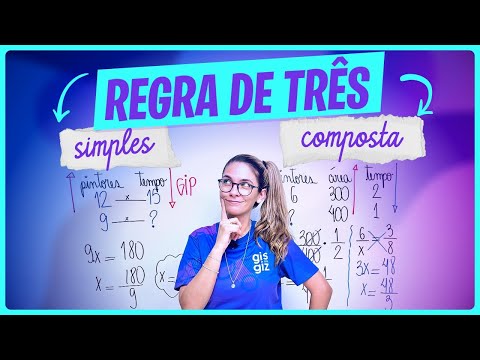
REGRA DE TRÊS SIMPLES E COMPOSTA | RESUMÃO |
Resumo: Regra de Três Simples e Composta
This section introduces the concepts of simple and compound rule of three, explaining how to differentiate between them based on the number of quantities provided in a problem.
Distinguishing Simple and Compound Rule of Three
- In a simple rule of three, there are two quantities mentioned in the problem, such as the number of workers and time taken for a task.
- A compound rule of three involves three or more different quantities, like the number of workers, days worked, and hours per day.
- Understanding how to solve each type is crucial. For instance, when painting a house with 12 painters in 15 days, identifying if they are directly or inversely proportional is key.
Solving Rule of Three Problems
- Analyzing if quantities are directly or inversely proportional helps determine the approach needed for solving the problem effectively.
- Utilizing equations to find unknown values by multiplying known quantities correctly ensures accurate solutions in both simple and compound rule of three scenarios.
Exemplo Prático de Regra de Três Composta
This part delves into a practical example involving compound rule of three to illustrate its application in real-world problem-solving.
Problem Analysis and Strategy Development
- Identifying multiple quantities like the number of painters, area painted, and time taken sets the stage for applying compound rule of three principles.
New Section
In this section, the speaker explains a mathematical problem involving proportions and ratios.
Solving a Mathematical Problem
- The speaker sets up the problem with the ratio 6: x for area and discusses its relationship to another variable.
- Explains the concept of inverse proportionality in relation to time and standard variables.
- Demonstrates multiplying fractions to solve for x in the given ratio equation.
- Calculates the final value of x as 16, representing the number of painters needed to paint an area of 400 square meters in one hour.
New Section
The speaker concludes by encouraging engagement with their educational content and offering further learning opportunities.
Conclusion and Call to Action
- Summarizes the solution involving simple and compound rules of three.