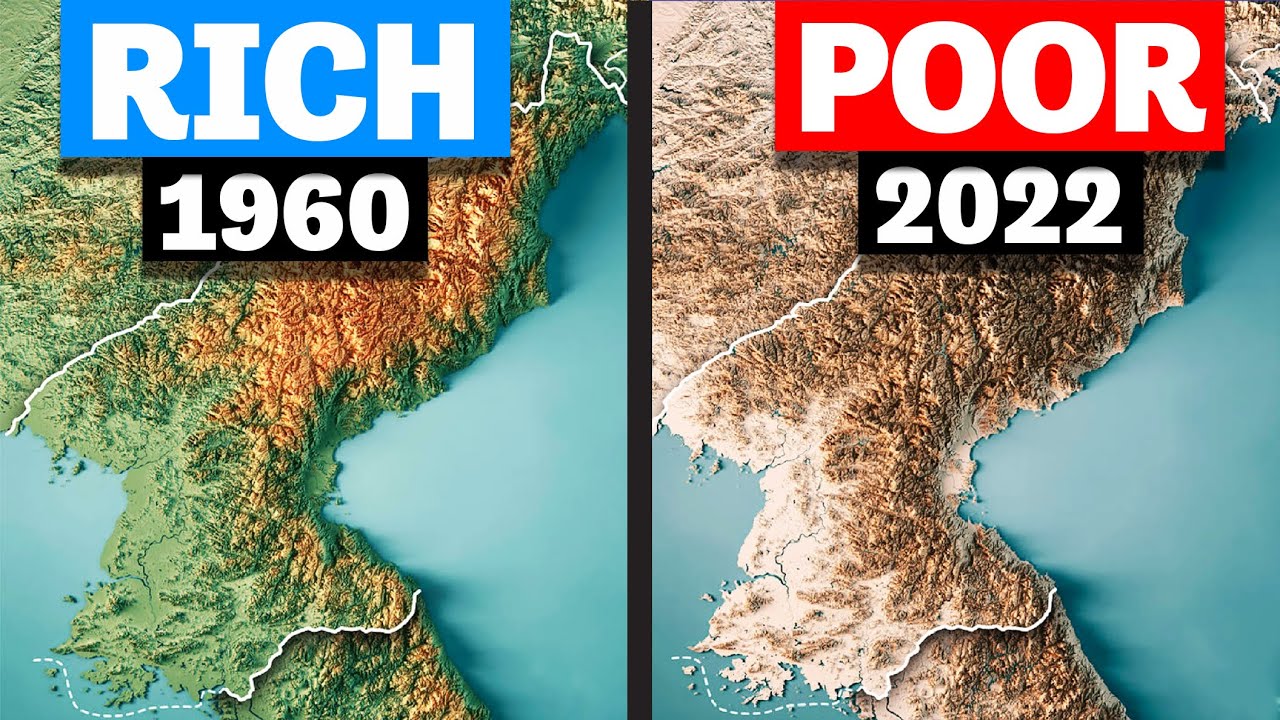
How North Korea Became So Insanely Poor
North Korea's Economic History
The video delves into North Korea's economic history, highlighting the impact of decisions made by the government and external influences on the country's development.
North Korea's Famine and Mountain Goat Breeding
- The government initiated a campaign to breed mountain goats in response to a severe famine.
- The rapid increase in goat population led to the destruction of vital shrubs, causing mudslides and flooding.
Contrasting Economies: North vs. South Korea
- Historically, North Korea held superiority over South Korea in various aspects such as politics, economy, technology, and military.
- Over time, South Korea emerged as an incredibly prosperous nation compared to the struggling North Korean economy.
Impact of External Influences on Korea
- Throughout history, Korea faced invasions due to its position among powerful nations like China and Japan.
- Japan's colonization of Korea brought exploitation but also some economic development through infrastructure improvements.
Korea Post World War II
This section explores the aftermath of World War II on Korea, focusing on the division of the country and its subsequent political ideologies.
End of Japanese Rule and Soviet Influence
- Japan's reign over Korea ended abruptly with Soviet troops invading Manchuria towards the end of World War II.
Market Economy and Industrial Development
This section discusses the economic landscape of North Korea post-World War II, highlighting the division of resources between North and South Korea and the subsequent industrial development in North Korea under Japanese occupation.
Market Economy vs. Dictatorship
- North Korea possessed abundant natural resources, industrial capacity, and electrical power generation.
- South Korea had prime agricultural land, leading to a scarcity of farmland in North Korea.
Korean War and Economic Impact
- The Korean War saw UN forces pushing back North Korean troops with Chinese intervention near the original borders.
- US carpet bombing campaigns severely damaged North Korea's industrial infrastructure.
Transition to Command Economy
This segment delves into Kim Il Sung's transformation of North Korea into a command economy post-Korean War, emphasizing state control over all aspects of life.
Command Economy Implementation
- All private property was seized by the state, markets were outlawed, and freedoms were restricted.
- Lack of experience in administration hindered accurate economic planning under state control.
Resurgence through Juche Ideology
The rise of North Korea's economy in the 1950s is explored through Kim Il Sung's leadership, Juche ideology, and external aid from socialist nations.
Economic Growth Under Juche Ideology
- Despite wartime destruction, North Korea experienced significant economic growth at 15% annually until the 1970s.
- Kim Il Sung's dominance through Juche ideology emphasized self-reliance and sacrifice for national progress.
Dependence on External Aid
This part examines how despite promoting self-reliance, North Korea heavily relied on aid from socialist nations for its economic resurgence.
External Assistance
- China and Soviet Union provided substantial aid including infrastructure projects, food supplies, forgiveness of loans, and free labor.
Kim Il Sung's Economic Strategy
This section delves into Kim Il Sung's economic strategy for North Korea, exploring the reasons behind the continuous aid received and the consequences of his heavy industry-focused approach.
Kim's Strategic Moves
- Kim leveraged North Korea as a microcosm of the Cold War to secure aid from the Soviets and Chinese.
- Aid continued due to tensions between the Soviet Union and China, with both vying for influence in North Korea.
- The emphasis on heavy industry led to economic growth but masked structural flaws, making North Korea reliant on aid.
Heavy Industry Focus
- Kim prioritized heavy industry over consumer goods and agriculture, impacting food production negatively.
- The "Chollima movement" aimed at mobilizing the population to compensate for economic shortages through increased productivity.
Military Buildup and Debt Crisis
- North Korea's focus on self-reliance led to massive military spending, straining the economy further during heightened Cold War tensions.
North Korea's Economic Struggles and Survival
This section delves into the economic challenges faced by North Korea, detailing its failed mega projects, reliance on other socialist states, and the catastrophic effects of the collapse of the Soviet Union.
North Korean Mega Projects
- The South's economic prosperity highlighted the stark contrast with the North, leading to increased tensions.
- North Korea embarked on extravagant but unsuccessful mega projects funded partially by the Soviet Union.
- These projects included a massive land reclamation project, attempts at building large-scale infrastructure like dams and power plants, and iconic failures like the Ryugyong hotel.
Economic Collapse and Dependency
- By the early 90s, North Korea faced a lopsided economy heavily focused on military spending and reliant on socialist states for support.
- The collapse of the Soviet Union in 1991 had severe repercussions as trade dwindled, aid stopped, and oil supply drastically reduced.
North Korea's Descent into Crisis
This section explores how North Korea's economy spiraled into crisis due to fuel shortages leading to widespread consequences such as power outages, halted industries, and food scarcity.
Ripple Effects of Fuel Shortage
- Drastic reduction in oil supply led to coal mining cessation, power plant shutdowns, fertilizer production halt causing a chain reaction across industries.
- The shortage of fuel disrupted agriculture with increased water needs for irrigation resulting in power plant closures and transportation halts.
Environmental Devastation and Food Scarcity
- Environmental degradation worsened due to deforestation for fuel leading to floods destroying farmlands along with underground grain stockpiles.
- The nation faced an apocalyptic scenario with food scarcity exacerbated by unproductive farmlands and transportation challenges.
North Korea's Resistance to Change
This section delves into why North Korea resisted structural reforms despite international aid dependency and dire circumstances.
Reluctance towards Reform
- Despite receiving significant international aid until 2000, North Korea refused to make necessary concessions or structural changes due to ideological reasons.
- The regime allowed limited market activities out of necessity but avoided substantial reforms fearing a domino effect similar to other nations' experiences post-reform movements.
Survival Strategies of North Korea
This section discusses how North Korea managed to survive economically through illicit activities amidst global isolation.
Survival Mechanisms
Conditions in North Korea
The discussion revolves around the illegal activities of North Korea, including drug production and counterfeiting, which generate significant revenue for the regime.
Illegal Activities in North Korea
- North Korea engages in illegal activities such as producing high-quality drugs and counterfeit currency.
- The country harbors international criminals, providing them with state-sponsored distribution and protection.
- These illicit activities offer plausible deniability to North Korea when criminals are caught.
- The revenue from these illegal ventures is estimated to be billions of dollars, supporting the regime's military and power hold.
China's Role in Supporting North Korea
This section highlights China's role in preventing a collapse of North Korea due to humanitarian concerns and potential nuclear crises.
China's Support for North Korea
- China views North Korea as a nuisance but aims to avoid a humanitarian crisis along its border.
- China provides energy and food aid to prevent destabilization in North Korea.