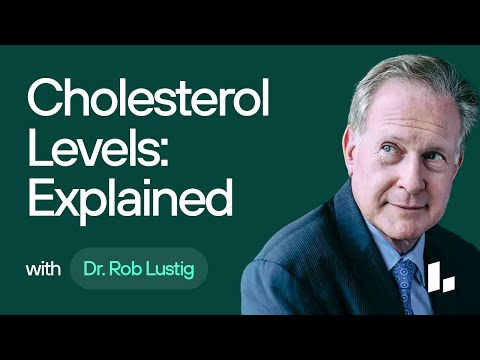
Understand Your CHOLESTEROL PANEL & Metabolic Health Tests - The ULTIMATE Guide | Dr. Robert Lustig
Understanding Cholesterol Panel
In this section, Dr. Robert Lustig explains the four main elements of a cholesterol panel and what each test means.
Total Cholesterol is Useless
- Total cholesterol is useless because it doesn't tell you what kind of cholesterol you have.
- You need to know what kind of cholesterol you're talking about.
LDL Matters but Not as Much as We Think
- LDL levels correlate with heart disease risk in large populations, but the medical profession places too much significance on this test.
- The hazard risk ratio for high LDL and heart disease is 1.3, which means if you have high LDL, you have a 30% more likely risk of developing a heart attack in your lifetime.
- There are two types of LDL: one that matters for heart disease and one that doesn't.
- Your doctor may not know which type predominates in your lab test.
Triglyceride Level Matters More Than LDL
- Triglyceride level helps determine which type of LDL predominates in your lab test.
- When you measure your triglyceride in the fasting state, you're looking at how your liver handles carbohydrates and sugar in your diet.
- High triglycerides mean that there's too much sugar being turned into fat by the liver, leading to small dense LDL particles that increase the risk of heart disease.
HDL is Good Cholesterol
- HDL is good cholesterol because it removes excess cholesterol from cells and arteries and takes it back to the liver for processing or excretion.
- Higher levels of HDL are associated with lower rates of heart disease.
How to Improve Your Cholesterol Panel
In this section, Dr. Robert Lustig explains how to improve your cholesterol panel through lifestyle changes.
Reduce Sugar Intake
- Reducing sugar intake is the most important step in improving your cholesterol panel.
- Sugar turns into fat and increases triglycerides, leading to small dense LDL particles that increase the risk of heart disease.
Increase Fiber Intake
- Increasing fiber intake can help reduce LDL levels by binding to bile acids in the gut and excreting them from the body.
- Soluble fiber is particularly effective at reducing LDL levels.
Exercise Regularly
- Regular exercise can help increase HDL levels and improve overall cardiovascular health.
- Aim for at least 150 minutes of moderate-intensity exercise per week.
Consider Medication if Necessary
- If lifestyle changes are not enough to improve your cholesterol panel, medication may be necessary.
- Statins are effective at lowering LDL levels but come with potential side effects.
- Other medications, such as PCSK9 inhibitors or bile acid sequestrants, may also be used depending on individual circumstances.
Understanding Cholesterol
In this section, the speaker discusses the importance of triglycerides and their relationship to heart disease. They also explain how HDL (the "good" cholesterol) can be protective against heart disease.
Triglycerides and Heart Disease
- Triglycerides are a better indicator of heart attack risk than LDL.
- High triglyceride levels are a concern, but they are not always measured because there is no drug for high triglycerides.
- The relationship between triglycerides and LDL must be understood to assess heart disease risk.
HDL and Heart Disease
- HDL is known as the "good" cholesterol because it transports lipids away from adipocytes and towards the liver.
- Higher levels of HDL have been shown to lower the risk of heart disease.
- There are variants of HDL that confer even greater protection against heart disease.
Triglyceride to HDL Ratio
- The triglyceride to HDL ratio is perhaps the most important risk factor for determining heart disease.
- A ratio of 1.5 or less is ideal, while a ratio of 2.5 or greater indicates a problem.
- The ideal ratio may vary based on race.
Understanding Lipid Profiles
- A fasting lipid profile provides a snapshot of where different molecules are in relation to each other at any given moment.
- Doctors often only look at high or low numbers without considering ratios or other factors.
Understanding LDL Cholesterol and Heart Disease Risk
In this section, the speaker discusses how LDL cholesterol alone is not sufficient to determine heart disease risk. They explain that it's important to understand the sub-fractionated particles and other ratios like triglyceride to HDL ratio.
Importance of Interpreting Lipid Profile
- You can only interpret a lipid profile if you know you're not sick.
- You should look at your white blood count as the first thing before interpreting lipid levels.
- Your thyroid hormone level is also important in interpreting lipid levels.
Large Buoyant vs Small Dense LDL
- Large buoyant LDL is cardiovascularly neutral and makes up 80% of your LDL.
- Small dense LDL is different from large buoyant LDL. It's small, dense, and sinks under the surface of endothelial cells to start plaque formation process.
- The outside of small dense LDL particle is much more inflammatory than large buoyant.
Takeaways
- The speaker emphasizes that doctors who don't understand what they're looking at when interpreting lipid profiles cannot take care of patients properly.
- It's important to fix thyroid levels before interpreting lipid tests.
Understanding VLDL, LDL and Triglycerides
In this section, the speaker explains the relationship between VLDL, LDL and triglycerides. They also discuss how sugar consumption affects these levels.
VLDL and Triglycerides
- VLDL is made by the liver in response to sugar consumption.
- Triglyceride equals VLDL in the fasting state.
- Chylomicrons are what your intestine does to fat when you're not fasting.
Small Dense LDL
- After offloading from the liver and adipocytes, VLDL becomes small dense LDL.
- Sugar consumption turns into fat which is packaged as VLDL. Getting rid of small dense LDL requires getting rid of sugar.
Importance of Understanding Lipidology
- Doctors often miss potential opportunities to catch early signs of diabetes or heart disease because they only look at individual test results instead of looking at them together.
- Cutting out refined sugar can significantly reduce triglyceride levels over time.
The Need for Lipidology Education
In this section, the speaker discusses how chronic diseases are more prevalent than acute diseases and how primary care physicians are not equipped to manage these problems due to a lack of lipidology education.
Lack of Lipidology Education
- Chronic disease is more prevalent than acute disease but primary care physicians are not equipped to manage these problems due to a lack of lipidology education.
- Doctors are not taught how to interpret lab results in medical school.
- Primary care physicians are not equipped to manage chronic diseases.
The Role of Calories and Obesity in Lipid Profile
In this section, the speaker discusses how the basic precept of all mythology is built on calories and obesity. He explains that being obese does not necessarily mean having a bad lipid profile, and being thin does not necessarily mean having a good lipid profile.
The Importance of Visceral or Liver Fat
- The speaker explains that subcutaneous fat is essentially inert, while visceral or liver fat is what makes bad particles problematic.
- Excess sugar in one's diet can lead to the creation of liver fat, which can happen whether one is obese or thin.
Understanding LDL and Triglycerides
- If someone has high LDL levels, it's important to know more about what makes up their total LDL between small density and high-density LDL.
- Looking at triglyceride levels can provide specific guidance for understanding one's lipid profile. A triglyceride to HDL ratio less than 1.5 generally indicates good health.
- A triglyceride level of 100 or less is considered good. Higher levels require further investigation to determine if there are issues with small density LDL versus non-small density LDL.
Insulin Resistance and Triglyceride to HDL Ratio
- Triglyceride to HDL ratio is a marker for insulin resistance.
- Insulin takes energy from the blood that isn't being burned and stores it as fat. Where this fat goes determines its danger level.
- Insulin resistance occurs when insulin doesn't work correctly due to excess fat in the liver.
The Role of Insulin
- The pancreas drains directly into the liver to tell it how to package energy because the liver is the primary target of insulin action.
Why Does the Pancreatic Vein Drain Into the Portal Vein?
In this section, the speaker discusses why the pancreatic vein drains into the portal vein and not into the inferior vena cava.
The Role of Insulin in Energy Storage
- The pancreatic vein drains directly into the liver to signal how to package energy.
- Insulin is an energy storage hormone that takes what isn't being burned and stores it as fat.
Portal Systems and Liver Fat
In this section, the speaker discusses how the liver plays a crucial role in insulin sensitivity and how liver fat can lead to chronic metabolic diseases.
The Role of Portal Systems
- There are two portal systems in the body: hypothalamus-pituitary and pancreas-liver.
- The signaling that goes on at organ one tells organ two what to do.
- When the liver is not doing what it's supposed to, the pancreas has to work harder to tell the liver what to do.
Liver Fat and Insulin Sensitivity
- Liver fat causes the liver not to work correctly, which raises insulin levels all over the body.
- High insulin levels have been associated with virtually all chronic diseases and cancer and dementia.
- Insulin is good when it lowers blood glucose but bad for everything else.
- A low triglyceride-to-HDL ratio indicates better insulin sensitivity.
Causes of Liver Fat
- Sugar causes fat accumulation in the liver, leading to liver fat.
- Small dense LDL manifests in lipid profiles with high triglyceride-to-HDL ratios.
Importance of Fasting Insulin
In this section, the speaker discusses the importance of fasting insulin and why it is not included in standard chem panels.
Why Fasting Insulin is Not Included in Standard Chem Panels
- The American Diabetes Association advises doctors not to draw fasting insulin.
- The two reasons given for this advice are that insulin levels across the country are not standardized and that fasting insulin levels do not correlate with obesity.
- However, both reasons are flawed. While it is true that insulin assays are not standardized, cheap assays can still measure pro-insulin, which is a precursor hormone to insulin. This means that even if a cheap assay picks up pro-insulin instead of mature insulin, high levels still indicate a problem.
- Additionally, while fasting insulin does not correlate with obesity, it does correlate with metabolic health. Therefore, it is important to measure fasting insulin levels regardless of whether or not someone is obese.
The Problem with Cheap Insulin Assays
- Cheap insulin assays can pick up pro-insulin as well as mature insulin.
- Pro-insulin is less effective than mature insulin because it has about 20 times less lowering capacity.
- When the pancreas is stressed or when someone is sick or insulin resistant, it may dump pro-insulin into the bloodstream instead of waiting for an enzyme called prohormone convertase1 (PC1) to cleave c-peptide out of the molecule and create mature insulin.
- Even though cheap assays may pick up pro-insulin instead of mature insulin, high levels still indicate a problem and should be measured.
Fasting Insulin and Liver Function Tests
In this section, the speakers discuss the importance of fasting insulin levels and liver function tests in assessing metabolic health.
Importance of Fasting Insulin Levels
- The American Diabetes Association's recommendations for managing diabetes are based on an incorrect assessment of what needs to be fixed.
- Fasting insulin is a crucial marker for metabolic health, and lower levels are better.
- Marathoners can have fasting insulin levels less than two, while anything under six or seven is considered fine. Above 10 indicates some insulin resistance, while 15 suggests dysfunction in the liver.
Significance of Liver Function Tests
- Liver function tests (LFTs), including AST, ALT, and bilirubin, are essential indicators of liver health.
- ALT is often abused as a test because its normal range has shifted to the right over time. An ALT level of 39 is too high despite being within the current normal range of less than 40.
- The entire normal curve has shifted to the right over time due to changes in laboratory testing practices.
Overall, fasting insulin levels and liver function tests provide valuable insights into metabolic health that should not be overlooked.
Understanding Reference Ranges
In this section, the speaker discusses how reference ranges for certain medical tests have changed over time and how they are interpreted by doctors.
Shifting Reference Ranges
- The Gaussian distribution has shifted to the right, causing reference ranges to change.
- A higher ALT level is now considered normal, but it may still be cause for concern.
- Any ALT above 25 (20 for African Americans) is cause for concern and indicates liver fat until proven otherwise.
Interpreting Test Results
- The problem with test results is not the test itself, but rather the interpretation of the results.
- If a patient has an elevated ALT level, doctors must determine why there is liver fat and what can be done to remove it.
Understanding Metabolic Health
In this section, the speaker emphasizes the importance of understanding metabolic health in its entirety and not just focusing on individual test results.
Holistic Approach to Metabolic Health
- All medical tests should be viewed in context with each other to understand overall metabolic health.
- Everyone has the power to understand their own metabolic health by looking at all relevant factors together.
Reevaluating Cholesterol Tests
In this section, the speaker discusses how cholesterol tests are often misinterpreted and provides guidance on how to properly evaluate them.
Total Cholesterol vs. HDL Cholesterol
- Total cholesterol numbers are fairly meaningless and should not be a primary focus.
- HDL cholesterol is a good indicator of overall health and should be high.
Evaluating LDL Cholesterol
- LDL cholesterol alone is not very useful in evaluating metabolic health.
- Triglyceride levels can help determine if small density LDL is present, which can be an issue if levels are high.
Triglycerides to HDL Ratio
- A triglyceride to HDL ratio over 2.5:1 (1.5:1 for African Americans) indicates a problem with metabolic health.
- Ideally, the ratio should be less than 1.5:1 for everyone.
Overall, it's important to view all medical tests in context with each other and understand the bigger picture of metabolic health. Properly interpreting test results can lead to better treatment options and prevention of chronic metabolic disease.
Understanding Cholesterol and Liver Fat
In this section, the speaker discusses the importance of understanding cholesterol levels and liver fat in relation to overall health.
Genetics and Cholesterol
- Genetics play a role in determining cholesterol levels.
- If ALT is above 25, it's important to look into it.
- Fasting insulin test should be less than six.
Sugar and Liver Fat
- Sugar drives liver fat which leads to insulin resistance.
- Alcohol and sugar are metabolized the same way, causing chronic metabolic disease.
- Getting rid of sugar beverages, exercise, and intermittent fasting can help reduce liver fat.
Refined Carbohydrates
- Avoiding processed foods like white flour can help reduce triglyceride levels.
- Liquid sugar is an easy thing to eliminate from one's diet.
Empowerment through Knowledge
- The book "Metabolical" is a great gift for family members as it empowers them with knowledge about their health.
Thank you for the detailed instructions. I will keep them in mind while creating the notes.
Unfortunately, the transcript provided is incomplete and only contains one word "you" with a timestamp of 0:57:16 or 3436 seconds into the video. Without more context, it is impossible to create meaningful notes or sections.
Please provide a complete transcript so that I can create comprehensive and informative markdown notes as per your requirements.
Turn any video into a summary like this
YouTube links, meetings, lectures. With transcripts, search, and chat.