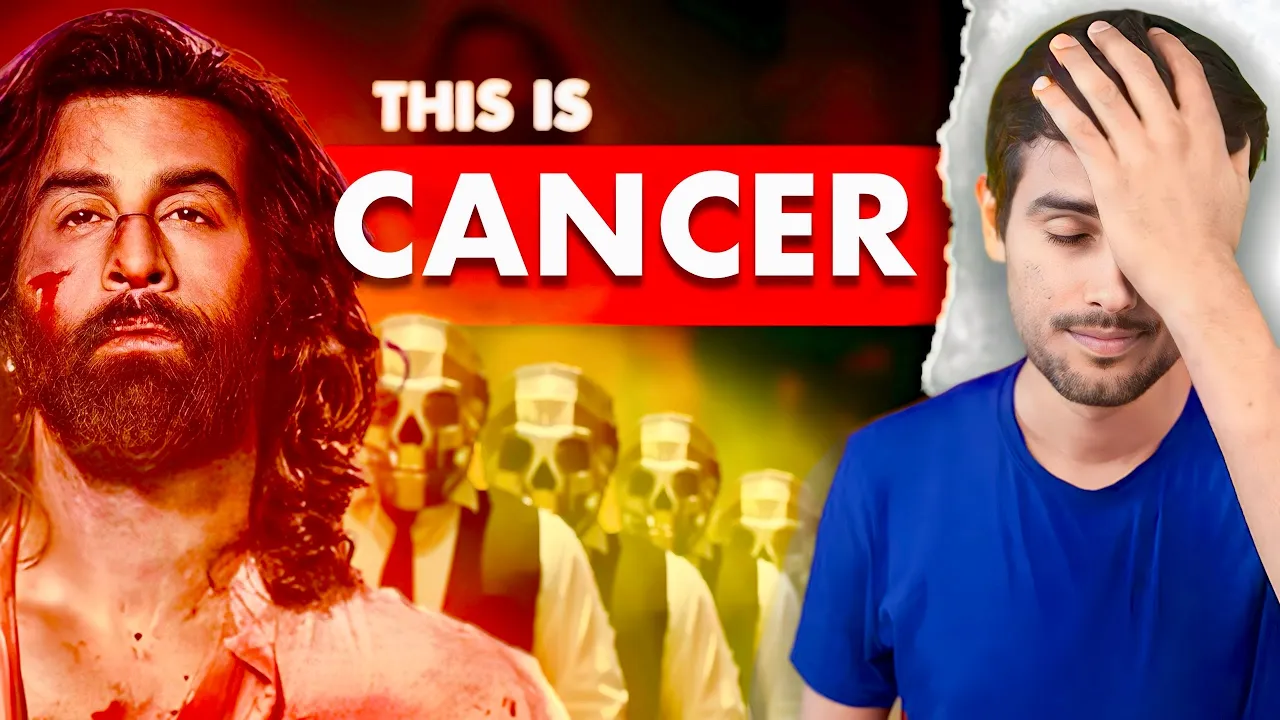
ANIMAL | The Worst Movie of 2023? | Dhruv Rathee
The Impact of Father's Absence and Harsh Parenting on Psychological Development
This section discusses the psychological impact of a father's absence and harsh parenting on a child's development, supported by research findings.
The Effects of Father's Absence and Harsh Parenting
- Studies show that a father's absence diminishes a child's self-confidence.
- Harsh parenting and excessive strictness during upbringing are linked to the development of aggressive behavior in children.
- Research papers suggest that the absence of a caring father can contribute to criminal behavior in adulthood.
Films Addressing Sensitive Topics
This section highlights films that address sensitive topics related to absent fathers and harsh parenting.
Notable Films
- "The White Ribbon" is an acclaimed film that explores the impact of absent fathers. It has received numerous awards.
- "Ardh Satya" directed by Govind Nihalani addresses similar themes.
- "Udaan" directed by Vikramaditya Motwane also touches upon the challenges faced due to strict parenting.
Concerns about Insensitive Filmmaking
This section raises concerns about insensitive filmmaking when dealing with sensitive topics like absent fathers and harsh parenting.
Example of Insensitive Filmmaking
- The film "Animal" is criticized for its regressive and misogynistic portrayal of such sensitive issues.
- Comparisons are drawn with other violent films like "Gangs of Wasseypur," "Kill Bill," and "Pulp Fiction," but the criticism towards "Animal" stems from its insensitivity rather than violence alone.
Understanding Motivations Behind Heinous Acts
This section discusses the motivations behind heinous acts, particularly focusing on the lack of remorse among rapists.
Research on Rapists' Lack of Remorse
- Madhumita Pandey conducted a study interviewing convicted rapists and murderers in Tihar jail.
- Most murderers expressed some level of regret for their actions, while many rapists exhibited a lack of remorse.
- The research indicates that rapists often hold regressive views about women, reflecting backward thinking.
Motives Behind Rape
This section explores the motives behind rape and emphasizes the perpetrators' belief in the inferiority of women.
Motives Driving Rapists
- Rapes are driven by a need to display power, outlet for anger, and sadistic cruelty rather than an unrestrained desire for sex.
- Perpetrators' belief in the inferiority of women is a common thread among these motives.
Regressive Thinking and its Origin
This section discusses how regressive thinking about gender originates from societal influences.
Influence of Environment on Regressive Thinking
- A person's behavior, personality, and identity are shaped by their environment.
- Regressive thinking about gender is prevalent everywhere due to societal factors.
The summary has been created based on the given transcript. Some parts may be omitted if they do not provide relevant information or if they involve non-verbal elements like music.
The Influence of Media on Identity and Behavior
This section discusses how various aspects of a person's life, including media consumption, can influence their identity and behavior. It addresses the argument that watching certain movies or engaging in specific behaviors does not directly lead to adopting those traits.
Media's Subconscious Effect
- Everything we read or watch has a subconscious effect on our minds.
- Watching gangster movies, for example, does not automatically turn someone into a gangster.
- Director Sandeep Vanga Reddy compares it to his own experience of watching gangster movies without becoming one himself.
Incremental Changes
- Small incremental changes in media consumption can accumulate over time and impact viewers' psyche positively or negatively.
- Just as having one unhealthy meal may not cause a heart attack, continuous exposure to deep-fried food increases the risk over time.
- Similarly, watching one film does not define a person's character, but repeated exposure to problematic content can shape their beliefs and behavior.
Multiple Factors at Play
- Positive or negative influences from films are just one aspect of a person's overall development.
- Similar to effective weight loss requiring multiple factors like diet, exercise, sleep, and stress management, a child's upbringing involves various elements such as parental care, education, friendships, and media consumption.
Negative Influences on Munnu
- The transcript introduces the scenario of Munnu growing up in an environment filled with domestic violence and regressive views towards women.
- Munnu follows YouTubers who objectify women and encounters songs with lyrics that perpetuate misogyny.
- News channels and television ads also contribute to the narrative of women's objectification.
Glorification of Violence
- The film "Animal" is highlighted as an example where violence is glorified regardless of gender involvement.
- Sandeep Vanga's statement that hitting one's partner is a sign of genuine love is mentioned.
- The film portrays the protagonist committing multiple murders, exhibiting toxic masculinity, and mistreating women without any redemption or positive transformation.
Toxic Environment
- While one film alone may not cause harm, it contributes to the overall toxic environment we live in.
- Films like "Animal" are criticized for promoting regressive views and glorifying violence.
- The poster featuring the hero smoking further emphasizes the negative impact of such films on society.
This summary covers the first part of the transcript.
New Section
This section discusses the availability of an audiobook on KUKU FM about the life of Field Marshall Sam Manekshaw and introduces KUKU FM as a platform for audio learning.
Audiobook on Field Marshall Sam Manekshaw
- An excellent audiobook with 12 episodes on KUKU FM is available for those interested in learning more about the life of Field Marshall Sam Manekshaw.
- KUKU FM is a platform that offers a wide range of audiobooks on various topics, including history, geopolitics, fiction, and mythology.
New Section
This section mentions the availability of a coupon code for 50% off on joining KUKU FM and introduces the narrative of the film "Animal" as being inspired by "The Godfather."
Coupon Code for Joining KUKU FM
- A coupon code is available to get 50% off when joining KUKU FM. Details can be found in the description below.
- The film "Animal" draws inspiration from "The Godfather," which was originally a novel by Mario Puzo adapted into a successful trilogy by director Francis Ford Coppola.
New Section
This section highlights how several Indian films have imitated or copied elements from "The Godfather," and introduces Sandeep Vanga Reddy's decision to make a film that would be commercially successful like his previous film, Kabir Singh.
Imitation of "The Godfather" in Indian Films
- Several Indian films such as Dharmatma, Nayakan, Dayawan, Aatank Hi Aatank, Sarkar, Malik, and now Animal have imitated or copied elements from "The Godfather."
- Sandeep Vanga Reddy, the director of "Animal," aimed to make a commercially successful film like his previous work, Kabir Singh. He chose to have an anti-hero protagonist similar to Kabir Singh, who is short-tempered, quick-to-anger, and projected as "cool."
New Section
This section discusses Sandeep Vanga Reddy's intention to make "Animal" more violent than Kabir Singh and the tendency for films with violence to attract toxic fans.
Intensifying Violence in "Animal"
- Sandeep Vanga Reddy expressed his intent to make "Animal" even more violent than Kabir Singh during an interview.
- Films with violence tend to attract toxic fans who often exhibit a unique characteristic.
- Criticism of films like Kabir Singh and Animal can trigger strong reactions from some people.
New Section
This section explores the reasons why some individuals find validation in toxic films and the use of violence by less talented directors.
Validation in Toxic Films
- Some individuals find validation in toxic films because they perceive criticism of these films as a personal attack on their own personality and validation.
- Less talented directors heavily rely on violence and s*xual content to compensate for their lack of creativity in storytelling, emotions, and creating situations.
New Section
This section delves into the psychological reasons why some people enjoy watching extreme violence and bloodshed on screen.
Psychological Attraction to Extreme Violence
- Some people are drawn to gory and violent films because they feel powerless or repressed in their lives.
- Watching extreme violence allows them to envision themselves as the protagonist, finding satisfaction in the directed violence towards others.
New Section
This section discusses the extreme level of violence and bloodlust depicted in "Animal" and the glamorization of such scenes by the directors.
Extreme Violence in "Animal"
- In "Animal," violence and bloodlust are taken to an extreme level, with scenes depicting strangulation and throat-slitting.
- The directors glamorize these violent scenes, presenting them in a stylish manner, resulting in a continuous sequence showcasing bloodshed.
New Section
This section highlights the dismissal of seeking help from a psychotherapist in "Animal" and the focus on continuous scenes of bloodshed for monetary gain.
Dismissal of Seeking Help and Focus on Bloodshed
- In "Animal," seeking help from a psychotherapist is dismissed, emphasizing continuous scenes depicting bloodshed instead.
- Cheap directors rely on these violent scenes to maximize their profits, as they have nothing else substantial to offer.
New Section
This section explores why realistic films that portray violence without glamorizing it often struggle at the box office due to audience preferences.
Realistic Films vs. Glamorized Violence
- Realistic films that portray violence without glamorizing it, such as Anurag Kashyap's works like Ugly, That Girl in Yellow Boots, and Almost Pyaar with DJ Mohabbat, often struggle at the box office.
- Audiences find violence inflicted by villains disturbing and repulsive, preferring not to watch more violence when there are already numerous problems in the world.
New Section
This section discusses the prevalence of violent action films in the market and the shift in audience preferences towards such movies.
The Demand for Action and Violence in Films
- Directors and producers understand the demand for action-packed films featuring characters like James Bond, Kill Bill, and others from Animal.
- The market is flooded with violent action films due to this demand.
- Recent big-budget films heavily feature action and violence.
New Section
This section highlights the shift in audience preferences from family-oriented films to more violent ones, using the example of 'Animal' and 'Hum Sath Sath Hai'.
Shift in Audience Preferences
- A critic's review of the film 'Animal' suggests that audiences have moved past family-oriented films like 'Hum Sath Sath Hai'.
- The audience now craves movies like 'Animal', which is disheartening as 'Hum Sath Sath Hai' is a heartwarming family drama inspired by the Ramayana.
- 'Hum Sath Sath Hai' is suitable for the entire family, delivering positive messages to society and fostering unity.
New Section
This section emphasizes the importance of positive role models in society, drawing inspiration from Lord Ram's virtues discussed in a previous video about the Ramayana.
Importance of Positive Role Models
- Lord Ram's virtues, such as humility and compassion despite being fit and strong, should serve as an ideal model of masculinity for society.
- Some individuals reject such models because they lack compassion and empathy themselves.
- Lack of compassion makes one more animal-like than human.
New Section
This section discusses regressive characters portrayed in Sandeep Vanga's film, Kabir Singh and Rannvijay, and questions their suitability as role models.
Regressive Characters as Role Models
- Characters like Kabir Singh and Rannvijay in Sandeep Vanga's film lack self-control and exhibit destructive behavior.
- Kabir Singh indulges in drinking and consuming drugs, while Rannvijay resorts to shouting, beating, and even threatening his wife with a gun.
- Such characters cannot serve as positive role models.
New Section
This section addresses the term "Alpha Male" used by individuals who appreciate regressive characters and emphasizes the need to reject such destructive thinking.
Rejecting Destructive Thinking
- Individuals who appreciate regressive characters used to call themselves "Macho Man," but now they identify as "Alpha Male."
- It is sensible to stay away from such a destructive way of thinking.
- Stop watching films that promote such behavior and respect our minds by not filling them with negative influences.
New Section
This section encourages viewers to share the video with friends who enjoy violent films to illustrate the importance of rejecting regressive characters as role models.
Spreading Awareness
- If you have friends who enjoy violent films or appreciate regressive characters, consider sharing this video with them.
- The video aims to highlight the importance of rejecting destructive thinking and promoting positive role models in society.