Chapitre 1a : Un système de pensée à deux vitesses
Understanding Decision-Making: The Role of Cognitive Systems
Introduction to Manon and Decision-Making
- Manon, a future healthcare professional, is introduced as someone whose studies require precise decision-making with minimal errors.
- It is explained that our perception of the world relies on five senses, but these senses merely relay signals that the brain processes and interprets.
Cognitive Processes in Decision-Making
- The video aims to describe how two cognitive systems function during decision-making.
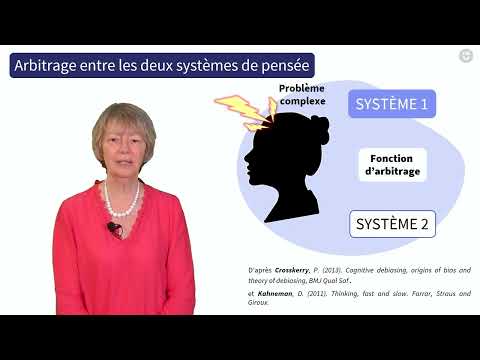
- Kahneman and Tversky's concepts are referenced, highlighting two opposing systems of thought: System 1 (heuristic) and System 2 (analytical).
System 1: Heuristic Thinking
- System 1 uses heuristics—unconscious rules that simplify problems for quick resolution.
- This system operates quickly, unconsciously, and is influenced by emotions; however, it can lead to errors due to its reliance on stereotypes.
System 2: Analytical Thinking
- When faced with complex problems or failures from System 1, individuals switch to System 2 for logical reasoning.
- System 2 is slower, conscious, logical, requiring more effort; it’s associated with scientific rigor.
Illustrating the Two Systems
- A test illustrates the difference between the two systems: most people visualize a stethoscope when asked about medical instruments (System 1).
- Given more time (System 2), responses would be more comprehensive and complex.
Implications of Heuristics in Decision-Making
- Quick decisions often rely on intuitive thinking (System 1), while reflective thinking (System 2) leads to more accurate representations of reality.
- Both systems are essential; System 1 aids rapid responses in urgent situations but can also introduce cognitive biases.
Cognitive Biases and Group Behavior
- Heuristics can lead to cognitive biases especially in ambiguous situations; this will be explored further in subsequent videos.
- The "bandwagon effect" exemplifies group bias where individuals follow others without critical analysis—illustrated by sheep following each other off a cliff.
Conclusion on Rational vs. Intuitive Reasoning
- The necessity of both intuitive (System 1) and rational (System 2) thinking is emphasized for optimal decision-making.
- Effective medical reasoning requires logical deduction rather than mere intuition.
Understanding Cognitive Bias
The Impact of Reflexive Systems on Cognitive Bias
- The discussion highlights that while reflexive systems can enhance efficiency, they may also lead to increased cognitive biases.
- It is emphasized that these reflexive systems do not provide complete protection against biases, suggesting a nuanced understanding of their effectiveness.
- The speaker notes that although reflexive systems can mitigate some biases, they can still introduce them in lesser degrees.
- A preview is given for the next video, which will delve deeper into the concept of cognitive bias and provide examples to illustrate these biases.