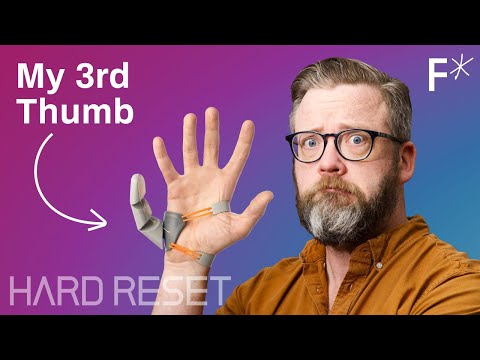
Bionic 3rd thumb: The future of human augmentation | Hard Reset
Introduction
The video introduces the concept of an extra thumb and how it is changing our understanding of what's happening inside our brains.
An Extra Thumb
- Dani, a designer from New Zealand, designed an extra thumb that fits onto a typical hand to get a better sense of what prosthetic users experienced.
- Falling prices for custom electronics components and huge advancements in affordable 3D printing have made it possible for designers like Dani to explore totally new territory in the world of prosthetics.
Trying on the Third Thumb
This section shows how to put on a third thumb and how it works.
Putting on the Third Thumb
- The third thumb goes on your right hand.
- There are two controls: one for your right foot and one for your left foot.
- You can use them together to get an in-between movement.
Neuroscience Research
This section explains how the project has blossomed into amazing neuroscience research.
Blossoming Neuroscience Research
- The project has created a model to very quickly test augmentation in the brain.
- This research is changing our understanding of what's happening inside our brains, and how our brains map to our bodies.
Extending Ourselves
This section explores why humans are fascinated with extending ourselves.
Fascination with Extension
- We as humans are really fascinated in extending ourselves, and we're gonna see more and more of this kind of technology.
- The end result could be a world where our bodies can change and our brain can adapt.
Designing Prosthetics
This section explains how Dani became fascinated with designing prosthetics.
Fascination with Prosthetics
- Dani became super fascinated with designing objects and products for people, and in particular, hands.
- She designed the extra thumb to breach that interface layer with the body.
Hard Reset
This section introduces "Hard Reset," a series about rebuilding our world, and maybe even our bodies, from scratch.
Introducing "Hard Reset"
- "Hard Reset" is a show about rethinking things from the ground up.
Doing Things Differently
This section explains why the host came to the U.K.
Doing Things Differently
- The host came to the U.K because it's good to go somewhere where they do things differently.
- Some people in the U.K have three thumbs due to Dani's extra thumb project.
The Third Thumb
In this section, Dani Clode introduces her invention, the third thumb. She explains how it works and how it differs from traditional prosthetics.
Introduction to the Third Thumb
- Dani Clode introduces her invention, the third thumb.
- It is not a prosthetic but an extension of our typical body plan.
- Unlike most prosthetics that trigger fingers to open or close, the third thumb is controlled by big toes.
- The controls are designed to be proportional so that how much the thumb opens or closes depends on how hard you press with your toes.
Brain Adaptation
- The third thumb asks some big questions about how our brain will adapt to suddenly having a new digit.
- Researchers at Cambridge University are studying how our brains map to our limbs and how that mapping might change when we introduce something like a prosthetic or a third thumb.
- They use FMRI technology to see exactly which parts of the brain light up as the thumb or other parts of the hand are used.
- After using the third thumb for about five days, FMRI studies found that the brain's representation of the hand began to change.
Augmentation Technologies
In this section, Dani Clode discusses augmentation technologies and their potential impact on society.
Impact on Society
- Augmentation technologies can potentially change the world.
- If we are irresponsible or unsafe in developing these technologies, we may miss this opportunity.
- Tamar Makin's lab provides proof-of-concepts of opportunities and limitations of these technologies so that they can safely deliver this new field.
FMRI Technology
- FMRI technology now allows us to see what's happening in the brain.
- Researchers use FMRI technology to see how the brain is changing as they use the third thumb.
- They can explicitly ask the question: "How does the brain form a representation of a body part that it never had before?"
Conclusion
In this section, Dani Clode concludes her talk by discussing how quickly our brains can adapt and change.
Brain Adaptation
- After using the third thumb for about five days, all those thousands of years of evolved neural pathways changed in five days.
- This shows how quickly our brains can adapt and change.
Augmenting the Human Body
In this section, the speaker discusses the possibility of augmenting the human body and how it could change our interaction with the world. They also touch on how technology has already allowed us to augment ourselves in different ways.
Augmentation Devices
- The speaker poses a question about whether we can use our arms to control wings or our feet to control tentacles if we can use our toes to control our thumbs.
- The speaker mentions that augmentation devices like exoskeletons, extra arms, or even tails are starting to pop up.
- The speaker talks about how physical extension of ourselves raises interesting questions about how our brain adapts to these technologies that feel like an extension of ourselves.
Changing Our World
- The speaker notes that we have designed a world around our hands and wonders how augmenting ourselves will change the world around us.
- The speaker asks what if the shape and function of your body could be as much of an expression of your personality as your clothing is?
- The speaker sees this as just a baby step forward and wants to keep pushing forward.
Miscellaneous
- The video ends with a humorous note about a cow trying to eat the microphone.
Turn any video into a summary like this
YouTube links, meetings, lectures — with transcripts, search, and chat.