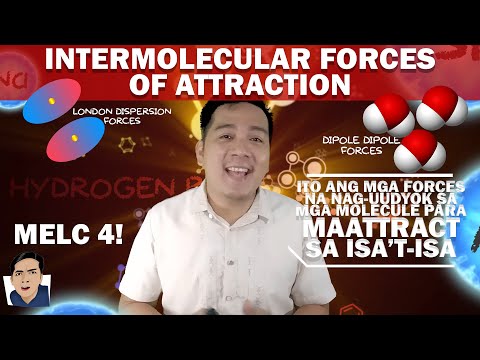
Intermolecular Forces of Attraction | another ScienceKwela Busy edition
Science Quella Introduction
The introduction sets the stage for exploring whether a substance is a molecule or polar, focusing on intermolecular forces of attraction.
Understanding Intermolecular Forces
- Intermolecular forces are attractions between molecules, likened to "good jokes" that attract molecules to each other.
- Various types of intermolecular forces include London Dispersion Force, Dipole-Dipole Forces, and Hydrogen Bonding.
- London Dispersion Force is the weakest type due to its dependence on electron quantity and the temporary nature of instantaneous dipoles.
Dipole-Dipole Forces and Polarity
Discusses dipole-dipole forces and how polarity affects molecular interactions.
Exploring Polarity
- Polar molecules experience dipole-dipole forces, unlike nonpolar molecules lacking dipoles.
- Water molecules exhibit polarity due to uneven electron distribution, leading to phenomena like surface tension.
Hydrogen Bonding and Molecular Interactions
Explores hydrogen bonding as a strong form of dipole-dipole force crucial for various molecular interactions.
Significance of Hydrogen Bonding
- Hydrogen bonding involves highly electronegative atoms like nitrogen, oxygen, and fluorine attracting hydrogen atoms.
- Hydrogen bonds are crucial for molecular attractions such as those seen in ammonia (NH3).
Forces Between Molecules
Examines the force of attraction among molecules and distinguishes it from fundamental universal forces.
Understanding Molecular Forces
- Inter-molecular force of attraction differentiates from fundamental universal forces like electromagnetic force or gravitational force.
Introduction to Intermolecular Forces
In this section, the speaker introduces the concept of intermolecular forces and their significance in determining properties like boiling points.
The Role of Intermolecular Forces
- The attraction between charged particles is equivalent to the electromagnetic force, leading to various intermolecular forces among molecules.
Boiling Point and Interactions
- Increasing the strength of intermolecular forces results in changes to the boiling point.
- Boiling point increases as intermolecular forces strengthen.
- The primary intermolecular force affecting boiling point is highlighted.
- Example with water molecule at 100 degrees Celsius illustrates this concept.
Molecular Behavior at Different Temperatures
- Explanation on how temperature affects molecular behavior and boiling points.
- Hydrogen bonds in water molecules impact boiling point.
- Comparison of states (gas, liquid, solid) for fluorine, chlorine, bromine, and iodine based on molecular size and interactions.