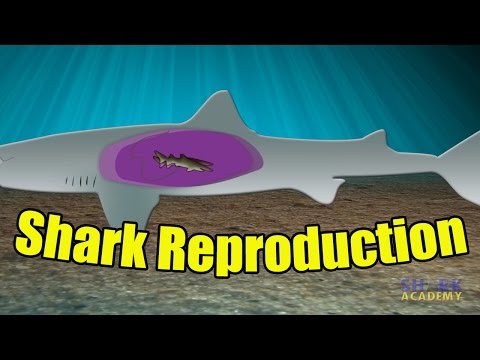
Sharks reproduce differently than fish, producing fewer but larger offspring that have a better chance of survival.
There are three main reproductive strategies in sharks: oviparous (egg-laying), viviparous (live-bearing), and ovoviviparous (eggs hatch inside the mother).
Oviparous Sharks
Small sharks like horn sharks, swell sharks, and cat sharks lay eggs on the ocean floor; the baby develops from a yolk sac.
The term "oviparous" refers to species that lay eggs, with gestation varying by species and water temperature.
Viviparous Sharks
Larger shark species such as Blue sharks, Bull sharks, and Hammerheads give birth to live young that develop inside the mother.
These young receive nutrients and oxygen through an umbilical cord similar to human development.
Ovoviviparous Sharks
In this method, mothers carry fertilized eggs inside their bodies until they hatch; babies emerge without an umbilical cord after living off a yolk sac.
Unique Reproductive Strategies
The Sand Tiger shark exhibits intrauterine cannibalism where the first pup to reach 4 inches consumes its siblings before birth.
Despite some species producing many pups at once (e.g., whale sharks with around 300), others like Thresher and Sand Tiger only produce two.
Gestation Period and Maturity
Gestation periods for sharks can be lengthy; for example, Baby Spiny Dogfish take nearly two years to develop.
Video description
In this great educational segment, Jonathan explores the reproductive strategies of sharks, explaining how some sharks lay eggs (oviparity), produce live young (viviparity) or produce eggs that develop internally (ovoviviparity).
**********************************************************************
If you like Jonathan Bird's Blue World, don't forget to subscribe!
You can buy some Blue World T-shirts & Swag!
http://www.blueworldtv.com/shop
You can join us on Facebook!
https://www.facebook.com/BlueWorldTV
Twitter
https://twitter.com/BlueWorld_TV
Instagram
@blueworldtv
Web:
http://www.blueworldTV.com
**********************************************************************
Are they born from eggs or live born? Or both? How do sharks reproduce? I’m Jonathan Bird and this is shark academy!
Unlike fish, which produce large amounts of eggs, most of which never reach maturity, sharks produce far fewer, but larger, offspring, and they have a much better chance of reaching adulthood.
Sharks can reproduce in several ways. Many small sharks, like the horn shark, the swell shark and cat sharks actually lay eggs on the bottom. The baby shark develops in there, living off a yolk sac filled with nutrients. The baby, a miniature version of its parents, is born after a few months to a year of gestation, depending on water temperature and the species. Sharks using this reproductive strategy are called oviparous. Meaning egg-laying.
Other sharks are viviparous. They give birth to live young which develop inside the mother shark, receiving nutrients and oxygen from mom through an umbilical cord, just like humans. Larger sharks like Blue sharks, Bull sharks and Hammerheads use this technique.
The last group of sharks are ovoviparous, (also known as Aplacental Yolk Sac Viviparous). In this system, the mother produces eggs like the oviparous system, but instead of laying her eggs on the bottom, she carries them inside her body until they hatch. When the babies pop out, you might think the shark was viviparous, but the babies had no umbilical cord inside, they lived off a yolk sac.
In the weird category, the Sand Tiger shark has a strange variation on its ovoviviparous reproduction known as intrauterine cannibalism. The mother produces up to 50 pups in each of two uteruses, but the first baby in each uterus that reaches about 4" long eats all its siblings! After 12 months of gestation, the mother then gives birth to a pair of 3 foot long pups! Pups that are well fed!
Because sharks put so much more time, effort and energy into producing a viable offspring than bony fish do, they give birth to far fewer pups. A whale shark produces the most pups of any shark—around 300 at a time—but then again, mom is the size of a bus. The Thresher and Sand Tiger only produce two pups at a time. The Blue shark can produce 135 at a time, which is a lot for a shark not the size of a bus.
Gestation is long too, averaging 9-12 months. Baby Spiny Dogfish take 22 months—almost two years—for their young to develop.
Most sharks take quite a while to become mature enough to reproduce as well. Great Hammerheads take 9 years. Lemon and Bull sharks take 15 years. Spiny Dogfish? 20 years.
So, between the small litters, a long gestation period and long time to reach maturity, sharks just don’t reproduce very quickly. This is the reason they are so vulnerable to overfishing.
If you’re interested in sharks, there are more than 30 Shark Academy episodes to watch! You can also join my underwater adventures on Jonathan Bird’s Blue World!
And don’t ever miss a new episode--subscribe now!