Signal Transduction part 4
Signal Transduction: Understanding Cyclic AMP and Protein Kinase A
Introduction to Second Messengers
- The discussion begins with cyclic AMP (cAMP) as a primary second messenger in signal transduction.
- cAMP binds to protein kinase A (PKA), which is crucial for its activation, leading to various cellular responses.
Role of Protein Kinase A
- PKA's targets vary between different cell types due to the presence of distinct proteins.
- Kinases are enzymes that phosphorylate other molecules, typically proteins, initiating phosphorylation cascades.
Phosphorylation Cascades
- These cascades involve sequential activation where one kinase activates another through phosphorylation.
- Phosphorylation is a reversible modification; however, in cascades, each step must lead to activation for effective signaling.
Importance of Kinases
- Humans possess over 500 protein kinases, highlighting their significance in survival and cellular functions.
Activation Process of Kinases
- The cascade starts with a signaling molecule binding to a receptor, causing conformational changes that activate relay molecules.
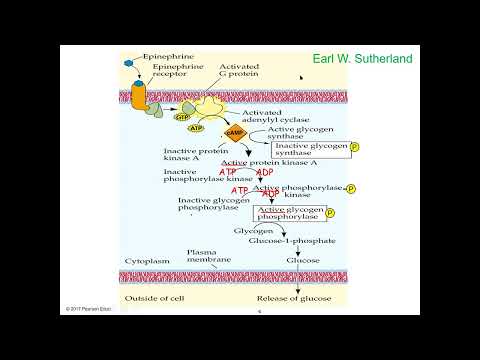
- Active PKA phosphorylates inactive kinases (e.g., kinase number two), changing their conformation and activating them.
Signal Amplification Through Cascades
- Each activated kinase can further activate additional substrates, creating an amplification effect within the signaling pathway.
Cellular Response Mechanism
- The final active protein from the cascade leads to specific cellular responses based on the initial signal received.
Reversibility of Phosphorylation Cascades
- It’s essential for these cascades to be turned off after activation; continuous activity would be detrimental.
Case Study: Epinephrine Signaling Pathway
- Epinephrine binds to its G-protein-coupled receptor on liver cells, activating a G-protein that facilitates ATP conversion into cAMP.
- This process ultimately leads to the activation of PKA through cAMP binding.
Summary of Key Enzymes Involved
Understanding the Role of Phosphorylation in Cellular Responses
Activation of Phosphorylase Kinase
- Inactive phosphorylase kinase becomes active upon phosphorylation by a protein, altering its conformation and function.
- Active phosphorylase kinase targets glycogen phosphorylase, an enzyme responsible for breaking down glycogen, a glucose storage polymer.
Glycogen Breakdown Process
- The phosphorylation of inactive glycogen phosphorylase activates it, allowing it to convert glycogen into glucose-1-phosphate.
- This process releases glucose into the bloodstream, providing energy for muscle activity during stress responses like fight or flight.
Dual Response to Epinephrine
- Epinephrine not only stimulates glucose release but also inhibits glycogen synthase, which is responsible for synthesizing glycogen.
- The inactivation of glycogen synthase through phosphorylation ensures that glucose breakdown and synthesis do not occur simultaneously.
Importance of Phosphorylation Cascades
- Phosphorylation can lead to either activation or inactivation of enzymes; this reversible modification plays a crucial role in cellular signaling.
- Understanding these pathways highlights how cells manage energy resources effectively during stress situations.
Gene Transcription and Signaling Pathways
- While the discussed phosphorylation cascade does not directly alter gene transcription, such cascades can influence gene expression under different circumstances.
- It’s essential to recognize that signaling pathways may involve both immediate enzymatic reactions and longer-term changes like gene transcription.
Amplification in Signal Transduction
Mechanism of Amplification
- A single binding event with epinephrine can activate multiple G-protein molecules (up to 100), leading to significant amplification within the signaling pathway.
Enzyme Activation Dynamics
Understanding Enzyme Activation and Signal Amplification
Mechanism of Enzyme Activation
- The activation of enzymes can lead to the production of multiple second messenger molecules, such as cyclic AMP (cAMP). Each enzyme can generate a series of cAMP molecules, although it takes four cAMP to activate one protein kinase.
- Once an active protein kinase A is formed, it can act on numerous substrates, demonstrating a significant amplification effect from activated enzymes to activated substrates.
- The process continues with these substrates being kinases themselves, leading to further amplification. For instance, active glycogen phosphorylases can break down glycogen into many glucose molecules in response to just one signaling molecule like epinephrine.
Importance of Signal Amplification
- The concept of amplification is crucial in multi-step pathways where signals are greatly amplified by acting on multiple targets. However, the extent of this amplification is limited due to the reversible nature of modifications.
- Active protein kinases do not remain active indefinitely; they have a limited period during which they can interact with their substrates.
Role of Protein Phosphatases
- Reversible modifications are facilitated by proteins known as phosphatases that remove phosphate groups added by kinases. This process allows for the return to inactive states.
- The balance between active kinases and phosphatases determines whether a kinase remains activated at any given time. Phosphatases generally maintain background activity within cells.
Cellular Response Dynamics
- Reversible modifications allow cells to respond dynamically to signaling molecules. Cells must reset after responding so they are prepared for subsequent signals.
- This cyclical process ensures that cellular responses are timely and efficient without overwhelming the system with permanent changes.
Calcium as a Second Messenger
Characteristics and Functionality
- Calcium ions serve as effective second messengers due to their small size and water solubility, allowing them to diffuse freely within cells. Their low concentration in the cytosol is maintained through pumping mechanisms.
- Calcium is stored outside the cell or in organelles like the endoplasmic reticulum and mitochondria. When calcium levels rise in the cytosol, it activates various proteins dependent on calcium concentration.
Interaction with Other Signaling Molecules
- One key player responsive to calcium levels is protein kinase C (PKC), which becomes activated when calcium concentrations increase alongside other signaling pathways involving cyclic AMP (cAMP).
Complexity of Signaling Pathways
- Many signaling pathways utilize calcium as a second messenger either independently or alongside cAMP. The complexity arises from interactions among various molecules involved in these pathways.
Understanding Phospholipid Signaling
Mechanism of Phospholipid Cutting
- A phospholipid embedded in the lipid membrane can be cleaved, resulting in the formation of two signaling molecules from one phospholipid: diacylglycerol and inositol trisphosphate (IP3).
- The generated IP3 acts as a second messenger, which plays a crucial role in cellular signaling by stimulating the release of calcium ions from the endoplasmic reticulum.
Role of Calcium as a Second Messenger
Turn any video into a summary like this
YouTube links, meetings, lectures — with transcripts, search, and chat.