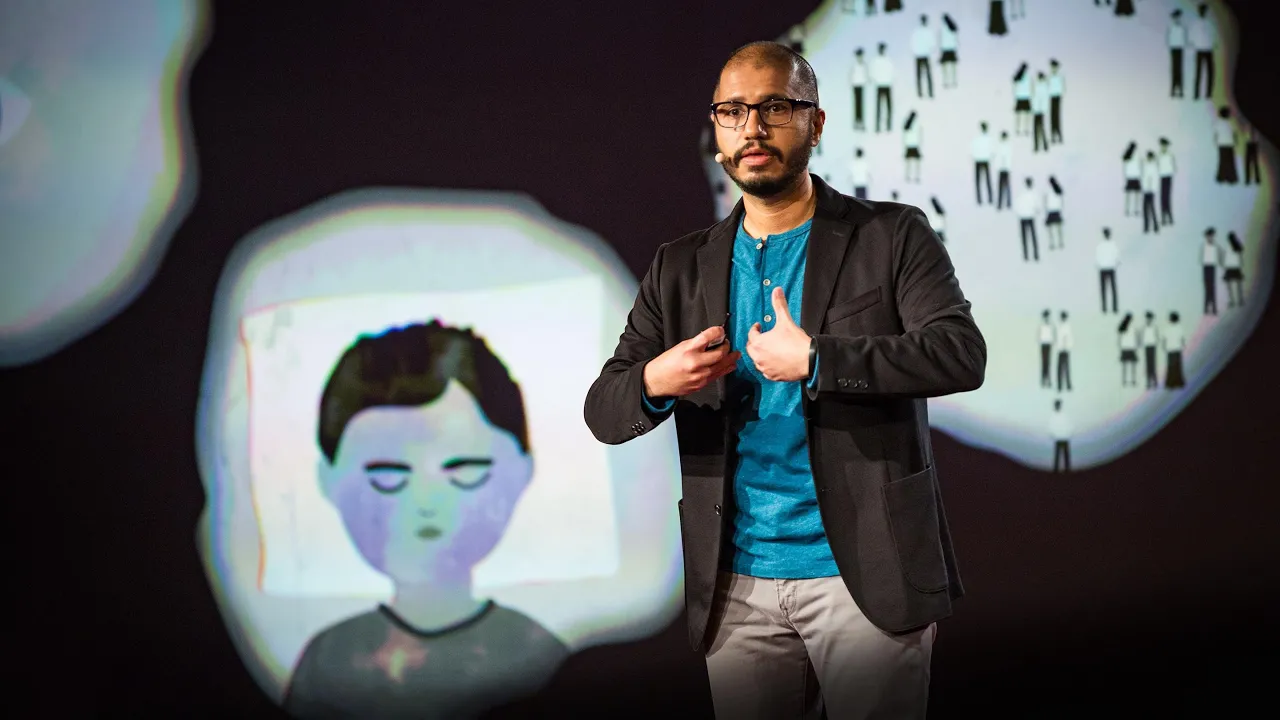
Why I keep speaking up, even when people mock my accent | Safwat Saleem
Introduction and Recurring Dream
The speaker shares a recurring dream where they enter a room full of people but struggle to respond when asked their name.
Recurring Dream
- The speaker describes a recurring dream where they avoid eye contact in a room full of people.
- When someone notices them, they panic and are unable to respond when asked for their name.
- Other people in the room join in asking if they have forgotten their name.
Voice-over Work and Stuttering
The speaker discusses their work as a visual artist and voice-over actor, as well as their experience with stuttering.
Voice-over Work
- The speaker enjoys doing voice-overs for various characters in animations.
- They share examples of characters they have voiced, including a bear, whale, greeting card, and Frankenstein's monster.
Stuttering Experience
- The speaker reveals that they have stuttered since childhood.
- They recall struggling to speak up in class or answer the phone due to their stutter.
- Introducing themselves was particularly challenging, often leading to jokes about forgetting their name.
Feedback on Video and Self-consciousness
The speaker reflects on receiving feedback on an educational video they made and how it affected their self-confidence.
Feedback on Video
- After posting an educational video online, the speaker eagerly awaited feedback.
- Initially receiving positive comments, the speaker felt excited and validated.
- However, negative comments about their voice started affecting them emotionally.
Self-consciousness
- The negative comments reminded the speaker of their self-consciousness about their voice and stuttering.
- Editing audio for future projects became difficult due to childhood memories of struggling with speech.
Perception of Normality
The speaker explores the concept of normality and how expectations shape our perception.
Perception of Normality
- The speaker ponders the meaning of "normal" and how it is influenced by societal expectations.
- They provide examples of biases and discrimination based on race, gender, and names.
- Our perception of what is normal often leads to unfair judgments and favoritism.
Colors and Perception
The speaker discusses the relationship between colors, language, and perception.
Colors and Language
- Ancient literature from various cultures mentions few colors or describes them inaccurately.
- The ability to perceive and recognize colors is linked to the cultural ability to create those colors.
- Some colors were recognized earlier due to their ease of creation, while others took longer to be perceived.
Personal Experience in Context
The speaker relates their personal experience with negative comments to the concept of normality discussed earlier.
Personal Experience
- Initially taking negative comments personally, the speaker realizes that commenters did not know about their self-consciousness regarding their voice.
- Biases in society's perception of normality contribute to unfair judgments based on accents or speech patterns.
Discrimination as Favoritism
The speaker highlights that discrimination often stems from biased expectations rather than objective assessments.
Discrimination as Favoritism
- Studies show that discrimination against certain groups is often a result of biased expectations rather than objective evaluations.
- Biases lead us to believe that certain characteristics are "normal" for specific groups, perpetuating inequality.
Desire to Help and Relating to Others
In this section, the speaker discusses how the desire to help people we can relate to is more prevalent than the desire to harm those we cannot relate to. The lack of representation and relatability starts at an early age, as seen in children's books.
Lack of Representation in Children's Books
- In 2014, only about 11 percent of children's books had a character of color.
- Majority groups often do not realize the extent to which they are similar to minorities.
- Normalcy is a construct based on what we have been exposed to and what is visible around us.
Challenging the Notion of Normal
- The speaker can either accept the preexisting notion of normal or challenge it through their work and voice.
- Challenging normalcy allows society to see beyond narrow definitions and embrace diversity.
Using Voice for Change
In this section, the speaker emphasizes the importance of using their voice for change despite facing criticism. They highlight that giving up is not an option when there is so much at stake.
- The speaker acknowledges using their voice in their work again, despite potential criticism.
- Understanding what is at stake motivates them not to give up.
- Continuous challenges to our notion of normal will allow society to see things from a different perspective.
Embracing Diversity
In this section, the speaker concludes by emphasizing the need for society to continuously challenge its notion of normal in order to embrace diversity fully.
- Embracing diversity will enable society to see the world in a new light.
- The speaker uses the analogy of the Ancient Greeks discovering that the sky is blue after centuries of ignorance.
- Challenging our notion of normal is essential for societal growth and understanding.
Turn any video into a summary like this
YouTube links, meetings, lectures. With transcripts, search, and chat.