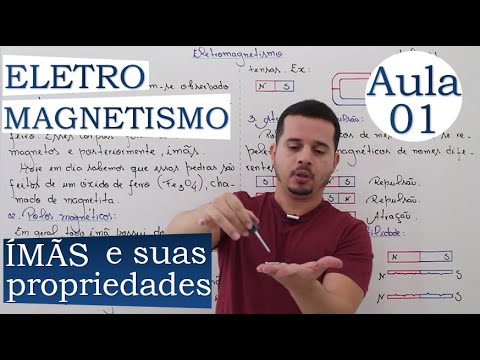
ELETROMAGNETISMO - AULA 01 (ÍMÃS E SUAS PROPRIEDADES)
Introduction to Electromagnetism
Overview of the Course
- Professor Davi Oliveira introduces himself and welcomes viewers to the first lesson in a series on electromagnetism.
- The course will cover various properties of magnetism, noting that some textbooks may separate topics into "magnetism" and "electromagnetism."
- The professor reassures students at different educational levels (8th or 9th grade) that the material is consistent regardless of how it is presented in their resources.
Historical Context
- Discussion on ancient observations of magnetic stones attracting iron, leading to the term "magnetic" derived from the region called Magnesia.
- Explanation of natural magnets, known as magnetite, which are composed primarily of iron oxides.
Types and Uses of Magnets
Natural vs. Artificial Magnets
- Modern magnets can be both naturally occurring and artificially produced by humans based on specific needs.
- The professor shares personal anecdotes about childhood experiences with magnets and their applications in various fields.
Properties of Magnets
- Introduction to basic properties of magnets, including attraction and repulsion, likened to a force field.
- Emphasis on hands-on experience with magnets to understand their properties better.
Magnetization Process
Understanding Magnetization
- Importance of understanding how magnets are used in everyday life, such as in headphones or computers.
- Recommendation for viewers to check out a YouTube channel called "Manual do Mundo," which provides insights into scientific processes related to magnet production.
Types of Magnets: Permanent vs. Temporary
- Explanation that there are two types of magnets: permanent (long-lasting effects) and temporary (short-lived effects).
- Clarification on how materials can become temporary magnets when influenced by stronger magnetic fields or contact with permanent magnets.
Understanding Magnetic Properties and Ferromagnetism
The Nature of Temporary and Permanent Magnets
- A screw can act as a temporary magnet when in contact with another magnetic object, creating a temporary attraction.
- It's essential to differentiate between permanent and temporary magnets; only certain metals like iron, nickel, and cobalt are attracted to magnets.
- Gold is not attracted to magnets, highlighting that not all metals exhibit magnetic properties.
- Objects that can be attracted by magnets are termed ferromagnetic materials; this includes various metal alloys.
- Emphasis on the importance of taking personal notes while studying to reinforce learning.
Magnetization Process
- Demonstration of magnetization through friction using a screwdriver rubbed against a magnet creates a permanent magnet effect.
- Personal anecdote about early experiments with making compasses using needles instead of screwdrivers for educational purposes.
- Instructions for safely conducting the needle magnetization experiment at home with adult supervision recommended for safety.
- After rubbing the needle, it becomes capable of attracting other metallic objects due to its new magnetic properties.
- The process involves floating the needle on water using styrofoam, allowing it to align with Earth's magnetic poles.
Understanding Magnetic Poles
- All magnets have two poles: north and south, named after Earth's geographic poles.
- It’s possible to create magnets with multiple poles (e.g., four or six), depending on their intended use or design requirements.
- The regions where magnetic forces are strongest are known as poles; these areas dictate how magnets attract or repel each other.
- Various shapes of magnets exist (e.g., bar-shaped), which influence their application in different contexts.
Magnetic Poles and Their Properties
Understanding Magnetic Poles
- The intensity of magnetic poles is discussed, emphasizing that they are located near the extremes of a magnet.
- A representation of a magnetic needle is introduced, highlighting its use in compasses, which are now also available on smartphones.
- The compass remains a crucial tool for navigation in aviation and maritime contexts, demonstrating its ongoing relevance.
Principles of Attraction and Repulsion
- It is explained that magnets cannot have only one pole; every magnet must possess both a north and south pole regardless of its shape.
- The principle of attraction and repulsion between magnetic poles is outlined: like poles repel each other while opposite poles attract.
Demonstrating Magnetic Interactions
- An experiment illustrates how two identical poles (north-north or south-south) repel each other when brought close together.
- Inverting polarity can lead to interesting interactions; the demonstration shows how strong repulsion can cause movement in magnets.
Principle of Inseparability
- The concept that every piece of a magnet retains both a north and south pole even when divided is introduced as the principle of inseparability.
- Cutting a magnet results in each new piece having its own distinct north and south pole, regardless of size.
Practical Applications and Examples
- Even at an atomic level, every fragment maintains both polarities. This principle holds true no matter how many times the magnet is divided.
- When breaking magnets, the original orientation (north/south designation) persists in each resulting piece, leading to predictable attraction or repulsion behaviors.
Interactivity with Magnetic Materials
Exploring Ferromagnetic Materials
- Discussion shifts to materials that interact magnetically with magnets. Ferromagnetic substances such as iron and nickel are highlighted as responsive to magnetic fields.
Understanding Magnetic Poles and Their Interactions
The Nature of Magnetic Poles
- Discussion begins with the assertion that magnetic poles can be created, emphasizing that they are not false. It is clarified that different names for magnetic poles attract each other.
- A true/false question regarding magnetic properties is posed, indicating that only one statement (option two) is correct.
Cutting a Magnet
- An illustration of a bar magnet being cut into two parts is introduced, highlighting how the resulting pieces repel each other depending on the cutting method.
- Clarification on how attraction or repulsion occurs based on whether the cut is made along specific lines (A or B), reinforcing the idea that cuts affect magnetic interactions.
Fragmentation and Magnetic Properties
- The discussion transitions to dividing a bar magnet into four parts, questioning whether fragments will attract or repel when brought close together.
- Explanation of how cutting affects pole orientation: if a magnet is split, one side retains its north pole while the other becomes south.
Further Division of Magnets
- Continuing from previous points, further division of magnets leads to smaller pieces still retaining their respective polarities (north/south).
- Emphasis on understanding how each piece maintains its polarity after multiple cuts; this reinforces concepts about magnetic field continuity.
Final Observations and Conclusions
- The final segments illustrate how even small fragments maintain their polar characteristics through repeated divisions.
Understanding Magnetic Interactions in Bars
Analyzing Magnetic Attraction and Repulsion
- The discussion begins with the examination of magnetic interactions between three bars, focusing on the extremes of each bar to determine attraction or repulsion.
- It is noted that when the extreme of bar one is brought close to bar two, attraction occurs; however, bringing the extreme of bar one near bar three results in repulsion.
- The speaker emphasizes that for cases where attraction occurs, the bars will align perfectly if each end has a unique magnetic pole.
- A conclusion is drawn regarding the magnetization status: bars one and three are magnetized while bar two is demagnetized.
- The speaker clarifies that repulsion can only occur between two like poles (e.g., north-north or south-south), reinforcing that a single ferromagnetic bar cannot exhibit repulsion.
Practical Applications and Experiments
- The importance of understanding these principles is highlighted as they apply to various exercises involving magnetic interactions.
- It’s reiterated that bars one and three are confirmed to be magnetized while bar two remains demagnetized, emphasizing practical implications for experiments.
- The speaker introduces an experiment involving breaking a magnet into pieces to observe how each piece retains its own magnetic properties (north/south).
- Participants are encouraged to engage with questions related to these concepts as they progress through their learning journey.
Experimentation with Magnet Poles
- A new scenario is presented where a fixed magnet's orientation affects its interaction with another object based on its poles (north/south).
- The explanation includes how similar poles repel while opposite poles attract, demonstrating fundamental magnetic principles through hands-on experimentation.
- As parts of magnets are broken down, it’s shown how each segment maintains distinct polarities which can lead to varied interactions when tested against other magnets.
- Four different experimental setups are proposed using broken pieces of magnets to explore their behavior under different conditions.
Conclusion on Magnetic Behavior
- Final thoughts emphasize understanding how broken magnets behave differently compared to whole ones, particularly in terms of polarity and interaction outcomes.
- Observations from multiple experiments illustrate consistent patterns in attraction and repulsion based on pole alignment.
Experiments in Magnetism and Electromagnetism
Overview of Experiments
- The discussion begins with the concept that experiences can lead to either attraction or repulsion, indicating a fundamental principle in magnetism.
- The first two experiments illustrate these principles: one involving repulsion and another demonstrating attraction between magnetic poles (north and south).
- The speaker emphasizes the importance of understanding these initial concepts in magnetism, especially for students beginning their studies in fundamental education.
- A call to action is made for viewers to engage with the content by liking and sharing the video, highlighting community involvement in learning.
Key Concepts Discussed
- Attraction vs. Repulsion: The core idea revolves around how different magnetic poles interact—like poles repel while opposite poles attract.
- Experiments as Learning Tools: Practical demonstrations are used to solidify understanding of theoretical concepts, making them more relatable for students.
- Engagement with Content: Encouraging students to actively participate in their learning process through discussions and shared experiences enhances comprehension.
Turn any video into a summary like this
YouTube links, meetings, lectures — with transcripts, search, and chat.