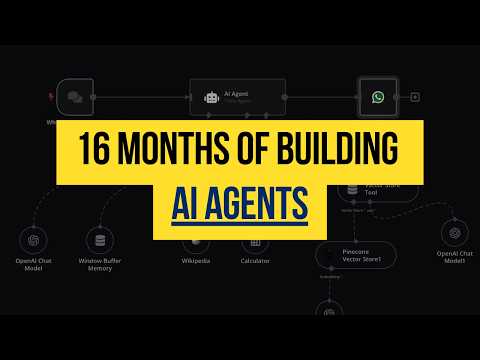
16 Months of Building AI Agents in 60 Minutes
Introduction to Building AI Systems
Overview of the Video
- The speaker introduces a special video focused on 16 months of experience building AI systems for personal, agency, and software company use.
- The discussion will cover tips, tricks, and fundamental concepts necessary for creating valuable AI systems for oneself and clients.
Examples of Built Systems
- The speaker showcases various conversational agents built using platforms like Bpress and Voiceflow.
- A complex workflow example is presented, specifically an appointment setter developed for a real estate agency.
Understanding AI Agents in Business
Importance of Feedback
- Currently in the demo phase with the AI software company, gathering feedback from potential users to improve products.
Core Question Addressed
- The video aims to answer how AI agents can assist businesses, emphasizing that this requires understanding core concepts rather than simple bullet points.
Basics of Language Models
Introduction to Language Models
- Emphasizes the importance of understanding basic concepts before tackling complex systems; foundational knowledge aids in troubleshooting failures.
Nature and Power of Language Models
- Large language models process human language as input to generate text output while grasping semantic meanings behind words (e.g., interpreting "great" on a scale).
Challenges Overcome by Language Models
Semantic Understanding
- Machines previously struggled with abstract concepts in human language; modern language models excel at understanding these nuances.
Practical Applications
- Examples include Q&A functionalities, text summarization, and code generation. Integration was challenging before advancements in technology.
The Role of LangChain
Introduction to LangChain Framework
- LangChain simplifies working with language models by allowing chaining together with tools and actions for more complex tasks.
Benefits of Using LangChain
Understanding the Basics of AI Communication and LangChain
The Foundation of Machine Communication
- Machines communicate through CPUs, GPUs, and storage, facilitated by an operating system.
- Binary code serves as a fundamental language for machine communication, leading to the development of programming languages that resemble English for easier coding.
Libraries and Frameworks in Programming
- Programmers often bundle repetitive lines of code into libraries to streamline application development.
- Frameworks like LangChain enable quicker building of AI-powered applications by providing structured tools and resources.
Application Level Development
- Most developers operate at the application level when creating chatbots or automation systems (e.g., Instagram, Facebook).
- Many applications with AI modules likely utilize LangChain in their backend processes.
Building with Language Models Using LangChain
- Users can create conversational chatbots and agent systems using language models integrated within platforms like Make or Zapier.
Core Concepts of LangChain
Chains in Language Models
- Understanding chains is crucial; they consist of language models and tools working together sequentially to achieve complex tasks.
- A chain allows the output from one language model to serve as input for another, enabling intricate task execution.
Agents: Autonomous Decision-Making Tools
- An agent is defined as a language model equipped with tools that can make decisions based on its environment and queries received.
Understanding AI Agents and RAG Systems
The Nature of AI Agents
- AI agents can self-correct errors, showcasing their ability to operate autonomously.
- An example is provided where an agent retrieves a graph of Apple stock performance over six months, illustrating the complexity involved in such tasks.
- Conversational chatbots lack the capability to access external tools or reason through tasks, limiting their functionality compared to agents.
Data Retrieval Process
- Language models have a cut-off date for training data; thus, they must check current date and time for accurate information retrieval.
- The agent accesses web APIs to obtain real-time data, allowing it to search for relevant historical stock data from March to September.
- This multi-step process enables the agent to generate graphs without further human interaction, highlighting its autonomous capabilities.
Introduction to RAG Systems
- RAG (Retrieval-Augmented Generation) systems enhance language models by providing access to external knowledge bases beyond their training data.
- These systems consist of three core elements: embedding model, vector store, and language model. They allow for question answering based on uploaded files or data.
Functionality of RAG Systems
- Users upload files into a vector store where text is converted into vectors that cluster similar words together for efficient retrieval.
- When a question is posed, it is transformed into a vector which helps identify nearby neighbors in the vector space for relevant answers.
Distinction Between RAG and AI Agents
- It’s emphasized that while RAG systems enhance language models with additional knowledge, they do not possess autonomy or problem-solving capabilities like AI agents do.
Multi-Agentic Systems: The Future of AI Collaboration
Understanding Multi-Agentic Systems
- Multi-agentic systems consist of AI agents that can think independently, utilize tools, and perform complex tasks collaboratively.
- These systems allow multiple AI agents to communicate and work together on projects, such as creating software or games from scratch.
- Each agent in a multi-agentic system can specialize in different areas (e.g., programming, marketing), enhancing overall efficiency and productivity.
Implications for Team Dynamics
- The emergence of multi-agentic systems could significantly reduce the need for traditional teams in software development and other fields.
- Microsoft’s introduction of autogen highlights the growing importance of these collaborative AI frameworks.
Performance Considerations
- A large language model tasked with multiple functions may underperform compared to smaller models focused on single tasks.
- This analogy compares specialized agents to humans; a person trained solely for one task will outperform someone with broader but shallower training.
Optimizing Task Management
- Utilizing several smaller, specialized models can yield better results than relying on one larger model for diverse tasks.
- Connecting these specialized models through another agent can help determine which model to activate based on the task at hand.
Contextual Awareness in Task Execution
- Maintaining context is crucial when tasks are interrelated; losing context between different models may hinder performance.
- The organization of models should consider task relationships to optimize performance effectively.
Distinguishing Between AI Agents and Automations
Key Differences Explained
- AI agents differ from automations; while both can perform tasks, automations typically handle repetitive actions without decision-making capabilities.
- Automations follow predefined paths (from point A to B), whereas AI agents have more flexibility in executing various tasks based on input conditions.
Understanding AI Agents and Their Capabilities
The Nature of AI Agents
- AI agents operate based on predefined workflows, allowing them to react without direct human intervention. They can make independent decisions and adapt to new situations.
- Unlike traditional input-output systems, AI agents learn from interactions, improving their performance over time, which is a limitation of standard completion modules.
Advantages of AI Agents
- AI agents excel in handling complex human tasks and can significantly speed up processes that require manual effort. This allows humans to focus on more creative and strategic roles.
- While both AI automations and agents have their strengths, agents are considered more advanced due to their ability to work collaboratively in multi-agent systems.
Building Your First Agent
- Creating an agent does not require extensive programming knowledge or tools like Python; platforms such as N10 simplify the process.
- N10 provides a clear view of the components involved in building an AI agent, unlike other tools that may be too abstract for users to understand effectively.
Functionality of N10
- Within N10, all logic for building AI agents can be managed internally, enabling seamless integration with automation workflows without needing external connections.
- Voice agents possess decision-making capabilities similar to those found in traditional programming environments but are enhanced by the functionalities offered by N10.
Demonstration of an Airbnb Chatbot
- A demonstration showcases how an Airbnb chatbot built on N10 retrieves information using various components like memory and vector stores.
- The chatbot interacts with Google Drive to download files into a vector store, converting data into vectors for efficient retrieval during user queries.
User Interaction with the Chatbot
- Users can ask specific questions about Airbnb policies (e.g., checkout times), with the system visually displaying how it processes these inquiries through vector conversion.
- The level of control provided by this setup is comparable to traditional programming methods while maintaining accessibility for users unfamiliar with coding.
Conclusion: Power of Integration
Understanding AI Tools and Their Applications
Utilizing Wikipedia for Information Retrieval
- The speaker demonstrates querying Wikipedia to retrieve information, specifically about Michael Jackson, emphasizing the process of refining the data for a more concise answer.
Integration of Simple Tools
- The discussion highlights the use of simple tools like calculators within an AI framework, suggesting that users can integrate various other tools to enhance functionality.
Building AI Agents with n10
- The speaker explains that n10 allows users to create AI agents similar to coding, providing full control over different components while integrating them into automation frameworks like Make.
Pros and Cons of Using n10
- There are advantages and disadvantages associated with using n10; it may lack flexibility compared to conversational agents built in platforms like Bpress but is beneficial for certain use cases.
Uploading Data to Pine Cone
- To utilize Pine Cone effectively, users must create indexes in a vector store. A separate workflow can be established for file uploads, allowing automatic triggers for continuous data integration.
Exploring WhatsApp Chatbots and User Interest
Potential Development of WhatsApp Chatbots
- The speaker mentions having developed a WhatsApp chatbot but refrains from detailing its setup. They express willingness to create a dedicated video if there is sufficient interest from viewers.
AI Agent Adoption in Enterprises
Current Market Trends in AI Agents
- The conversation shifts towards the adoption of AI agents by major companies like JP Morgan. There's an ongoing race among enterprises to integrate these technologies into production systems efficiently.
Early Market Opportunities
- Despite low current market cap regarding agent adoption, there's potential for growth. Understanding these technologies places individuals in the top 20% who are informed about emerging trends.
Key Considerations When Building High-Quality AI Solutions
Importance of Quality Data
Understanding Prompt Engineering and API Integration
The Importance of Prompting in Language Models
- Data is crucial for the performance of language models, emphasizing the need for effective prompting to ensure optimal results.
- A structured framework for system prompts includes objectives, tools, and concise instructions; avoiding fluff is essential for clarity and effectiveness.
- Providing examples within prompts helps tailor the output of language models to meet specific needs.
- Striking a balance between detail and conciseness in instructions is vital for guiding the model's actions effectively.
- Reminders can be added at the end of prompts to address any shortcomings without altering the main structure.
Integrating Applications with APIs
- Understanding API calls is fundamental; two primary methods are GET (to retrieve data) and POST (to send data).
- An example illustrates using POST requests to send data for web scraping tasks, followed by retrieving information through GET requests if necessary.
- Familiarity with service URLs and request bodies is critical as they vary by application; knowing what information to send is essential.
- Authorization headers are often required when sending messages to services, ensuring secure access and preventing misuse.
- Studying API calls is important as they play a significant role in connecting applications.
Utilizing Webhooks for Simplicity
- Webhooks offer an easier method of integration compared to traditional APIs; they require less understanding of request structures.
- A webhook URL allows sending data while expecting a response back without complex configurations or red flags.
Understanding Webhooks and Automation in Data Management
The Role of Webhooks
- A webhook is a tool that triggers an action when certain conditions are met, sending requests to a specified address for real-time data retrieval.
- When triggered, the automation not only initiates but also receives a request body, which can include JSON objects for further processing or integration into applications like Google Sheets.
- Webhooks provide a universal method for transferring data between applications and services, simplifying the process unless specific requirements dictate otherwise.
Data Manipulation and Programming Skills
- Understanding how to manipulate data within automation platforms is crucial; familiarity with programming languages like Python and JavaScript enhances problem-solving capabilities through conditional logic.
- Key programming concepts such as variables, data types, statements (if/else), lists, arrays, and parsing are essential for effective data manipulation.
Authentication Challenges
- Learning about different authentication methods is important due to complexities involved in accessing services like Google or WhatsApp; understanding access tokens and refresh tokens is vital.
Client Needs and Project Architecture
- Grasping client objectives allows programmers to translate needs into actionable tasks; this skill develops through practice in creating project architectures or workflows.
- Building flow diagrams helps visualize task interactions and user engagement within projects. This pre-planning simplifies implementation by providing clear blueprints.
Future of Automation Agents
- Automation agents are powerful tools capable of independent operation; their integration into multi-agent architectures could potentially replace traditional team structures.
Turn any video into a summary like this
YouTube links, meetings, lectures — with transcripts, search, and chat.