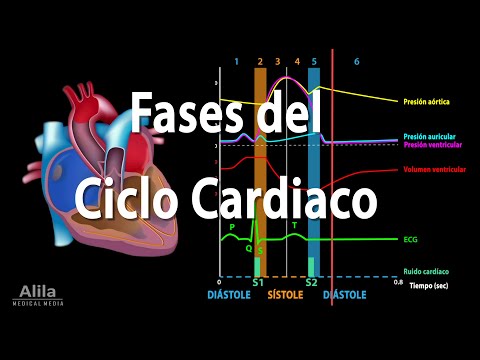
Fases del Ciclo Cardiaco y el Esquema de Wiggers, Animación. Alila Medical Media Español.
Cardiac Cycle Overview
Phases of the Cardiac Cycle
- The cardiac cycle consists of a sequence of events that repeat with each heartbeat, divided into two main phases: SYSTOLE and DIASTOLE. Each phase can be further subdivided into shorter phases.
- Systole refers to ventricular contraction, while diastole refers to ventricular relaxation. Blood flows from areas of higher pressure to lower pressure throughout these phases.
Mechanisms of Contraction and Relaxation
- During contraction, pressure within a chamber increases; during relaxation, it decreases. Atrioventricular (AV) valves open when atrial pressures exceed ventricular pressures and close when the gradient reverses. Similarly, semilunar valves open when ventricular pressures exceed those in the aorta/pulmonary artery and close under opposite conditions.
- The cycle begins with the firing of the SA node, which stimulates atrial depolarization represented by the P wave on an ECG. This initiates atrial contraction shortly after the P wave appears.
Atrial Contraction and Ventricular Filling
- Atrial contraction forces blood into ventricles but only contributes minimally to filling since ventricles are nearly full due to passive blood flow through open AV valves prior to this contraction.
- As atrial contraction ends, atrial pressure falls, reversing the pressure gradient across AV valves causing them to close—this closure produces the first heart sound (S1) marking the start of systole. Ventricular depolarization is indicated by the QRS complex at this point as ventricular contractions begin rapidly increasing their internal pressures.
Isovolumetric Contraction Phase
- For a brief moment during isovolumetric contraction, all valves remain closed while ventricles contract in a confined space without ejecting blood; thus, there is no change in ventricular volume during this phase.
- Ejection begins once ventricular pressures surpass those in both the aorta and pulmonary artery leading to opening of semilunar valves allowing rapid ejection of blood from ventricles into systemic circulation.
Transitioning to Diastole
- As repolarization occurs (indicated by T wave), ventricular pressure drops reducing ejection force until it falls below arterial pressures causing semilunar valves to close—this marks end of systole and beginning of diastole producing second heart sound (S2).
Turn any video into a summary like this
YouTube links, meetings, lectures — with transcripts, search, and chat.