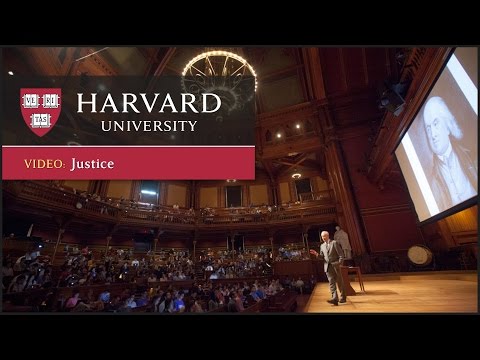
Justice: What's The Right Thing To Do? Episode 09: "ARGUING AFFIRMATIVE ACTION"
Funding for the Program
This section discusses the funding provided for the program.
Additional Funding Provided
- The transcript does not provide any specific details about the additional funding.
- No further information is available regarding the source or purpose of the additional funding.
Rawls' Distinction between Moral Desert and Entitlements to Legitimate Expectations
This section explores Rawls' distinction between moral desert and entitlements to legitimate expectations.
Rawls' Argument
- Rawls argues that distributive justice is not solely based on moral desert.
- He emphasizes that it is a mistake to think that distributive justice should only reward people according to their virtue.
- The distinction is made between claims of moral desert and entitlements to legitimate expectations.
Exploring Moral Desert in Connection with Opportunities
This section focuses on exploring moral desert in connection with opportunities, specifically related to hiring decisions and admission standards.
Affirmative Action and Cheryl Hopwood's Case
- The case of Cheryl Hopwood is discussed as an example.
- Cheryl Hopwood applied for admission to the University of Texas Law School but was turned down.
- The university had an affirmative action admissions policy that considered race and ethnic background as factors for diversity.
- Hopwood argued that she was being discriminated against because she was white, while minority applicants with similar grades and test scores were admitted.
Fairness of Affirmative Action Policy
This section examines whether Cheryl Hopwood's rights were violated by the affirmative action admissions policy.
Perspectives on Fairness
- The question of fairness arises regarding whether considering race and ethnicity as factors in admissions is justifiable or unfair.
- Some argue that it is fair to consider these factors due to educational disadvantages faced by minority students.
- Others believe that admissions should be based solely on academic merit and not arbitrary factors like race or ethnicity.
Arguments in Defense of Affirmative Action
This section presents arguments in defense of affirmative action.
Correcting for Educational Disadvantage
- One argument is that affirmative action helps correct for the effects of unequal educational opportunities.
- Minority students may have attended schools with less funding and resources, leading to lower test scores.
- Admissions should take into account the educational disadvantage faced by these students when evaluating their potential.
Diversity as a Value
- Another argument is that diversity along racial and ethnic dimensions is valuable in itself.
- Even if candidates have similar academic qualifications, considering diversity can enhance the overall learning environment.
Considering Race and Ethnicity as Arbitrary Factors
This section discusses whether race and ethnicity should be considered arbitrary factors in admissions decisions.
Arbitrary Factors Outside Applicant's Control
- It is acknowledged that race and ethnicity are arbitrary factors beyond an applicant's control.
- The general principle suggested is that admissions should not reward arbitrary factors over which individuals have no control.
Discrepancies in Educational Opportunities
This section highlights discrepancies in educational opportunities based on race and socioeconomic status.
Unequal Funding for Minority Schools
- Minority schools often receive less funding and resources compared to predominantly white schools.
- This discrepancy can lead to differences in academic performance due to a lack of support and quality education.
Adjusting Test Scores for Educational Disadvantage
- Admissions should consider the meaning of test scores within the context of educational disadvantage.
- Test scores may not accurately reflect an applicant's true potential if they faced unequal preparation due to a disadvantaged background.
The Importance of Equal Backgrounds
This section discusses the importance of equal backgrounds in education and addresses the argument that affirmative action is a temporary solution to compensate for past injustices.
Equal Backgrounds and Education
- Having equal backgrounds is crucial for fair education.
- Affirmative action is seen as a temporary solution to address historical injustices, such as slavery and segregation.
Justification for Affirmative Action
This section explores the justification for affirmative action as a means of compensating for past injustice, particularly related to slavery and segregation.
Compensating for Past Injustice
- Affirmative action is justified as a way to compensate for the wrongs done to African-Americans due to slavery and segregation.
- It aims to alleviate historical disadvantages faced by African-Americans.
Criticism of Affirmative Action
This section presents criticism against affirmative action, arguing that past events should not have an impact on present-day discrimination based on race.
Discrimination Based on Race
- Discriminating based on race should always be considered wrong.
- Ancestors' actions should not affect present-day individuals.
Addressing Differences in Opportunities
This section discusses alternative approaches to addressing differences in opportunities, such as focusing on educational programs and funding rather than artificially fixing results through affirmative action.
Fixing Differences in Opportunities
- Differences in education and upbringing should be addressed through programs like Head Start and increased funding for lower-income schools.
- Artificially fixing results does not lead to true equality.
Affirmative Action vs. Legacy Admission
This section compares affirmative action to legacy admission and highlights the need for equal consideration in both cases.
Affirmative Action and Legacy Admission
- Affirmative action is seen as a way to correct past injustices, while legacy admission provides advantages based on family connections.
- Both should be considered when discussing fairness in admissions.
Diversity and Legacy Admission
This section emphasizes the importance of diversity and mentions legacy admission as a factor that should be questioned if one disagrees with affirmative action.
Promoting Diversity
- Diversity in institutions like Harvard enhances education for all students, including those from predominantly white areas.
- Legacy admission also contributes to diversity and should be considered alongside affirmative action.
Perpetuating Racial Divisions
This section presents opposing views on whether affirmative action perpetuates racial divisions or promotes diversity.
Views on Affirmative Action
- Some argue that affirmative action perpetuates racial divisions rather than achieving the goal of race becoming irrelevant in society.
- Others believe that promoting racial diversity educates all students and brings unique perspectives to the table.
Judging Based on Merit vs. Race
This section discusses the argument against judging individuals solely based on their race and advocates for merit-based evaluations instead.
Judging Based on Merit
- African-American leaders, like Martin Luther King Jr., advocated for being judged by character, merit, and achievements rather than race.
- Solely considering someone's race is deemed inherently unfair.
Unfairness of Uncontrollable Factors
This section highlights the unfairness of basing admissions solely on factors individuals cannot control, such as race.
Unfairness of Uncontrollable Factors
- Individuals cannot control their race, and using it as a basis for admissions is unfair.
- Disadvantaged backgrounds should be considered, but race alone should not determine admission.
Family Background and Merit
This section discusses the influence of family background on merit and argues against solely relying on test scores for admissions.
Influence of Family Background
- Family background plays a significant role in an individual's achievements and opportunities.
- Merit-based evaluations should consider factors beyond test scores to promote diversity.
The transcript provided does not include timestamps for all sections.
The Role of Race and Alumni Status in Admissions
This section discusses the arguments surrounding the consideration of race and alumni status in college admissions. Three main arguments emerge from the discussion: correcting for educational disadvantage, compensating for past wrongs, and promoting diversity.
Arguments for Considering Race and Ethnicity
- One argument is to correct for differences in educational background, such as school quality and opportunities.
- Another argument is to compensate for historic injustices by considering race and ethnicity.
- The third argument is based on promoting diversity, both for the educational experience of all students and for the benefit of society.
Objections to These Arguments
- An objection to the compensatory argument is whether it is fair to ask individuals today to pay compensation for past injustices they were not implicated in.
- An objection to the diversity argument questions whether individual rights are violated when admission decisions are made based on the common good or social mission of an institution.
Examining Individual Rights vs. Common Good
- The counterargument states that there is no individual right to admission based on specific criteria or achievements.
- This brings up the issue of desert versus entitlement, where some argue that individuals do not deserve admission solely based on their efforts or achievements.
Correcting Educational Disadvantage
This section focuses on one of the arguments discussed earlier - correcting for educational disadvantage.
Importance of Correcting Educational Disadvantage
- Correcting educational disadvantage involves considering factors like different schools attended and opportunities available to students.
- This argument aligns with the idea that academic promise and scholarly potential should be considered beyond test scores and grades alone.
Compensating for Past Wrongs
This section explores the argument of compensating for past wrongs through affirmative action.
Justification for Compensation
- Affirmative action can be justified as a way to compensate for historic injustices, even if there is no need to correct educational disadvantage in a specific applicant's case.
Promoting Diversity
This section delves into the argument of promoting diversity in college admissions.
Importance of Diversity
- Having a racially and ethnically diverse student body benefits the educational experience for everyone.
- It also contributes to the strength and civic well-being of society by training future leaders who will make positive contributions.
Objections to Arguments
This section addresses objections raised against the arguments discussed earlier.
Objection to Compensatory Argument
- The objection questions whether it is fair to ask individuals today to pay compensation for past injustices they were not implicated in.
Objection to Diversity Argument
- The objection raises concerns about individual rights being violated when admission decisions prioritize the common good or social mission of an institution.
New Section
This section discusses the concept of moral desert and its relation to admission policies in educational institutions. It explores arguments for and against affirmative action, focusing on the diversity argument.
Harvard's Mission and Admission Criteria
- The discussion revolves around whether Harvard College has the right to define its mission and design its admission criteria according to its own goals.
- The argument is made that individuals who fit the criteria defined by Harvard's mission are entitled to be admitted.
- However, it is questioned whether anyone deserves Harvard College to define its mission in a way that prioritizes certain qualities or characteristics.
Affirmative Action and Diversity Argument
- The debate about affirmative action, particularly the diversity argument, raises questions about rights and distributive justice.
- The diversity argument suggests that race and ethnic background should be considered as a means of promoting diversity and correcting past injustices.
- The University of Texas Law School's affirmative action program is mentioned as an example of using the diversity argument to produce leaders who reflect the state's composition.
Objection to the Diversity Argument
- An objection is raised regarding whether arguments for the common good or general welfare should override individual rights.
- Rawls' perspective is mentioned, highlighting his belief that individual rights should not be violated in pursuit of the common good.
- The objection challenges whether defining admissions criteria solely based on social mission can justify violating individual rights.
Right to Define Mission vs. Fairness
- A student named Hannah argues that Harvard has the right to define its mission as a private institution.
- However, it is countered that just because an institution has the right to define its mission doesn't necessarily make it morally justified or fair.
- Affirmative action is brought up as an example where race is considered as a factor due to its relevance in promoting diversity and correcting historical imbalances.
Historical Examples
- The cases of the University of Texas Law School in the 1950s and Harvard in the 1930s are mentioned.
- In both cases, these institutions invoked their social purpose or mission to justify discriminatory admissions policies.
- The question is raised whether there is a principled distinction between invoking social purpose for diversity today and past instances of discrimination.
Timestamps are approximate and may vary slightly.
The Principle of Inclusion vs Exclusion
This section discusses the distinction between inclusion and exclusion based on arbitrary factors such as religion or race. It argues that it is morally wrong for universities to exclude individuals based on these factors.
Inclusion vs Exclusion
- The university's exclusion of individuals based on religion or race is morally wrong.
- Harvard's diversity initiatives aim to include groups that were historically excluded.
- Affirmative action programs today do not involve malice or judgment towards certain groups.
- Present-day policies focus on using people in a way that benefits the social purpose of the institution, without judging them as intrinsically less worthy.
Competing for Positions and Moral Desert
This section raises questions about whether competing for positions or seats in colleges and universities is solely based on moral desert. It explores the idea of using individuals for a wider social purpose rather than judging them based on their moral worthiness.
Using Individuals for Social Purpose
- When competing for positions or seats in colleges and universities, individuals are being used for a wider social purpose.
- This discussion relates back to the concept of distributive justice and whether it should be tied to moral desert.
- If moral desert was the basis of admissions policies, rejection letters would have to acknowledge societal factors rather than individual fault.
- Acceptance letters would highlight traits that society currently values, emphasizing exploitation of assets for society's advantage.
Detaching Distributive Justice from Moral Desert
This section delves into the question of whether distributive justice should be detached from questions of moral desert and virtue. It explores why various political philosophers argue against tying justice to moral merit or virtue.
Tying Justice to Moral Merit
- Various political philosophers, including libertarian and egalitarian theorists, agree that justice should not be tied to rewarding or honoring virtue or moral desert.
- The reason for this detachment goes beyond concerns for equality.
- Tying justice to moral merit may lead away from freedom and respect for individuals as free beings.
Aristotle's Idea of Justice
This section introduces Aristotle's perspective on justice, which ties it explicitly to honoring virtue, merit, moral desert, and individual qualities. It highlights the power and strangeness of Aristotle's idea in contrast to modern political philosophy.
Aristotle's Perspective on Justice
- Aristotle's idea of justice is intuitively powerful but also strange in some ways.
- His concept ties justice directly to honoring virtue, merit, moral desert, and individual qualities.
- This contrasts with modern political philosophy that seeks to detach justice from these considerations.
- Understanding the debate about justice and its connection to desert and virtue requires examining Aristotle's viewpoint.
Aristotle's Concept of Justice
In this section, the concept of justice according to Aristotle is discussed. Justice, for Aristotle, involves giving people what they deserve based on their virtues and appropriate social roles.
Understanding Justice According to Aristotle
- The concept of justice differs from the views held by libertarian and egalitarian rights-oriented theorists.
- Justice means giving each person their due and what they deserve.
- The question arises as to what constitutes a person's "due" or merit.
- Aristotle explains that the notion of desert depends on the type of things being distributed.
- When distributing things, equal persons should receive equal assignments.
- However, determining equality requires considering the relevant merits or grounds for distribution.
Merit-Based Distribution
- For example, when distributing flutes, the relevant merit or basis of dessert would be flute-playing ability.
- The best flutes should go to the best flute players because that is what flutes are meant for - producing excellent music.
- Discrimination in allocation is necessary in order to achieve justice, but it must be based on relevant excellence or virtue associated with having flutes.
Teleological Reasoning in Justice
- Aristotelian reasoning in justice involves looking at the purpose or goal (telos) of a particular activity or object.
- In the case of flute playing, the purpose is to produce excellent music.
- Therefore, just allocation and discrimination should be determined by considering this goal or purpose.
Intuitive Plausibility and Teleological Reasoning
- There is an intuitive plausibility to reasoning from the purpose when allocating resources such as tennis courts at Harvard University.
- Aristotelian teleological reasoning may seem strange in the modern world, but it aligns with the ancient view of nature as a meaningful order.
- Teleological reasoning extends beyond social practices and applies to understanding nature as well.
Conclusion
- Aristotelian teleological reasoning may be challenging to grasp in the modern scientific context, but it offers a natural way of looking at justice and allocation.
- This way of thinking is ingrained in children's natural perspective until they are educated out of it.
- Teleological reasoning involves considering the purpose or goal (telos) when determining just allocation and discrimination.
New Section
This section discusses the concept of teleological reasoning and its relevance in understanding nature and moral intuition.
Teleological Reasoning and Bees
- A buzzing noise usually indicates that something meaningful is happening, as it is not a random occurrence.
- Bees make buzzing noises, and the only reason for making such noises is because they are bees.
- The primary purpose of being a bee is to make honey.
- The main reason for making honey is so that it can be consumed.
New Section
This section explores the plausibility and power of teleological explanations, even if they do not align with modern science.
Intuitive and Moral Plausibility
- Although teleological explanations may not fit with modern science, there is still an intuitive and morally plausible aspect to them.
- Aristotle's idea of reasoning from the purpose or goal (telos) of a social practice relates to thinking about justice.
- Disagreements about topics like affirmative action can be seen as disagreements about the proper purpose or end of a particular practice.
- Reflecting on Aristotle's politics prompts us to consider whether reasoning from purpose is essential in thinking about justice.
New Section
This section provides information on how to engage with other viewers online and access additional resources related to justice.
Online Interaction
- Viewers have the opportunity to interact online with others interested in justice.
- They can participate in conversations, take quizzes, watch missed lectures, and gain further knowledge by visiting justiceharvard.org.
New Section
This section acknowledges the funding sources for the program.
Funding
- The program receives funding from various sources. Additional funding has been provided for this specific program.
The transcript provided does not contain any timestamps for the remaining sections.