22 Potencial de membrana
Concepts Related to Membrane Potential
In this section, the basic concepts related to membrane potential are discussed, including fixed ions and their role in maintaining electrical neutrality within the cell.
Fixed Ions
- Fixed ions refer to large organic molecules that do not pass through the plasma membrane and are confined within the cell.
- Anions fijos are molecules with negative chemical groups that help maintain electrical neutrality inside the cell by being counteracted by associated ions like those transported by the sodium-potassium pump.
- Potassium leak channels in the plasma membrane allow free passage of potassium, leading to a high intracellular potassium concentration compared to extracellular levels.
Transport Mechanisms Through Plasma Membrane
This section delves into different transport mechanisms across the plasma membrane, such as simple diffusion through the lipid bilayer and solute transport via transmembrane proteins.
Transport Mechanisms
- Various types of transport occur through the plasma membrane, including simple diffusion through the lipid bilayer and solute transport via transmembrane proteins like channels or carriers.
- Active transport moves substances against their electrochemical gradient, while passive transport occurs in favor of the electrochemical potential.
Understanding Electrochemical Potential
The concept of electrochemical potential is explained in detail, emphasizing how it influences solute movement across membranes based on electric and chemical forces.
Electrochemical Potential
- Electrochemical potential combines electric and chemical potentials to determine solute movement direction across membranes.
- When there is no membrane potential, charged solutes move from areas of high concentration to low concentration solely driven by their chemical potential.
Potassium Ion Equilibrium Potential
Focuses on understanding potassium ion equilibrium potential concerning concentration gradients and membrane permeability changes.
Potassium Ion Equilibrium
- The potassium ion channel is initially closed with an electrically neutral interior but a higher potassium concentration intracellularly due to its greater chemical potential.
Potassium Equilibrium Potential and Membrane Potential
In this section, the discussion revolves around the equilibrium potential of potassium and its significance in determining the membrane potential.
Understanding Potassium Equilibrium Potential
- The membrane potential counteracts the chemical potential of ions like potassium.
- By considering concentrations inside and outside the cell, one can calculate the equilibrium potential using Nernst equation.
- The membrane potential equation incorporates constants, external and internal ion concentrations for positive or negative ions.
Calculating Ion Equilibrium Potentials
- Utilizing concentration values, one can compute equilibrium potentials for sodium, potassium, and chlorine using logarithmic calculations.
- The process involves multiplying specific values by logarithms to derive equilibrium potentials expressed in millivolts.
Influence of Ion Permeability on Membrane Potential
This segment delves into how ion permeability impacts membrane potential by considering relative permeabilities of different ions.
Impact of Permeability on Membrane Potential
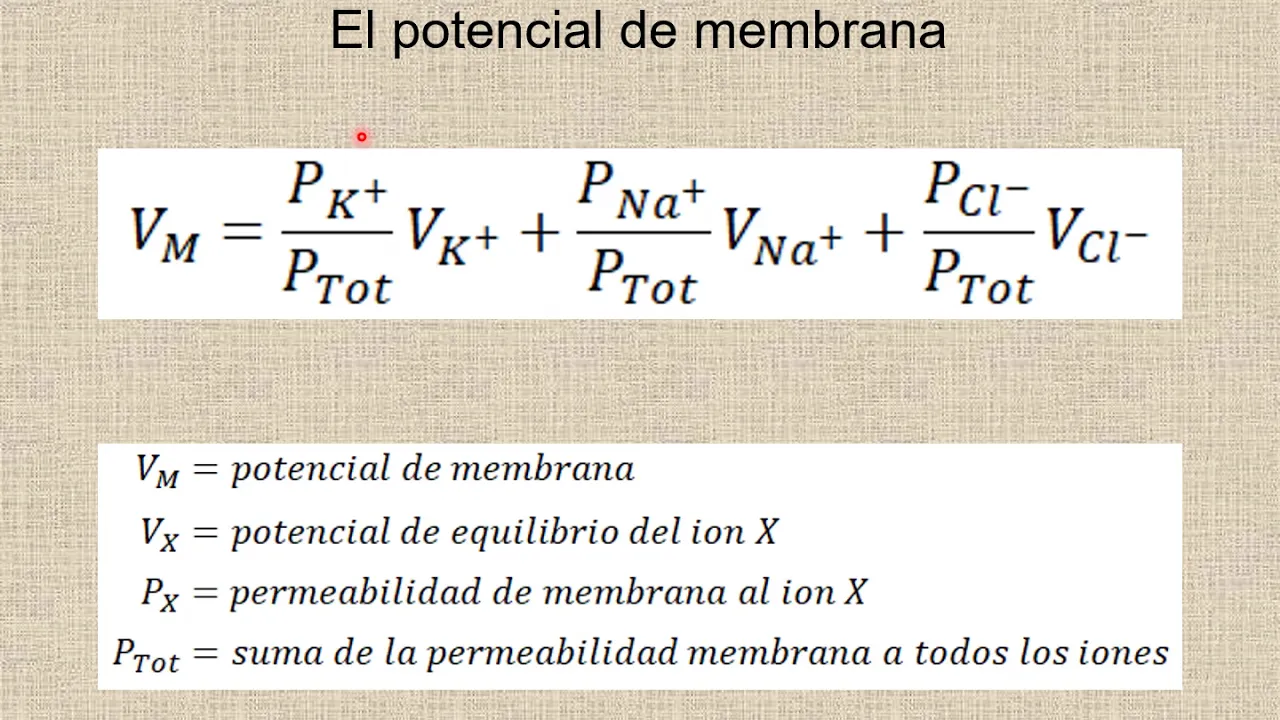
- The membrane potential calculation involves summing equilibrium potentials multiplied by relative permeabilities for various ions.
- Different ions' influences are summed up based on their relative permeabilities to determine overall membrane potential.
Role of Ion Channels in Modifying Membrane Potential
Exploring how opening or closing ion channels alters membrane potential based on their conductance properties.
Influence of Ion Channel Conductance
- When specific ion channels open or close, their conductance affects the overall membrane potential.
- Channels like potassium leak channels significantly impact membrane polarization due to their high conductance properties.
Dynamic Changes in Membrane Potential
Discussing how alterations in ion channel conductance lead to dynamic shifts in membrane potential.
Dynamic Shifts in Membrane Polarization
- Changes in channel conductance influence the balance between different ions' contributions to the overall membrane potential.
- Opening sodium channels with higher conductance than potassium channels shifts the membrane potential towards sodium's equilibrium value.
Estimating Membrane Potential under Varying Conditions
Estimating changes in membrane potential under different scenarios by considering ion channel activities.
Estimation of Membrane Potential Changes
- Alterations in channel conductances lead to fluctuations in membrane polarization towards respective ion equilibriums.
New Section
This section discusses the voltage-dependent sodium channel and its behavior in response to changes in membrane potential.
Voltage-Dependent Sodium Channel Behavior
- The voltage-dependent sodium channel remains closed at rest but opens during membrane depolarization.
- When the membrane potential reaches a threshold, the sodium channel opens, allowing sodium ions to enter the cell.
- Sodium influx leads to membrane depolarization, bringing the membrane potential closer to the sodium equilibrium potential.
- Upon inactivation, the sodium channel closes, halting further sodium permeability.
- Absence of voltage-sensitive channels results in local fluctuations in membrane potential.
Neuronal Signaling and Action Potential Propagation
This section delves into action potentials' generation and propagation along neurons.
Action Potential Generation
- Fluctuations due to channel activity lead to action potentials.
- Neurons have distinct protein compositions across soma, dendrites, and axon regions.
Axon Functionality
- Axonal membranes contain voltage-dependent sodium channels crucial for signal propagation.
- Differential protein distribution defines distinct membrane domains within neurons.
Action Potential Conduction
- Integration of stimuli at soma influences axonal depolarization initiation.
- Action potentials propagate unidirectionally along axons towards terminals.
Propagation of Action Potentials
Explores how action potentials travel through neurons and their impact on neighboring regions.
Polarization States
- Describes polarization states during action potential conduction.
Channel Dynamics
- Sodium influx triggers depolarization spread via neighboring channels opening successively.
Signal Transmission
Understanding Synaptic Transmission
In this section, the process of synaptic transmission is explained, focusing on the role of calcium in triggering vesicle release and neurotransmitter function.
Calcium Influx and Vesicle Function
- The synaptic vesicle's function involves interaction with the presynaptic membrane through protein complexes, such as Complexin A, inhibiting further protein interactions to stop vesicle fusion.
Calcium Entry and Complexin Interaction
- Complexin A within a protein complex inhibits protein binding, allowing for vesicle attachment without fusion until calcium influx occurs.
Calcium Association and Vesicle Fusion
- Calcium entry via voltage-gated channels leads to Complexin dissociation, enabling vesicle-plasma membrane interaction for fusion and neurotransmitter release.
Neuromuscular Junction Communication
This part delves into the neuromuscular junction's communication process involving acetylcholine release and receptor activation.
Acetylcholine Release at Neuromuscular Junction
- Acetylcholine released into the synaptic cleft initiates communication with muscle cells through ligand-gated sodium channels like those activated by acetylcholine.
Sodium Channel Activation Mechanism
- Ligand-gated sodium channels open upon acetylcholine binding, leading to depolarization necessary for reaching threshold potential and activating voltage-gated sodium channels in muscle cell membranes.
Propagation of Action Potential
This segment explores how action potentials propagate along muscle cell membranes through tubules connected to the endoplasmic reticulum.
Action Potential Propagation Mechanism
- Action potentials stimulate voltage-sensitive proteins that trigger conformational changes, allowing calcium influx from the sarcoplasmic reticulum into the cytosol for muscle contraction initiation.
Calcium Role in Muscle Contraction
The significance of calcium in initiating muscle contraction by interacting with troponin and tropomyosin is discussed here.
Calcium Impact on Muscle Contraction Process