Momento dipolar
Introduction to Dipole Moments and Molecular Polarity
In this video, we will explore the concept of dipole moments and molecular polarity. We will learn how to define dipole moments numerically and understand their significance in determining the polarity of a molecule.
Understanding Dipole Moments
- A dipole moment is a numerical value that represents the polarity of a chemical bond or molecule.
- It indicates how polar an individual bond or overall molecule is.
- The dipole moment is represented by a lowercase Greek letter "mu" (μ).
Calculation of Dipole Moment
- The dipole moment (μ) can be calculated using the equation μ = q × d, where q is the charge at any point on the dipole and d is the distance between the charges.
- The units for dipole moment are debye (D), which is equal to coloumbs multiplied by meters (C × m).
Experimental Determination
- The exact value of a molecule's dipole moment cannot be determined just by observing its structure. It needs to be determined experimentally.
- Simply looking at a bond or molecule does not provide information about its exact dipole moment.
Molecular Polarity and Vector Summation
In this section, we will explore how molecular polarity depends on the vector summation of individual bond moments. We will also review vector addition rules.
Summation of Bond Dipole Moments
- A molecule can be polar if the sum of its individual bond dipole moments is not zero.
- Each bond's dipole moment acts as a vector with magnitude and direction.
- The total molecular polarity depends on both magnitude and direction.
Vector Addition Rules
- When two vectors are in the same direction, they add up to a vector with greater magnitude.
- When two vectors are in opposite directions, they cancel each other out and result in a zero vector.
- When vectors form a "V" shape, the parallelogram method can be used to add them.
Examples of Molecular Polarity
In this section, we will examine examples of molecules and determine their polarity based on the summation of bond dipole moments.
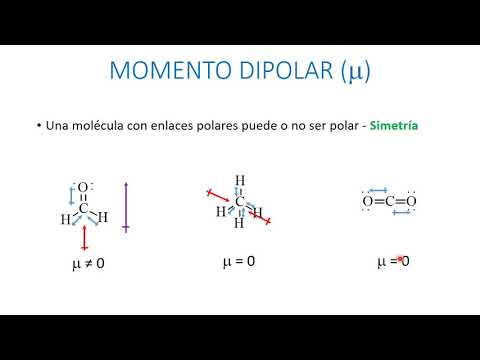
Example 1: Carbon-Oxygen Bond
- A compound with a carbon-oxygen bond can have a large dipole moment at that position.
- Additionally, there may be smaller dipole moments between carbon-hydrogen bonds (considered nonpolar covalent).
- The vector sum of these dipole moments results in an overall nonzero dipole moment for the molecule, indicating polarity.
Example 2: Carbon-Hydrogen Bonds Only
- In a compound consisting only of carbon-hydrogen bonds, each individual bond may have a small dipole moment.
- However, when these dipole moments are summed up, they cancel each other out due to their opposite directions.
- The resulting total dipole moment is zero, indicating that the molecule is nonpolar.
Example 3: Carbon Dioxide (CO2)
- In carbon dioxide (CO2), there are two polar carbon-oxygen bonds.
- However, since these bonds are equal in magnitude and opposite in direction, their vector sum cancels out.
- As a result, the overall dipole moment of CO2 is zero despite having polar bonds. Thus, CO2 is considered nonpolar.
Conclusion
In this video, we learned about dipole moments and molecular polarity. We understood how to calculate and determine the polarity of individual bonds and molecules based on vector summation. We also explored examples of polar and nonpolar molecules.
The transcript provided is in Spanish, but the summary has been written in English for clarity and understanding.