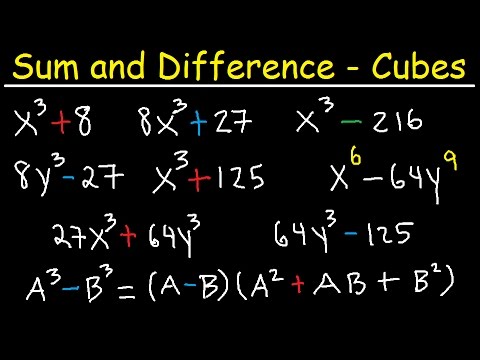
Factoring Sums and Differences of Perfect Cubes
Factoring Sums and Differences of Cubes
Introduction to Factoring Cubes
- The video focuses on factoring sums and differences of cubes, starting with the expression x^3 + 8.
- Introduces the formula for factoring sums of cubes: a^3 + b^3 = (a + b)(a^2 - ab + b^2).
Example 1: Factoring x^3 + 8
- Identifies a = x and b = 2 since 8 = 2^3.
- Substitutes into the formula yielding (x + 2)(x^2 - 2x + 4).
Example 2: Factoring x^3 + 125
- Recognizes that 125 = 5^3, thus setting b = 5.
- The factorization results in (x + 5)(x^2 - 5x + 25).
Example 3: Factoring 8x^3 + 27
- Establishes that for this case, a = 2x and b = 3.
- The final factorization is (2x + 3)(4x^2 -6x +9).
Example with Non-Cube Coefficient
- Discusses factoring an expression like 25 x^3 +64y^3, adjusting to use perfect cubes.
- Concludes with the factorization as (3x+4y)(9 x^2 -12xy+16 y^2).
Difference of Cubes
Introduction to Difference of Cubes
- Introduces the formula for factoring differences of cubes:
a^3 - b^3 = (a - b)(a^2 + ab + b^2).
Example: Factoring X^3 -216
- Sets up with values where a=x, and finds that cube root of 216 =6.
- Results in the factorization (X -6)(X^2 +6X+36).
Additional Examples
Example: Factoring 64y^3-125
- Identifies values where cube roots yield:
a =4y, b =5.
Final Factorization Steps
- Concludes with factors as (4y−5)(16y^2+20y+25).
Complex Case: Higher Powers
- Discusses a more complex example involving higher powers such as
X^6-64Y^9.