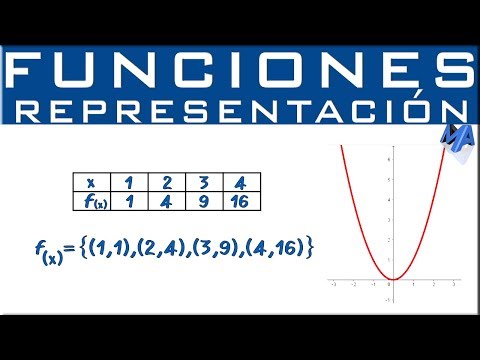
Representación de funciones
Understanding Functions: Different Representations
Introduction to Functions
- The course begins with an introduction to functions, focusing on different ways to represent them. An example discussed is the square of a number.
Analytical Expression of Functions
- The analytical expression is described as a formula that represents a function. It relates two sets of real numbers, denoting input (x) and output (y).
- A function is defined as a relationship between two sets, specifically the set of real numbers for both input and output.
Function Representation through Formulas
- The function can be expressed analytically as f(x) = x^2 , indicating that each input value (x) will be squared.
- This representation can also be written as y = x^2 .
Tabular Representation of Functions
- Another way to represent functions is through tables, where specific values are assigned to x and their corresponding outputs are calculated by squaring those values.
- Commonly used values for x include -3, -2, -1, 0, 1, 2, and 3; however, any real number can be used.
Calculating Outputs from Inputs
- The output values depend on the chosen inputs. For instance, if x = 2 , then f(2) = 2^2 = 4 .
- Continuing this process for other inputs like x = 3 , we find that f(3) = 3^2 = 9 .
Working with Negative Numbers
- When calculating squares for negative numbers such as -2:
- The calculation shows that f(-2) = (-2)^2 = 4 .
- This illustrates how squaring negative numbers results in positive outputs.
Ordered Pairs Representation
- Finally, functions can also be represented using ordered pairs. Each pair consists of an input value and its corresponding output.
Understanding Ordered Pairs and Graphing Functions
Introduction to Ordered Pairs
- The concept of ordered pairs is introduced, emphasizing that the first element (x) is written before the second element (fx). For example, if the first pair corresponds to -2 and 4, it is expressed as (-2, 4).
Characteristics of Ordered Pairs
- It is noted that some values correspond to specific outputs; for instance, at least one input corresponds to 1. The discussion highlights how ordered pairs can continue indefinitely, often ending with ellipses to indicate more pairs exist.
- The importance of maintaining order in these pairs is stressed. An example illustrates that one cannot mix values incorrectly; for instance, pairing 3 with 5 when it should correspond to a different output.
Graphical Representation of Functions
- The graphical method for expressing functions is discussed as one of the most common approaches. A table of values or ordered pairs must be known beforehand.
- A table of values will be created first before plotting on a Cartesian plane. This process involves locating points based on their corresponding x and y coordinates.
Plotting Points on a Graph
- Specific examples are provided for plotting points such as (-2, 4), where -2 represents the x-coordinate and 4 represents the y-coordinate.
- Additional points are plotted sequentially: (-1, 1), (0, 0), (2, 4), and so forth. The speaker notes limitations in displaying all points due to space constraints.
Connecting Points and Function Types
- After plotting points on the graph, they are connected to form a visual representation of the function being analyzed.
- Future videos will focus on different types of functions like linear and quadratic functions. A practice exercise involving writing an analytical function in various forms is also mentioned.
Creating Value Tables
- Viewers are encouraged to create value tables based on given equations like f(x)=2x. They can choose any numbers for x but must multiply them by two for corresponding fx values.
- Examples illustrate how negative inputs yield negative outputs while positive inputs yield positive results. This section emphasizes understanding relationships between variables through graphical representation.
Turn any video into a summary like this
YouTube links, meetings, lectures. With transcripts, search, and chat.