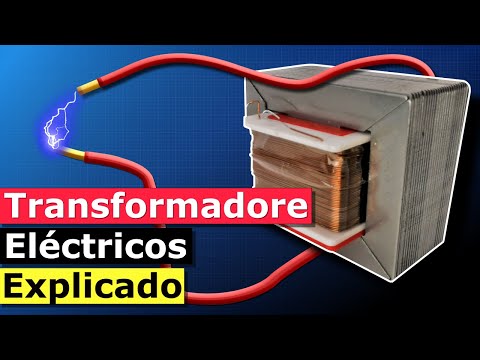
Transformadores Eléctricos Explicados
How Do Transformers Work?
Introduction to Transformers
- Transformers are essential devices found everywhere, providing a connection between homes and power plants.
- They transfer electrical energy and can change voltage and current, but only work with alternating current (AC), not direct current (DC).
- Transformers are classified in volt-amperes or kilovolt-amperes, with small transformers used in doorbells and laptop chargers.
Structure of a Transformer
- A transformer consists of two wire coils wrapped around an iron core; the primary coil connects to the power source while the secondary coil connects to the load.
- Disassembling a transformer reveals its simple structure: two separated wire coils and layers of iron.
Voltage Transformation
- Using step-up transformers increases output voltage, while step-down transformers decrease it.
- Power plants may produce high voltages (e.g., 12,000 volts), which are stepped up to 400,000 volts for transmission over long distances to reduce energy loss.
Energy Loss Reduction
- Higher voltage transmission reduces current flow; lower current results in significantly less energy loss due to resistance in cables.
- For example, sending electricity at 400,000 volts incurs only about 1% loss compared to 87% at lower voltages like 240 volts.
Electrical Systems Overview
- North American homes typically use a three-wire system allowing for both 120V and 240V outputs from one transformer.
- Most of the world uses a simpler two-wire system operating around 230 volts for efficient power delivery.
The Role of Magnetic Fields
Electromagnetic Induction Principles
- When electric current flows through a wire, it generates a magnetic field that changes direction when the current reverses.
- This alternating magnetic field induces voltage in nearby conductors; thus, transformers can increase or decrease voltage without altering frequency.
Oscilloscope Observations
- An oscilloscope connected to an AC outlet shows repeating wave patterns at frequencies of either 50 or 60 Hz depending on regional standards.
Importance of Insulation
- The wire must be insulated with enamel coating to ensure proper current flow along its length rather than taking shortcuts that would prevent functionality.
Induction Mechanism Explained
- Placing another coil near the first allows the changing magnetic field from one coil to induce voltage in the second coil through electromagnetic induction.
Limitations of Direct Current
Why AC is Necessary for Transformers
- The constant change in polarity and intensity of AC creates movement among free electrons. This phenomenon is known as electromotive force (EMF).
Understanding Transformers and Their Efficiency
The Basics of Electromagnetic Induction
- A constant magnetic field is established around the primary coil, which does not disturb electrons in the secondary side until a direct current (DC) switch is opened or closed.
- When DC flows through the transformer, a brief voltage spike occurs due to changes in the magnetic field; this happens when the magnetic field increases or decreases.
- Using alternating current (AC), however, results in a steady output voltage because the magnetic field continuously changes.
Transformer Design and Efficiency
- Two separate wire coils can function as a transformer but are inefficient due to significant wasted magnetic fields; introducing a ferromagnetic core helps concentrate and guide the magnetic field towards the secondary coil.
- Despite improvements, induced currents around the core generate heat and waste energy. To mitigate this, cores are made from thin sheets that limit these induced currents.
- Energy losses occur in copper wires and iron cores due to resistance, leading to heat generation.
Power Transfer and Voltage Regulation
- In transformers, power loss occurs both in copper (wires) and iron (core). AC causes laminations to expand and contract slightly, resulting in vibrations that produce noise.
- Step-up transformers have more turns of wire on the secondary side, increasing voltage while decreasing current; conversely, step-down transformers have fewer turns on the secondary side, reducing voltage but increasing current.
Understanding Power Ratings
- The relationship between voltage and current remains consistent across transformer sides; multiplying them gives apparent power measured in volt-amperes (VA).
- Real power depends on what is connected to the transformer; manufacturers specify nominal apparent power without knowing actual load conditions.
Reactive Power Explained
- Some energy consumed does not perform useful work but dissipates as heat—this is termed reactive power measured in volt-amperes reactive (VAR).
- An analogy compares real power to liquid beer (useful energy), while foam represents reactive power—less foam means more usable beer for efficiency.
Practical Applications of Transformers
- Manufacturers indicate how much load their transformers can handle based on design efficiency; better devices allow for more effective energy transfer.
- Transformers are also used with rectifier circuits to convert AC into rough DC before smoothing it out with capacitors for clean output.
Calculating Transformer Outputs
- Basic calculations assume perfect transformers: if a primary has 1000 turns at 120 volts input leads to 12 volts output on a step-down transformer using specific formulas.
Transformers and Power Calculations
Understanding Transformer Formulas
- The discussion begins with the application of formulas to determine current and voltage in transformers, emphasizing that knowing either primary or secondary current along with voltages allows for calculations.
- An example is provided involving a step-up transformer with 100 turns on the primary side and 200 on the secondary. When supplied with 120 volts, the output voltage is calculated to be 240 volts.
- The formula can also be rearranged to find input voltage if only output voltage and turns are known, demonstrating flexibility in transformer calculations.
Calculating Turns and Currents
- If one knows the secondary voltage and primary turns, they can calculate the number of turns needed on the secondary side using specific formulas.