UD3 Componentes de E S 5
Specifications for SSDs
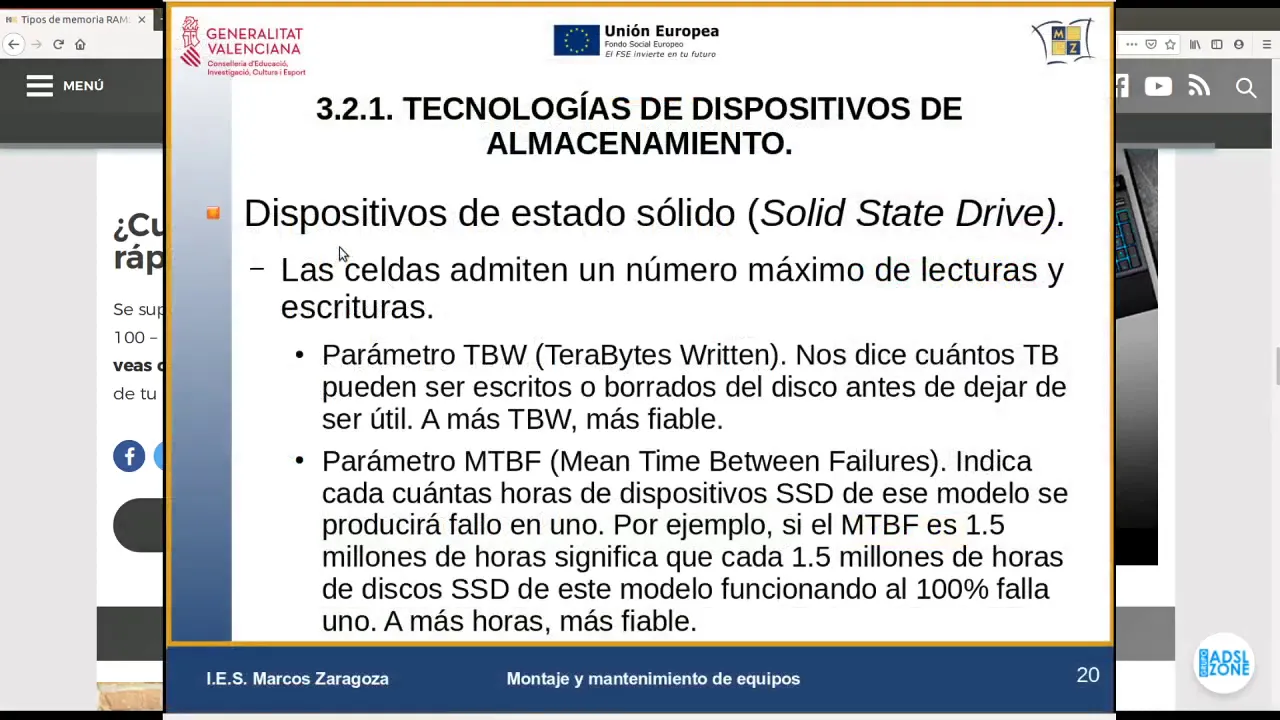
This section discusses two parameters related to the maximum number of read and write operations that can be performed on SSD cells, which affects the lifespan of the disks.
VW Terabytes Wright Parameter
- Indicates how many terabytes can be written or erased from the disk before it becomes unusable.
- Higher values indicate a more reliable disk.
Min Time Between Failures (MTBF)
- Represents the number of hours a disk model can operate without failing.
- A higher MTBF value indicates greater reliability.
- For example, an MTBF of 15 million hours means that if 15 million units of this model were simultaneously functioning, one unit would fail per hour.
Comparison of Terabytes Written
This section compares different SSD models based on their terabytes written (TBW) values, which indicate durability.
- Sandisk Ultra SATA SSD has a TBW value of 100 terabytes (from 2018).
- Sandisk Ultra with 2 terabytes has a TBW value of 500 terabytes.
- These high TBW values suggest long lifespans for these SSDs.
Durability Calculation
This section explains how to calculate the durability of an SSD based on its TBW value and daily usage.
- If we assume daily usage of 100 gigabytes (GB), then writing 500 terabytes would take approximately 5,000 days or around 8 years.
- However, actual usage may vary significantly from this estimate depending on individual needs and average daily usage.
Reliability Factors
This section discusses additional parameters that provide information about the reliability of SSDs.
- MTBF (Min Time Between Failures) indicates the reliability of a disk model.
- SSDs have higher read and write speeds compared to magnetic hard drives, reaching up to 550 megabytes per second (MB/s).
- Latency in SSDs is lower than in magnetic hard drives, resulting in faster access times.
Fragmentation and Performance
This section explains how fragmentation does not affect the performance of SSDs due to their distributed memory chips.
- The information stored across different memory chips does not impact access speed.
- SSDs provide consistent access times regardless of data distribution.
- Applications and operating systems start up quickly on SSDs due to low latency.
The transcript provided is a partial transcript.
SSD Operations per Second
The speaker discusses the number of operations per second that an SSD can perform.
SSD Performance
- SSDs can perform up to 250,000 input/output operations per second (IOPS).
- This high IOPS rate makes SSDs suitable for fast read and write operations.
- The speaker mentions that the speed of writing data is also interesting.
Terabytes Written and Mean Time Between Failures
The speaker talks about terabytes written and mean time between failures in relation to SSDs.
Terabytes Written and Mean Time Between Failures
- The speaker mentions that he doesn't see the terabytes written specification for a specific SSD model.
- He explains that mean time between failures is around 1.5 million hours for some SSD models.
- The speaker compares two types of NAND technology used in SSDs: TLC (Triple-Level Cell) and MLC (Multi-Level Cell).
- TLC stores 2 bits per cell, while MLC stores 3 bits per cell.
- He notes that MLC-based SSDs may last longer but can store less data compared to TLC-based ones.
Speed and Capacity Comparison
The speaker discusses the speed and capacity differences between different types of SSDs.
Speed and Capacity Comparison
- The speaker mentions that desktop-class HDD-based SSDs have slower speeds compared to other types.
- Sequential read/write speeds for desktop-class HDD-based SSDs are up to 520/320 MB/s respectively.
- Random input/output operations on these drives are measured at around 250,000 IOPS.
- He suggests comparing these parameters when evaluating different models.
SSD Connectivity and Performance
The speaker explains the different connectivity options for SSDs and their impact on performance.
SSD Connectivity and Performance
- The speaker introduces a Kingston SSD model that uses PCI Express connectivity.
- He mentions that this type of connection offers higher speeds compared to desktop-class HDD-based SSDs.
- The Kingston PCI Express SSD has sequential read/write speeds of 2200/2000 MB/s respectively.
- It utilizes multiple PCI Express lanes, resulting in increased performance.
- The terabytes written specification for this model is around 350 TBW (Terabytes Written).
Reliability and Capacity Considerations
The speaker discusses the reliability and capacity considerations when choosing an SSD.
Reliability and Capacity Considerations
- The speaker mentions that the reliability of SSDs has improved due to advancements in protocols like NVMe (Non-Volatile Memory Express).
- He highlights an example of an NVMe-based Samsung 860 SSD with a terabytes written specification of 75 TBW.
- However, he notes that these high-performance NVMe-based drives tend to be more expensive compared to other types.
- He suggests considering factors like latency and cost when selecting an appropriate SSD.
Timestamps are approximate.
Turn any video into a summary like this
YouTube links, meetings, lectures. With transcripts, search, and chat.