erlang b
Traffic Engineering Concepts
Introduction to Traffic Engineering
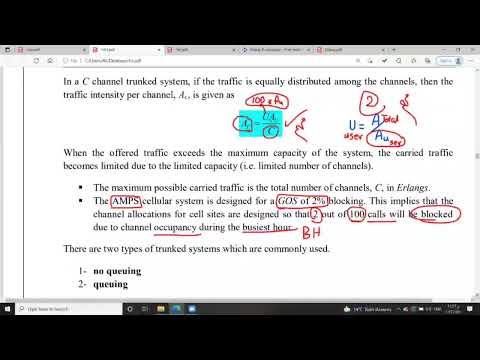
- The lecture continues from the previous session, focusing on traffic engineering concepts, specifically "traffic intensity" and "grade of service."
- The term "grade of service" is introduced as a measure similar to "quality of service," indicating the percentage of successful connections in mobile networks.
Understanding Grade of Service
- A grade of service indicates the probability of call blocking; for example, if 5% of calls are blocked, it means that out of 100 calls, 95 will connect successfully.
- Two theories regarding call completion probabilities are discussed: one focuses on immediate blocking upon connection attempts, while the other allows for waiting periods before blocking occurs.
Call Completion Theories
- The first theory suggests that if a user tries to connect and all channels are busy, their call is immediately blocked.
- In contrast, the second theory allows users to wait (e.g., 20 seconds), during which time they may still attempt to connect if channels become available.
Statistical Analysis in Traffic Engineering
- Companies aim to minimize call blocking rates by analyzing traffic patterns and designing systems accordingly.
- Important statistical laws are referenced that relate total network load (E) with individual user load (EU), helping determine overall system performance.
Key Formulas and Their Applications
- A critical formula mentioned is E = EU/N, where N represents the number of users in the system. This helps calculate network congestion levels.
- Another significant formula relates total traffic generated by users (EIC), emphasizing its importance in understanding network dynamics.
Practical Implications and Observations
- An example illustrates how a design might account for a 2% blocking rate based on historical data from previous connections.
- Discussion includes potential outcomes when calls cannot be completed due to channel unavailability or other factors affecting connectivity.
Conclusion and Future Directions
- Emphasis is placed on practical applications within laboratory settings where theoretical concepts can be tested through simulations or programming exercises.
- The lecture concludes with an overview of how mathematical relationships can predict traffic behavior under varying conditions.
Understanding Call Blocking and Traffic Management
Overview of Call Types
- The discussion begins with the classification of calls into two types: those without waiting time and those that involve a waiting period. The second type is characterized by a delay before connection, which can last from ten to twenty seconds.
Network Behavior and Traffic Laws
- It is explained that if there is no network availability, calls will be blocked. This leads to the introduction of a theoretical framework for calculating call blocking probabilities based on traffic intensity, expressed in percentages (e.g., 2%, 1%, or 0.5%).
Key Formulas and Derivations
- A critical formula related to traffic management is introduced, emphasizing the importance of understanding how time factors into calculations. The derivation process is highlighted as essential for grasping these concepts.
Erlang B Formula Application
- The Erlang B formula is mentioned as a key tool for determining call capacity under specific conditions. This section indicates that practical examples will follow to illustrate its application in real scenarios.
Understanding User Traffic
- The concept of user traffic is discussed, where it’s noted that every thousand calls might result in five blocked due to network limitations. This highlights the relationship between total traffic and blocking rates.
Calculating Unknown Values in Traffic Models
Solving for Unknown Variables
- A method for solving unknown values within traffic models is presented, focusing on how known values can be used to derive missing data points through intersection with existing parameters.
Importance of Accurate Calculations
- Emphasis is placed on accuracy when dropping values during calculations; discrepancies can lead to significant differences in results. Alternative methods are suggested for achieving precise outcomes.
Practical Examples and Applications
Example Scenarios
- Two example scenarios are proposed where users' average traffic needs are calculated using established formulas. These examples serve as practical applications of previously discussed theories.
User Blocking Probability Calculation
- A specific case involving user blocking probability at 0.5% illustrates how this translates into actual numbers—indicating that out of every 200 users, one may experience a block due to network constraints.
Key Terms and Concepts Recap
Terminology Clarification
- Important terms such as "trunks" are clarified within the context of call management systems, linking them back to previous discussions about Erlang B formulas and their implications on service quality.
Final Thoughts on User Capacity
- Concluding remarks focus on determining user capacity based on given probabilities while reiterating the significance of understanding both theoretical frameworks and practical applications in telecommunications management.
Understanding System Parameters and Calculations
Introduction to System Access and Parameters
- The speaker introduces the concept of system access, indicating that it is crucial for understanding the overall system operation.
Exploring Percentage Values in Systems
- A discussion on a specific system's percentage value (5%) is presented, emphasizing its significance in calculations related to the "side GOS" and "wiring."
- The speaker explains how to graphically represent this percentage using horizontal lines to intersect with numerical values.
Analyzing Curve Intersections
- The importance of accurately identifying intersections on a curve is highlighted, noting potential discrepancies in student calculations due to approximation methods.
- The method of dropping vertical lines from points of intersection is discussed as a way to clarify results.
Practical Application of Values
- The speaker emphasizes hands-on application by encouraging students to physically manipulate values for better comprehension.
- A breakdown of numerical values illustrates how they relate to each other within the context of the problem being solved.
Addressing Calculation Accuracy
- Different approaches are suggested for calculating values between known quantities, stressing that multiple answers can be valid depending on rounding methods used.
Refining User Count Calculations
Methodology for User Count Extraction
- The process for extracting user counts from charts is explained, focusing on dividing total users by specific parameters (e.g., 10).
Adjusting Parameters Based on Context
- Changes in parameter values (from 5% to 10%) are discussed, demonstrating how these adjustments affect graphical representations and outcomes.
Identifying Value Ranges
- A detailed examination reveals how calculated values fall within certain ranges, providing insight into expected outcomes based on proximity to whole numbers.
Finalizing Results and Approaches
Summary of Calculation Techniques
- A recap emphasizes that increasing user numbers logically leads to higher outputs, reinforcing foundational principles behind these calculations.
Alternative Methods for Verification
- Mentioned are alternative approximate methods available online that can provide additional insights or verification options for students seeking clarity.
Practical Implementation in Labs
- Students are encouraged to apply learned techniques practically during lab sessions, ensuring they grasp concepts through direct experience with data manipulation.
This structured approach provides an organized overview while linking back directly to relevant timestamps for further exploration.
Analysis of Statistical Methods in Problem Solving
Introduction to Statistical Concepts
- The speaker discusses the absence of issues with previously established statistical methods, indicating a smooth transition into the topic.
Understanding Probability and Its Applications
- A need for clarity on unknown variables is expressed, emphasizing the importance of understanding various probabilities (1, 5, 10, 20, and 100) in relation to a specific case scenario.
Case Study Analysis
- The example presented involves calculating probabilities using a traditional method while adhering to ministerial guidelines. The speaker highlights how certain values intersect within the data set.
Calculation Techniques
- The discussion shifts towards calculation methods where results yield significant figures (e.g., 1.3), demonstrating how these calculations can be derived from different approaches.
Online Tools and Their Effectiveness
- An online tool is mentioned as being effective for obtaining accurate answers; however, there are concerns about its reliability compared to traditional methods.
Comparative Analysis of Results
- The speaker compares results obtained through different methodologies, noting discrepancies between calculated values and those derived from online tools.
Final Thoughts on Methodology
- Emphasis is placed on maintaining consistency in methodology when analyzing data sets. This includes ensuring that all calculations align with established standards.
Conclusion: Importance of Accurate Data Interpretation
- The session concludes with reflections on the significance of precise data interpretation and adherence to methodological standards in statistical analysis.
Understanding Calculations in Context
Importance of Precision in Calculations
- The speaker emphasizes the significance of clarity when dealing with calculations, particularly distinguishing between five per thousand and five percent. This distinction is crucial to avoid confusion in results.
- There is a mention of potential issues arising from misinterpretation of numerical values, highlighting the need for careful consideration when presenting data.
Tools for Calculation
- The speaker introduces various online resources available for calculating earnings, suggesting that a simple search for "earnings calculator" will yield numerous options.
- A specific tool mentioned is the "GIS number," which appears to be a key component used in their calculations, indicating its relevance in practical applications.
- The discussion includes reference to an established method outlined in educational materials, reinforcing the importance of adhering to recognized standards and methodologies during calculations.