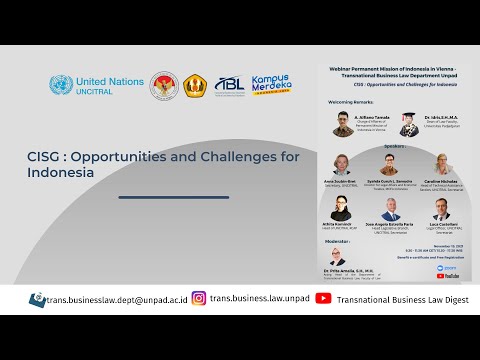
Webinar CISG: Opportunities and Challenges for Indonesia
Introduction
The speaker welcomes the participants to the webinar and explains that they will be allowed to ask questions using the chat box feature in Zoom. The aim of the webinar is to disseminate information on UNCITRAL and its work, with a focus on the United Nations Convention on Contracts for International Sale of Goods (CISG).
Welcoming Remarks
- His Excellency Alfiano Tamala greets the audience.
- He reiterates his greeting.
- Tamala hands over the screen to the Director for Legal Affairs of Economic Treaties.
Importance of International Trade Law
- Indonesia's trade has been essential in improving its national economy and welfare.
- To implement strategic policies effectively at a technical level, Indonesia needs to take advantage of various international regimes or facilities currently available, such as CISG.
Acknowledgments
- Tamala expresses gratitude towards co-hosts, partners, and representatives from UNCITRAL who helped make this webinar possible.
Rationale for Organizing Webinar
The speaker explains why they organized this webinar and how it can benefit Indonesia in terms of international trade law.
Purpose of Webinar
- The primary aim is to disseminate information on UNCITRAL and its work that might benefit Indonesia in the future.
- It might be beneficial now for Indonesia to revive discussions about joining CISG as a party.
Importance of International Trade Law
- Indonesia has implemented strategic policies to ensure smooth practice of international trade, such as the enactment of job creation law in 2020 and forming various international trade agreements with other countries.
- Concrete work and mutually beneficial cooperation on the issue of international trade law within UNCITRAL can benefit Indonesia.
Overview of CISG
The speaker provides an overview of CISG and its significance in fulfilling the international community's need for a uniform and fair regime for the international sale of goods.
Significance of CISG
- CISG is arguable one of the significant achievements of UNCITRAL.
- CISG tries to fulfill the international communities need to have a uniform and fair regime for the international sale of goods.
Benefits for Indonesia
- Reviving discussions about joining CISG as a party might be beneficial now for Indonesia.
Conclusion
The speaker concludes by expressing hope that this mutual corporation would be sustainable.
Acknowledgments
- Tamala expresses gratitude towards co-hosts, partners, and representatives from UNCITRAL who helped make this webinar possible.
Future Cooperation
- It is hoped that this mutual corporation would be sustainable.
Introduction and Welcome
The Dean of the Faculty of Law at the University welcomes attendees to a public lecture on international business law, thanking those who made it possible.
Welcoming Remarks
- Dr. Idris, the Dean of the Faculty of Law at the University, thanks everyone for attending a public lecture on international business law.
- He expresses gratitude to colleagues in the International Business Law Department and Law School for organizing this event.
- Dr. Idris acknowledges that this is an important opportunity for students to learn from an international speaker and gain insights into global legal systems.
Acknowledgments
Dr. Idris thanks various individuals and organizations for their contributions to the event.
Acknowledgments
- Dr. Idris thanks His Excellency Alfie Natala for his remarks.
- He expresses appreciation to Director of Legal Affairs Indonesia for their cooperation with the university.
- Dr. Idris thanks Caroline Nicolas, Legal Officer Secretary, as well as other participants from different universities and institutions.
Importance of International Object Contracts Convention
The speaker discusses the importance of ratifying the United Nations Patent on Contract about International Object Convention.
Ratification of Convention
- The United Nations Patent on Contract about International Object Convention is one of the most significant conventions in terms of cell upgrade support.
- The convention has been ratified by more than 85 countries, but Indonesia has not yet ratified it.
- Dr. Idris explains that ratifying the convention would provide an opportunity for students to analyze the advantages and disadvantages of ratification, as well as how to regulate or conduct international business in terms of different national efforts.
Bridging Legal Systems
The speaker discusses how the International Object Contracts Convention can help bridge legal systems between different countries.
Harmonization of Legal Systems
- The International Object Contracts Convention is important because it helps overcome gaps between different legal systems in terms of cell upgrade support.
- Article 7 of the convention is significant because it provides a solution for overcoming differences in civil law or ecosystems among building countries.
- Dr. Idris believes that this convention can help harmonize and unify output even when countries have different legal systems.
Conclusion and Next Steps
Dr. Idris concludes the lecture by thanking attendees and expressing hope for future cooperation.
Final Remarks
- Dr. Idris thanks attendees for their participation and encourages them to consume material from the speaker.
- He expresses his desire for increased cooperation between UNPAD and other institutions, particularly in international business law.
Importance of Trend in Industrial Cooperation
In this section, the speaker emphasizes the importance of trend in industrial cooperation.
The Most Important Element for Industrial Cooperation
- The trend is the most important element for industrial cooperation.
Photo Session
In this section, the moderator announces a brief photo session for all participants to turn on their cameras.
Brief Photo Session
- All participants are encouraged to turn on their camera for a brief photo session.
- The moderator gives time for others to open up their camera.
- Two pages worth of participants have opened their cameras and smile at the camera.
Introduction of Mr. Guru El Samudra as Director for Legal Affairs and Economic Treaties Form of Indonesia
In this section, Mr. Guru El Samudra's CV is read out before he delivers his remarks.
Mr. Guru El Samudra's Background
- Mr. Guru graduated from Brawijay University with a bachelor's in law in 1999.
- He pursued his master's in law at the University of Indonesia graduating in 2005.
- He has worked on various jobs relating to international law such as being the minister counselor for the permanent mission of Indonesia to the United Nations and becoming the director of legal and economic treaty for Indonesia's ministry of foreign affairs.
Importance of International Legal Tools in Ensuring Free Trade Agreements
In this section, Mr. Guru El Samudra discusses the importance of international legal tools in ensuring free trade agreements.
Use of International Legal Tools
- Indonesia should consider using any international legal tools available that could help ensure free trade agreements could be enjoyed at grassroots levels.
- The discussion on CISG is very timely for Indonesia as it provides a modern uniform and fair regime for contract for the international sale of goods.
Russia's Legal System and the CISG
In this section, the speaker discusses the importance of reviewing Russia's legal system and ensuring adequate human resources to implement the CISG. The webinar is seen as a milestone in continuing discussions about the benefits and challenges of acceding to the CISG.
Importance of Reviewing Legal System
- After becoming a party in 2dcisg, Russia should review its legal system.
- Industry should ensure there are adequate human resources capable of implementing these CISG in practice.
- This process might take time to be completed.
Milestone for Discussion
- The webinar is crucial to become one of the milestones to continue discussion.
- Further identify benefits and challenges if initial were to exceed to cisd in future.
- Continue past effort in 2013 whereas agency of national law development conducted economic study for accession.
Comprehensive Input on Acceding to CISG
- Take note of all information, discussion, and suggestions presented today.
- Prepare comprehensive input on whether Russia should revive process of acceding to CISG.
- Kunti continues long-standing effort of Indonesia's national law reform colleagues.
Mutual Cooperation with UNCITRAL
In this section, the speaker echoes a statement made by Jaje Defense regarding mutually beneficial cooperation on international trade law with UNCITRAL that can cover many issues such as investment, transparency arbitration, etc.
Opportunities for Cooperation
- Echoes statement made by Jaje Defense regarding opportunity for mutually beneficial cooperation on issue of international trade law with UNCITRAL.
- Cooperation can cover many issues such as investment, transparency arbitration, etc.
- Ministry of Foreign Affairs and Permanent Missions of Indonesia in Vienna are more than happy to facilitate any immersion stakeholders in particular the academics.
Introduction to UNCITRAL
In this section, the speaker introduces herself as the Secretary of UNCITRAL and gives greetings from Vienna where the secretariat is based. She discusses how unsettled instruments are useful for increasing legal predictability and promoting unification and harmonization of international trade law through codification.
Introduction to Speaker
- Speaker is Anna Juban Play, Secretary of UNCITRAL.
- Holds postgraduate degree in private international law from University of Paris Pantheon Sorbonne and a master's degree in international economic law from University of Paris.
- Works as Director of International Trade Law Division in Office of Legal Affairs at United Nations.
Importance of Unsettled Instruments
- When trade takes place across borders, legal uncertainty due to diversity of domestic laws makes outcome of commercial disputes highly unpredictable and increases transaction costs.
- Promotion of unsettled instruments increases legal predictability by promoting unification and harmonization of international trade law through codification.
- CISG is most successful substantive uniform law instrument covering contract sale goods.
Adoption of CISG in Asia and the Pacific
The speaker discusses the adoption of the CISG in various countries in Asia and the Pacific, including recent adoptions by Vietnam, Laos, and North Korea. The importance of having a uniform default contractual framework for complex cross-border supply chain management is highlighted.
- The CISG has been adopted in 94 states belonging to all regions and economic systems.
- Recent adoptions have been made by Vietnam, Laos, and North Korea.
- The majority of Indonesian companies that conduct international sales recommend ratification of the CISG.
- A uniform default contractual framework is important for complex cross-border supply chain management.
- The adoption by Indonesia has been endorsed by Indonesian researchers.
Introduction to CISG Principles
This section provides an introduction to the principles of the CISG.
- The speaker provides an overview of the history and purpose of the CISG.
- The principles of freedom of contract and party autonomy are discussed.
- Key provisions related to formation, performance, and remedies are highlighted.
- Differences between common law and civil law approaches are noted.
Benefits and Policies of CISG
This section discusses the benefits and policies associated with adopting the CISG.
- The speaker highlights how adopting the CISG can reduce transaction costs for businesses engaged in international trade.
- Predictability in commercial transactions is increased through use of a uniform legal framework.
- Parties can avoid disputes through clear communication about their expectations under the contract.
- Adopting countries benefit from increased participation in global trade due to reduced barriers to entry.
Technical Cooperation and Assistance from ARCADE
This section discusses technical cooperation and assistance available from ARCADE (the Regional Center based in Incheon, Korea).
- ARCADE provides technical assistance to stakeholders on the CISG and other UNCITRAL instruments.
- The center works to promote the adoption and uniform interpretation of international trade law in the Asia-Pacific region.
- ARCADE can provide training, research, and other forms of support to countries considering adoption of the CISG or seeking to improve their implementation of it.
Introduction to the CISG
The purpose of this section is to introduce the CISG as a modern, uniform, and fair regime for international sales of goods. It also highlights the significance of the CISG in introducing certainty in commercial exchange and decreasing transaction costs.
Functions of UNCITRAL
- UNCITRAL's mandate is to promote the progressive harmonization and unification of international trade law.
- UNCITRAL's work on international commercial law reform is an integral part of engagement in the international trading community.
- Participation in UNCITRAL can bring benefits to a particular country.
Caroline Nicholas' Speech on UNCITRAL
- Caroline Nicholas is a head of technical assistants and senior legal officers at the International Trade Law Divisions United Nations Office of Legal Affairs.
- She has previously served as secretary of the UNCITRAL working groups one and three leading uncitral work on procurement and infrastructure development in faster state dispute settlement and online dispute resolutions.
- Caroline Nicholas has obtained a master degree in philosophy politics and economics from University Oxford United Kingdom and public procurement law and policy from Nottingham United Kingdom.
- In her speech, she talks about Answer Trial's focus on CISG, its mandate, work, relevance, Indonesia's engagement in international trade law reform, benefits that participation can bring to a particular country.
Conclusion
This section provides an introduction to the CISG as well as an overview of UNCITRAL's functions. It also introduces Caroline Nicholas' speech on Answer Trial's focus on CISG.
The Role of UNCITRAL in International Trade Law
In this section, the speaker explains the role of UNCITRAL in international trade law and how it promotes the unification and harmonization of international trade law.
UNCITRAL's Objective
- UNCITRAL aims to promote the progressive unification and harmonization of international trade law.
- Its objective is to ensure that businesses in different countries get the same results when they use certain texts in their commercial contracts and relationships.
- This helps to reduce transaction costs that businesses might encounter in international trade.
What UNCITRAL Does
- UNCITRAL does not set the trade rules applicable between states like WTO. Instead, it coordinates and prepares draft laws and conventions that can be used at a national level.
- It encourages countries to use its texts for harmonization purposes and ensures that they are understood in the same way.
- Its rules are designed to enable international business to work, facilitate international investment, support businesses' access to international markets, particularly smaller businesses, micro small and medium-sized enterprises (MSMEs), businesses in developing countries, and transition countries.
Supporting Sustainable Development Goals
- UNCITRAL supports sustainable development goals by enabling international business to flourish whether they're selling goods or trading services or investments.
- It contributes significantly to post-pandemic recovery by supporting businesses during the pandemic using its tools.
Introduction to UNCITRAL and its work
In this section, Caroline Nicholas introduces the United Nations Commission on International Trade Law (UNCITRAL) and its work in supporting commercial transactions.
UNCITRAL's Work
- UNCITRAL supports commercial transactions by providing legal texts for various areas of business life cycle.
- Electronic commerce and digitalization are important for businesses to communicate internationally and do as much as they can online because it's more efficient.
- An important part of a flourishing business environment is to allow businesses to exit the market that allows debt and capital that might be invested in them to become re-available in the market and to allow new businesses to grow.
- Technical assistance is provided by UNCITRAL if states decide they want to use their texts. This includes legal drafting, policy explanations, e-learning materials, capacity building, etc.
- UNCITRAL provides case law on the CISG (Convention on Contracts for the International Sale of Goods).
Summary of Presentation
In this section, the speaker summarizes what was covered in her presentation about UNCITRAL.
Key Takeaways
- The United Nations Commission on International Trade Law (UNCITRAL) was introduced along with its support for commercial transactions.
- Legal texts such as international commercial arbitration, Singapore mediations convention are useful for business and commercial transactions in Indonesia.
- Clothes are used by academic institutions like theirs to support student assignments related to norms in UNCITRAL.
Introduction to CISG and its underlying principles
In this section, Mr. Jose Angelo Estrella Faria introduces himself and provides a brief overview of the purpose of his presentation. He also mentions that he will be discussing the CISG and its underlying principles.
- Mr. Faria's background: He is a principal legal officer at the Secretariat of the United Nations Commissions on International Trade Law (UNCITRAL). He was also the Secretary-General of the International Institute for the Unification of Private Law (UNIDROIT) from 2008 to 2017.
- Purpose of presentation: Mr. Faria will be providing an introduction to the CISG and its underlying principles in two parts. The first part will cover a brief overview of what the CISG covers as well as its underlying principles, while the second part will highlight some practical aspects and discuss the status of its implementation.
Rationale for Development of CISG
This section discusses why there was a need for development of CISG.
- Reducing transaction costs: One purpose of unification and harmonization of commercial law is to reduce transaction costs and facilitate business.
- Differences in contract law across domestic legal systems: Contract law differs across domestic legal systems, which raises transaction costs.
- Outdated laws raise transaction costs: Domestic sales law evolved slowly over time and is still strongly influenced by historical metrics rather than by modern trade needs, such as payment transfer, customs clearance, and supply chain requirements.
- Legal differences make outcome less predictable: Legal differences between countries raise transaction costs by requiring parties to establish what is the applicable law of that contract, which is established on the basis of the rules of private international law of the competent court. This makes the outcome of commercial disputes less predictable.
Conclusion
This section concludes Mr. Faria's presentation.
- Importance of CISG: The CISG is an important instrument for reducing transaction costs and facilitating business by providing a uniform set of rules governing international sales contracts.
- Practical importance: The practical importance of CISG lies in its ability to provide predictability and certainty in international trade transactions.
- Status of implementation: While many countries have adopted the CISG, there are still some countries that have not yet done so.
Differences in Domestic Legal Systems and Contract Law
The speaker discusses how differences in domestic legal systems affect contract law, including basic questions related to commercial contracts such as what makes a contract offer complete and whether it can be revoked. Different legal systems provide different answers to these questions.
Elements of a Contract
- Different legal systems have different answers to whether the irrevocability of a contract offer is assumed or if there is a broader possibility of revoking that offer before acceptance.
- Some legal systems consider price an essential element of the contract, while others provide more flexibility in determining the price.
- It is uncertain whether leaving the price open or for determination will be valid under domestic contract law.
- Different legal systems provide different answers to whether a contract needs to be in writing, if you can have an oral contract, and how you modify a written contract.
Contract Performance
- Different legal systems provide different answers on whether there can be implied terms of the contract and if courts can conclude that some provision would have been included even if not expressed by parties.
- Different legal systems treat breaches of contracts differently. Specific remedies may depend on the type of breach.
- Common law assumes all breaches give rise to claiming damages, while civil law countries are generous in allowing specific performance.
- In many legal systems, you cannot actively suspend performance but can defend yourself against demands for performance if the other party has not performed.
Harmonization of Contract Law
- The international community put harmonization of sales law on its agenda early on due to significant differences between domestic legal systems.
- Two conventions were adopted at The Hague in 1964, but they had limited impact because they did not benefit from thorough implementation.
Introduction to the CISG
In this section, the speaker introduces the CISG and explains how it was established.
Establishment of the CISG
- The CISG was placed on the agenda of UNSETTRAU at its very first session.
- It was adapted from existing conventions to make it more acceptable to a broader public.
- The CISG came into force in 1988 with the deposit of instruments of ratification by Italy, China, and the United States.
- Currently, 94 countries have ratified the CISG.
Scope of Application
This section covers what goods are covered under the CISG and what is excluded from its scope.
Goods Covered by the CISG
- The CISG governs tangible movable goods.
- The terms "marchandises" in French and Spanish confirm that it only applies to tangible movable goods.
Exclusions from Scope
- Sales for personal household purposes or consumer sales are excluded due to special protective laws applicable to consumer transactions.
- Sales at auctions or forced sales are also excluded as they are subject to a particular regime in most countries.
- Sales of negotiable instruments and securities are not covered as they represent immaterial rights.
- Sales of ships, vessels, and hovercrafts associated with immovable property are also not covered.
Territorial Scope of Application
- The CISG covers contracts for sale between parties who both have their place of business in different contracting states.
- If one party is not a contracting state, then it does not apply unless private international law leads to application under a contracting state's law.
Formation and Interpretation of Contract
This section covers how contracts under the CISG are formed and interpreted.
Formation of Contract
- A contract is formed by the exchange of offer and acceptance.
- The CISG adopts a classical understanding of contract formation.
- Revocation of an offer is no longer possible after the offeree has dispatched its acceptance.
Interpretation of Contract
- The CISG provides provisions for filling gaps in a sales contract.
- It also has provisions on the interpretation of contracts.
Overview of Provisions
This section provides an overview of the provisions covered under the CISG.
Content Covered by the CISG
- The CISG covers provisions on contract formation, interpretation, and filling gaps in a sales contract.
- It also covers effects when offers can be revoked and adopts a mixture of dispatch and receipt theory for formation of contracts.
Overview of the CISG
In this section, the speaker provides an overview of the CISG and its central obligations for both parties.
Obligations of Seller and Buyer
- Countries use contractor negotiations to interpret terms of contract
- Chapter on obligation of seller and remedy available to buyer in case of breach by seller
- Chapter on obligation of buyer and remedies for breach by buyer
- Essential obligation of seller is to deliver goods that meet requirements of contract and pass property to those goods
- CSG includes obligation for seller to transfer goods that are free from third-party property rights, including intellectual property claims
- CSG has provisions on contract performance and passing risk
Passing Property
- No provisions in CISG indicating at which point property passes from seller to buyer due to divergence among domestic legal systems
- Germanic and Scandinavian countries require transfer of physical possession while common law countries adopt a middle ground
- CISG deals with who bears risk loss or damage to goods at which point in time during the contract
Contract Breach, Damage, Termination, Force Majeure
- Provisions concerning contract breach damage and termination
- Provisions concerning effects of force majeure or exempting impediment on party's obligations
Underlying Principles in International Spirit of CISG
In this section, the speaker discusses underlying principles in international spirit of CISG.
Party Autonomy
- CISG recognizes freedom of parties to exclude or derogate from any of its provisions
- Contract law is not mandatory law in most countries, and neither is the CISG
Freedom of Form
- CISG does not impose a writing for formation of a contract of sales
- Recognizes trade customs and usages
Conclusion
- The CISG provides an international framework for the sale of goods, with obligations for both sellers and buyers. It recognizes party autonomy and freedom of form, as well as trade customs and usages.
Principles of the CISG
In this section, the speaker discusses the principles of the CISG and how it embraces the philosophy of preservation of contract.
Key Points:
- The CISG recognizes that international contracts are difficult to undo due to various peripheral contracts such as insurance arrangements, carriage arrangements, etc. Therefore, it reduces the right to terminate a contract to instances where there has been a fundamental breach of contract.
- The principle of mitigation of damages is recognized by the CISG. This means that even if you are an innocent party in case of breach, you have an obligation to preserve goods and do what is reasonable within your sphere to reduce damage caused by breach.
- The CISG recognizes parties cannot be bound to do the impossible and if they are prevented from performing by an unforeseeable unexpected event beyond their control, they would not be liable for damages.
- Full compensation for damages is recognized by the CISG for all damages that were foreseeable at the time a breach was committed.
Practical Importance of the CISG
In this section, the speaker stresses on practical importance of CISG contracting state.
Key Points:
- Currently countries that have ratified represent about 80% of world's trade in goods.
- The CISG offers an alternative for purely domestic law when parties are reluctant to accept a contract governed by unfamiliar law.
- It is flexible instrument that parties can adapt according to their needs because it recognizes empty freedom of contract.
- It accommodates use of trade users and customs and even makes them mandatory.
Map with CSG
In this section, speaker shows map with CSG and indicates two things: firstly wide spotted continental Europe which has recently been filled with entering into force in Portugal; secondly large white gap above Australia.
Key Points:
- The map shows that a wide-spotted continental Europe has been filled recently with the entering into force in Portugal.
- There is a large white gap above Australia where the CISG has not yet been ratified.
Understanding the CISG
In this section, the speakers discuss the purpose and scope of the CISG treaty.
Purpose of CISG
- The CISG is a treaty that aims to provide a uniform legal framework for sales contracts across different legal and economic systems.
- It has been adopted by 94 states, including many important countries in East Asia such as Japan, Republic of Korea, China, Singapore, Australia and New Zealand.
Scope of Application
- The CISG applies to contracts for sale of goods between professionals with a place of business in different states. It does not apply to consumers.
- If all parties have their place of business in a contracting state or if private international law points at the law of a contracting state, then the CISG applies.
- Even if Indonesia is not yet a party to the CISG, many sale contracts concluded with businesses in Indonesia may already fall under its scope due to choice-of-law clauses or arbitration agreements that refer to countries where the CISG is applicable.
Customs and Usages
- The CISG takes into account international trade customs and usages when it comes to defining terms such as delivery and pricing.
- Incoterms are often used in international sale contracts to define these terms. Since many countries' laws include the CISG, it's important for business people to know whether they are making use of it when choosing an incoterm or other trade custom or usage.
The Importance of the CISG in International Trade
In this section, the speaker discusses how the CISG is used as an enabler for parties to choose the law they want to apply. It also explains why adopting the CISG is a better option than choosing the law of a more economically powerful party or a third state.
Benefits of Adopting the CISG
- Parties are free to choose any rule they agree upon, making it easier to establish party autonomy in international trade.
- Choosing the law of a more economically powerful party or a third state can be disadvantageous for smaller parties with limited resources and access to legal counsel.
- The CISG is neutral and protects all interests, making it easier for parties to negotiate and ascertain applicable law.
- The same rules apply regardless of which tribunal is used, ensuring uniformity in outcomes.
Principles of Conservation and Adjustment in Long-Distance Transactions
This section discusses how the CISG is specifically designed for long-distance transactions and its principles of conservation and adjustment that help mitigate costs.
Principles of Conservation and Adjustment
- The principle of conservation ensures that contracts are only avoided if there is a fundamental breach, helping mitigate costs in long-distance transactions.
- The range of remedies available under the CISG helps parties find solutions to problems that arise during long-distance transactions.
- The duty to mitigate damages ensures that both parties act in good faith and prevent disputes from arising.
- Uniform and autonomous interpretation ensures that decisions are based on principles unique to the CISG rather than domestic laws.
Proper Contract Management and Dispute Resolution
This section emphasizes the importance of proper contract management in preventing disputes and achieving economic benefits.
Proper Contract Management
- Proper contract management is key to having happy parties, achieving economic benefits, and preventing disputes.
- Parties should focus on proper contract management before resorting to dispute resolution.
- The CISG provides many materials that can help parties manage their contracts better.
The Benefits and Challenges of the CSG
In this section, the speaker discusses the benefits and challenges of the CSG.
The Coverage of the CSG
- The CSG covers a vast majority of matters that come up in daily trade, such as price and conformity with contracts.
- Some highly theoretical issues like validity of contracts or transfer of property were excluded due to lack of uniform position.
Legal Notions and Interpretation
- Legal notions used in the CSG are new and undefined to ensure autonomous interpretation.
- Uniformity in interpretation is achieved despite absence of a supranational supreme court.
- More than 5000 cases have been reported on the CSG, showing its practical use.
Global Trend Towards Freedom of Contract
- There is a global trend towards promoting freedom of contract, party autonomy, freedom of choice of law and form.
- The CSG is an ideal tool for transnational business models due to its predictability and flexibility principles.
Three Dimensions of the CSG
- The three dimensions of the CSG are as a treaty, modulo, and element of lux mercatoria.
Understanding the Importance of the CISG
In this section, the speaker discusses the importance of understanding applicable law when trading under free trade agreements. The CISG is presented as a solution to this problem.
Adoption Trends and Declarations
- Two main trends in adopting the CISG as a treaty are discussed: new member states and review of declarations.
- Careful consideration must be given to which declarations to file if Indonesia wants to adopt the CISG.
- The use of the CISG as a model for national law reform is discussed, with China's adoption of it as an example.
Bridging Differences Between Civil Law and Common Law Jurisdictions
- The CISG bridges differences between civil law and common law jurisdictions, making it important for Indonesia.
- Brazil and Vietnam have adopted the CISG with a view to experimenting with new notions of control that could influence national law development.
Use in International Arbitration
- The CISG is an optional tool that people working in international commercial law must know.
- It can be applied under its own scope or by choice of parties in arbitration cases.
- Hong Kong's adoption of the CISG will give professionals there access to an important resource for their work.
Benefits of the CISG and its Implementation
In this section, Mr. Luca discusses the benefits of the CISG and how its implementation can support regional trade integration.
Key Points:
- The CISG has many benefits, including facilitating cross-border trade by decreasing transaction costs for users of the system and consumers.
- The implementation of the CISG can support regional trade integration, such as with ATIGA (ASEAN Trade in Goods Agreement).
- The CISG can be used as a modern law to reform national contract law.
Introduction to Miss Atita Commander
This section introduces Miss Atita Commander and her experience in international trade and economic law.
Key Points:
- Miss Atita Commander is currently ahead of the UNCITRAL Regional Center for Asia and the Pacific (UNCITRAL RCAP), managing technical assistance and capacity building programming available to over 50 states in ASEAN and the Pacific.
- She has 20 years of experience in international trade and economic law, arbitration, multilateral dispute resolutions, rule of law, and development.
- Prior to joining UNCITRAL RCAP, she advised numerous Thai agencies including Thailand Institute of Justice, Ministry of Science and Technology, Thailand Arbitration Center. She also worked for Thailand Minister of Commerce in Bangkok and Geneva.
Non-Legislative Work of UNCITRAL
This section focuses on non-legislative work undertaken by UNCITRAL with a particular focus on the Pacific region.
Key Points:
- Harmonization achieved through adoption and uniform interpretation/application of UNCITRAL texts facilitates cross-border trade by decreasing transaction costs for users/consumers.
- Non-legislative work includes promoting use/adoption of UNCITRAL texts including uniform interpretation; undertaking national legislation reviews; providing technical assistance and capacity building programming.
- Collaboration between Indonesia and UNCITRAL RCAP can further promote the use of UNCITRAL texts in the Pacific region.
Technical Assistance and Capacity Building Activities
This section provides an overview of the technical assistance and capacity building activities carried out by the UNCITRAL Regional Centre for Asia and the Pacific (RCAP).
RCAP's Mandate
- RCAP is located in Incheon, Republic of Korea, and is supported by the South Korean government and Hong Kong SAR China.
- RCAP promotes the use, adoption, and uniform interpretation of UNCITRAL texts in approximately 60 jurisdictions in the Asia-Pacific region.
- Since its establishment, most Asia-Pacific jurisdictions have adopted at least one UNCITRAL instrument.
Examples of Successes
- Approximately 40 Asia-Pacific jurisdictions have adopted the Model Law on International Commercial Arbitration with an increase of about 33% since 2016.
- The successful launching of the Singapore Convention on Mediation has led to over half of its signatories being from the Asia-Pacific region.
Collaborations
- RCAP collaborates with a wide range of regional stakeholders such as government officials, judiciary legal experts, academia, regional institutional partners, and development banks to further harmonization efforts.
- RCAP has an ongoing collaboration with Asian Development Bank to promote legislative reforms facilitating trade and investment in the region.
Flagship Events
- RCAP hosts annual or biannual flagship events such as Uncitral Special Session for Asia-Pacific Jurisdictions, Incheon Law & Business Forum, Asia-Pacific ADR Conference.
- All activities have smoothly transitioned to hybrid or virtual formats due to COVID19 pandemic.
Technical Assistance and Capacity Building Activities for Laos
This section provides an overview of the technical assistance and capacity building activities provided by RCAP to Laos.
- RCAP has provided technical assistance and capacity building to Laos in the region leading up to and following Laos joining the CISG in 2019.
Entertainment Asia Pacific Day Flagship Series
This section provides an overview of the Entertainment Asia Pacific Day flagship series.
- The Entertainment Asia Pacific Day flagship series is an annual series of academic activities that UNCITRAL hosts.
Introduction and Overview
In this section, the speaker introduces the purpose of the webinar and provides an overview of the topics that will be covered.
Purpose of Webinar
- The webinar is being held to celebrate the 40th anniversary of the United Nations Convention on Contracts for the International Sale of Goods (CISG).
- The CISG is a treaty that governs international commercial transactions.
- The webinar aims to raise awareness about the importance of UNCITRAL's work in promoting international trade and harmonizing commercial law.
Topics Covered
- The importance of UNCITRAL's work in promoting international trade
- The role of CISG in governing international commercial transactions
- Recent developments in UNCITRAL's work on commercial law harmonization
- Opportunities for students and academics to get involved with UNCITRAL's work
Importance of UNCITRAL's Work
In this section, the speaker discusses why UNCITRAL's work is important for promoting international trade and economic development.
Key Points
- International trade is essential for economic growth and development.
- However, differences in national laws can create barriers to trade.
- UNCITRAL works to promote legal harmonization by developing model laws that countries can adopt.
- This helps to reduce legal barriers to trade and promote economic development.
Role of CISG
In this section, the speaker explains what CISG is and how it governs international commercial transactions.
Key Points
- CISG is a treaty that governs contracts for the sale of goods between parties from different countries.
- It applies when both parties are from countries that have ratified or acceded to CISG.
- CISG provides uniform rules for contract formation, performance, breach, remedies, and other issues related to the sale of goods.
- CISG is widely used in international trade and has been adopted by over 90 countries.
Recent Developments in UNCITRAL's Work
In this section, the speaker discusses recent developments in UNCITRAL's work on commercial law harmonization.
Key Points
- UNCITRAL has been working on a number of new model laws and instruments to promote legal harmonization.
- These include a model law on secured transactions, a model law on electronic transferable records, and a convention on the recognition and enforcement of foreign judgments.
- UNCITRAL is also working to update existing model laws, such as the Model Law on International Commercial Arbitration.
Opportunities for Students and Academics
In this section, the speaker discusses opportunities for students and academics to get involved with UNCITRAL's work.
Key Points
- Students can apply for internships at UNCITRAL's Regional Centre for Asia and the Pacific (UNCITRAL RCAP).
- Interns assist with legal analysis of regional developments and awareness-raising activities.
- Academics can conduct research or support academic activities related to UNCITRAL's work.
- UNCITRAL offers an online training course called "Introduction to UNSETTRAL" that introduces users to legal harmonization, UNICTRAL's methods of work, and how UNICTRAL texts contribute to achieving sustainable development goals.
Q&A Session
In this section, participants ask questions about UNCITRAL's work.
Key Points
- Participants ask about how UNICTRAL can improve implementation of CISG.
- The speaker explains that UNICTRAL does not have enforcement powers but works through member states to promote adoption of its model laws.
- Participants also ask about opportunities for collaboration between UNICTRAL and universities.
- The speaker explains that UNICTRAL welcomes collaboration with universities and encourages students to apply for internships.
Importance of Understanding the Benefits of CISG
In this section, the speaker discusses the importance of understanding the benefits of CISG and how it can be used for international contracts.
Benefits of Using CISG for International Contracts
- Using CISG for international contracts eliminates arguments about which national law applies.
- Business organizations and chambers of commerce should understand the benefits of using CISG to encourage its use.
- The long-term objective is to have a system based on CISG for both national and international contracts.
Applicability of CISG to Public Private Partnership Contracts
This section covers whether or not CISG can be applied to public private partnership (PPP) contracts.
Applicability of CISG to PPP Contracts
- If a PPP contract is only for the purchase of goods, then there is no impediment to applying CISG.
- However, most PPP contracts involve provision of services, which are not covered by CISG.
Relationship Between CISG and Lex Mercatoria
This section discusses the relationship between CISG and lex mercatoria.
Relationship Between CISG and Lex Mercatoria
- The CSG is entirely compatible with general trades and usages, particularly INCO terms.
- Article 9 paragraph 2 makes any generally widely acceptable trade usage that parties knew or ought to have known applied binding on parties.
- While there is no mention of lex mercatoria in CSG, one could say that CSG supports lex mercatoria to the extent that it incorporates generally applicable trades usages and practices.
Understanding the CISG and Hardship
In this section, the speakers discuss whether hardship situations are covered under the CISG. They compare the definitions of hardship under the CISG and UNIDROIT principles and explain how they differ.
Interpreting Article 79 of the CISG
- The speakers discuss whether hardship situations are covered under the CISG.
- They question whether avoidance of contract can apply to hardship situations.
- The Unidroit principle mentions hardship, but it is not mentioned in the CISG.
- The term "hardship" can be interpreted differently by different people, which is why it is not used in the CISG.
- Exemptions in Article 79 of the CISG refer to force majeure, which is an impediment beyond one's control that prevents them from performing their obligation.
Differences between Hardship under UNIDROIT Principles and CISG
- Under UNIDROIT principles, excessive onerosity occurs when performance becomes excessively burdensome for a party due to a foreseeable event.
- Excessive onerosity does not release a party from its obligations under UNIDROIT principles.
- If excessive onerosity becomes an impediment, parties have a right to demand negotiations to adjust contracts.
- Belgian court applied principle of hardship saying it was covered by the CISG but has been heavily criticized by many scholars and countries.
- The position taken here is that there is no express provision for hardship under the CISG.
Economic Impossibility under CISG
- If performance of the contract would be ruinous for a party, then the CISG allows that party to excuse their performance.
- The CISG does not cover the possibility of contract adjustment or an obligation to negotiate under hardship circumstances.
General Principles of Law in CISG
In this section, the speakers discuss how general principles of law are included in the CISG and how they relate to lex mercatoria.
General Principles of Law in CISG
- The CISG contains general principles of law, which are characteristics of lex mercatoria.
- Lex mercatoria is spread from practice instead of being designated for those directly interested.
- The background forming these conventions were formed based on state parties' consents.
Lex Mercatoria and the Use of CISG in International Business Transactions
The speakers discuss the use of texts that are universally applicable in arbitration, such as the UNIDROIT principles and the CISG. They emphasize that while lex mercatoria may exist as a concept, it is more important to focus on the practical benefits of using tools like the CISG for cross-border trade.
The Role of Rules of Law in Arbitration
- In arbitration, parties can choose rules of law as the governing law of their contract or the law to be applied by the arbitral tribunal.
- "Rules of law" is a term used to include not only state law but also general principles of law or lex mercatoria.
- Tribunals typically use rules of law when parties are not happy to accept each other's legal systems or they are unsuitable for the project.
The Usefulness and Applicability of CISG
- While not mandatory, CISG is a highly necessary tool for cross-border trade to improve predictability and efficiency.
- Parties can choose CISG as governing law even if it's not enforced in countries involved.
- Answer trial texts like CISG have a soft law element since their use is entirely voluntary. However, there are opportunities to do things differently within these conventions.
Additional Resources
- A publication from HEY Conference on Private International Law provides further illustration on applying rules of law in arbitration.
The Use of CISG as Soft Law
In this section, the speakers discuss the use of CISG as soft law and how it can be used as a model for legislation. They also talk about how regional organizations like the European Union and OHADA use CISG indirectly.
CISG as Soft Law
- Although no country is obliged to right to fight this ASG, it is directly applicable in all 193 U.N member states.
- When a country uses the CISG as a source of inspiration, it's not obliged to do so but because they are persuaded that the CISG contains good solutions that are a good basis for developing domestic law.
- The same happens in OHADA when they develop a uniform act on sales which is essentially the CISG.
- When an arbitral tribunal decides that the most appropriate set of rules for an international sales contract can be found in the CISG.
Limitations of Using CISG
- Even when using CISG as soft law or model, it would be different if we rectify or bind to these conventions because there are some limitations on how we could implement DCIC. For example, if there's some contrary with our national law, we should also prevail some mandatory provisions.
Exclusion of Clauses from CISG
- The parties may opt-out of their application on any or all provisions except one provision that may not be varied. It is possible to exclude only several clauses from the contract while governing by CIC. However, this is subject to interpretation based on the will of parties and specific rules provided by CIC.
Recent Case Law on CISG
In this section, the speakers discuss recent case law on CISG and how it affects the interpretation of the will of parties.
Recent Case Law
- The text of the CISG is extremely clear. There are two things coming together that have something to do with a recent decision, a German decision, but also with the Bismuth case.
- It's a matter of interpretation of the will of parties because the CISG gives the possibility to exclude any or all provisions except one. However, sometimes there are even offer and acceptance and there is not a single document. This is where specific rules provided by CIC come into play.
- These rules are meant for international transactions and favor an objective interpretation because of the distance between parties rather than a subjective one.
Filling the Gap in the Map Above Australia
The speakers discuss recent developments in the Asia-Pacific region, including Laos and Vietnam joining, as well as North Korea. They express hope for more activity in Southeast Asia and mention that both the Philippines and Thailand are considering the CISG.
Recent Developments in Asia-Pacific Region
- Laos, Vietnam, and North Korea have joined.
- Hope to see more activity in Southeast Asia.
- Philippines and Thailand are considering CISG.
Indonesia's Contributions to CISG
The speakers discuss how Indonesia's participation in CISG will support harmonization of goods sales in ASEAN. They also mention that Indonesia has done research on CISG and is giving it serious consideration.
Indonesia's Contributions to CISG
- Indonesia's participation will support harmonization of goods sales in ASEAN.
- Indonesia has done research on CISG.
- Indonesian government is giving it serious consideration.
Closing Statements from Speakers
Each speaker gives a closing statement expressing gratitude for the opportunity to share information about CISG. They express hope for cooperation with Indonesia and encourage its acceptance of CISG.
Caroline & Peter's Closing Statements
- Thankful for opportunity to share information about CISG.
- Grateful for interest shown by participants.
- Looking forward to cooperation with Indonesia.
Mr. Faria's Closing Statement
- Thankful for opportunity to participate.
- Encourages Indonesia to accept CISG.
- Pandemic provides opportunity to draw attention to benefits of CISG.
- Raises awareness among practitioners and business sectors.
Introduction
The speakers introduce themselves and the purpose of the webinar.
- Caroline introduces herself as the moderator.
- The webinar is about the CISG and its impact on Indonesian law.
- The speakers will discuss how the CISG can inspire law reform in Indonesia.
Understanding the CISG
The speakers provide an overview of what the CISG is and how it works.
- The CISG is a set of rules that govern international commercial contracts.
- It applies to contracts for the sale of goods between parties from different countries.
- It provides uniform rules that are recognized by many countries around the world.
- Parties can opt out of the CISG or modify its provisions if they wish to do so.
Benefits of Using the CISG
The speakers discuss some benefits of using the CISG in international commercial contracts.
- Using the CISG can reduce transaction costs and increase efficiency in international trade.
- It provides a neutral framework for resolving disputes between parties from different legal systems.
- It allows parties to avoid having to navigate multiple legal systems when entering into international contracts.
Interaction Between Indonesian Law and the CISG
The speakers discuss how Indonesian law interacts with the provisions of the CISG.
- Indonesian law does not automatically apply to contracts governed by the CISG.
- However, Indonesian courts may use principles from Indonesian law to interpret provisions of the CISG if necessary.
- Parties can also choose to incorporate specific provisions from Indonesian law into their contract alongside those from the CISG.
Inspiring Law Reform Through Use of the CISG
The speakers discuss how using and studying the provisions of the CISG can inspire law reform in Indonesia.
- Studying the CISG can help Indonesian lawyers and scholars understand how international commercial law works.
- It can also inspire them to think about how Indonesian law could be reformed to better align with international standards.
- The next generation of Indonesian lawyers will be the specialists in the CISG, so it is important for them to engage with it now.
Conclusion
The speakers conclude the webinar and thank everyone for their participation.
- The speakers express their gratitude for being able to participate in the webinar.
- They encourage participants to reach out if they have any further questions or want to collaborate on future projects.
- The master of ceremony thanks everyone for attending and reminds participants that pictures from the event can be found on Instagram.