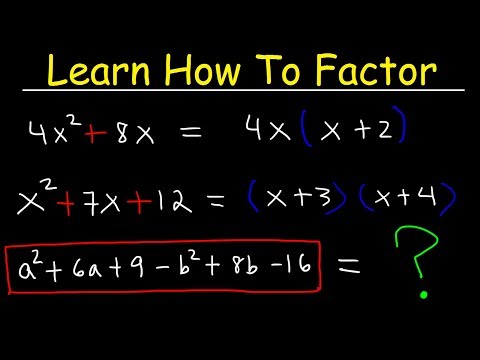
Factoring Trinomials & Polynomials, Basic Introduction - Algebra
Factoring Basics
Understanding the Greatest Common Factor (GCF)
- The video introduces factoring, specifically focusing on finding the greatest common factor (GCF). An example is given with the expression 3x + 15.
- It is established that both terms in the expression are divisible by 3, making 3 the GCF. The factored form is x + 5 after dividing each term by 3.
Additional Examples of Factoring
- Another example presented is 7x - 28, where both terms are divisible by 7. The result after factoring out the GCF is x - 4.
- Two more expressions are introduced: 4x² + 8x and 5x² - 15x³. For the first, GCF is determined to be 4x, leading to a simplified form of x + 2.
- In the second expression, GCF is found to be 5x²; thus, it simplifies to x² - 3x.
Factoring by Grouping
Introduction to Grouping Method
- The video transitions into factoring by grouping using a polynomial with four terms: x³ - 4x² + 3x -12.
- The first two terms yield a GCF of x², simplifying to x(x -4). For the last two terms, taking out a GCF of three results in an expression of (x -4).
Completing the Factoring Process
- Both parts lead to a common factor of (x -4), allowing for final simplification into (x -4)(x² +3).
Factoring Trinomials
Leading Coefficient Equals One
- The focus shifts to factoring trinomials where the leading coefficient equals one. An example provided is x² +7x +12.
- To factor this trinomial, numbers that multiply to give twelve and add up to seven are identified as three and four. Thus, it factors into (x +3)(x +4).
More Examples and Techniques
- A new trinomial example presented is x² +3x -20. Here negative seven and positive four satisfy multiplication and addition requirements for factoring.
- Another case involves x² -3x -10; factors identified as negative five and positive two lead to its factored form being (X –5)(X+2).
Final Example with GCF
Utilizing GCF Before Factoring
- A complex trinomial example given is 2X^2+20X+48. Recognizing a common factor of two allows for initial simplification before proceeding with standard factoring techniques.
Factoring Trinomials and Perfect Square Trinomials
Understanding Basic Factoring Techniques
- The process of factoring involves breaking down expressions like X + 4 and X + 6 into simpler components, such as (X + 4)(X + 6).
- When the leading coefficient is not equal to one, multiply it by the constant term (e.g., 2 times -3 = -6) to find two numbers that multiply to this product but add up to the middle coefficient.
- Factor by grouping: extract the greatest common factor (GCF) from pairs of terms. For example, from 2x^2 - 6x, take out 2x, resulting in 2x(X - 3).
Advanced Factoring Techniques
- In more complex cases, such as with coefficients like 15x^2 + x - 6, first calculate the product of the leading coefficient and constant term (15 times -6 = -90).
- Identify pairs of factors that yield both a product matching this value and a sum equating to the middle term's coefficient. For instance, factors of -90 that add up to 1.
Perfect Square Trinomials
- A perfect square trinomial follows the form a^2 + 2ab + b^2 = (a+b)^2. To verify if an expression fits this model, check if twice the product of its square roots equals the middle term.
- Example: For x^2 + 8x + 16, since sqrt16 = 4, we confirm it can be factored as (x+4)^2.
Using Equations for Verification
- If direct factoring seems challenging, use equations: Calculate square roots and ensure their products align with coefficients. This method confirms whether an expression is a perfect square trinomial.
Practical Examples
- Analyzing another example like 9x^2 + 30x + 25: Check if it's a perfect square trinomial by calculating roots; here it is confirmed as such because doubling yields correct results.
- Conversely, for expressions that do not fit neatly into perfect squares (like some others discussed), traditional factoring methods may require more steps but ultimately lead to valid solutions.
This structured approach provides clarity on how to tackle various types of trinomials through systematic techniques in algebraic factoring.
Factoring Techniques: Perfect Squares and Differences
Perfect Square Trinomials
- A perfect square trinomial can be factored using the formula derived from its square roots. For example, 9x^2 + 25 factors to (3x + 5)^2.
Difference of Squares
- The difference of squares follows the formula a^2 - b^2 = (a + b)(a - b). For instance, x^2 - 25 factors into (x + 5)(x - 5).
Example Problems
- When factoring expressions like x^2 - 36, identify the square roots: sqrtx^2 = x and sqrt36 = 6, leading to (x + 6)(x - 6).
- Another example involves 4x^2 - 9: factor it as (2x + 3)(2x - 3).
Handling Non-Perfect Squares
- If an expression like 3x^2 - 48 cannot be factored directly due to non-perfect squares, first extract the greatest common factor (GCF), which is 3. This simplifies it to a difference of squares.
Larger Examples and GCF Extraction
- In more complex cases such as 16X^4 - 81Y^8, apply GCF extraction and then use the difference of squares method for further simplification.
Factoring Sums and Differences of Cubes
Sum of Cubes Formula
- The sum of cubes can be factored using the formula: a^3 + b^3 = (a + b)(a^2 - ab + b^2).
Example with Sum of Cubes
- For example, in factoring X^3 + 8, recognize that this corresponds to (X + 2)(X^2 - 2X + 4).
Difference of Cubes Formula
- The difference of cubes uses a different formula: a^3 - b^3 = (a - b)(a^2 + ab + b^2).
Example with Difference of Cubes
- An example is factoring 8X^3 -27: identify cube roots leading to a final factorization result.
More Complex Examples
- In larger examples like 125X^6 -64Y^9, apply both cube root extraction and proper application of formulas for accurate results.
Factoring Sums and Differences of Cubes
Introduction to Factoring
- The speaker explains how to factor sums and differences of cubes, providing a foundational understanding for solving polynomial equations.
Example Problem: a^2 + 6a + 9 - (b^2 - 8b + 16)
- The first step involves factoring out a negative one from the second part of the expression, transforming it into a perfect square trinomial.
- The left side is identified as (a + 3)^2, while the right side becomes (b - 4)^2, leading to a difference of squares.
Applying the Difference of Squares Formula
- Using the formula a^2 - b^2 = (a + b)(a - b), the expression is factored further into two binomials.
- The final factors are presented as (a + b - 1)(a - b + 7).
Another Example: Quadratic Expressions
New Problem: 4x^2 + 20x + 25 - (9y^2 + 24y + 16)
- The speaker encourages viewers to pause and attempt this problem independently before revealing the solution.
Factoring Process
- After factoring out a negative one, both sides reveal perfect square trinomials.
- This leads to another application of the difference of squares formula, resulting in factors that combine terms effectively.
Solving Equations by Factoring
Introduction to Solving Equations
- The lesson transitions into solving equations through factoring, starting with an example equation 6x^2 - 30x = 0.
Finding Solutions
- By identifying the greatest common factor (GCF), solutions are derived using the zero product property.
Further Examples in Factoring
Additional Problems Explored
- A new example is introduced: 3x^2 - 27 = 0. Here, GCF extraction leads to recognizing a difference of squares.
Final Steps in Solving
- Each factor is set equal to zero, yielding solutions for x as -3 and 3.
Conclusion on Factorization Techniques
- Another trinomial example illustrates finding two numbers that multiply and add correctly for successful factoring.