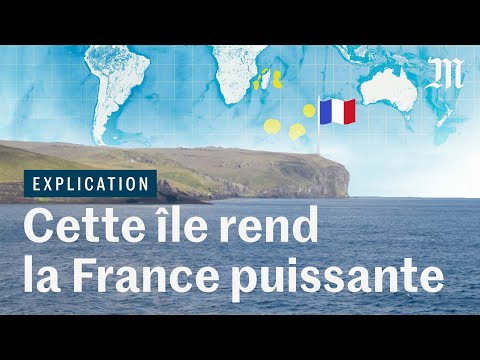
Pourquoi la France s’accroche à des ilots inhabités ?
Exploring the French Southern and Antarctic Lands
Introduction to the Location
- The speaker describes being on a remote piece of land, 12,700 kilometers from Paris and over 3,000 kilometers from any inhabited land. This area is part of France.
- Aboard the "Marion Dufresne," the only ship supplying these islands, the speaker notes the harsh climate with an average temperature of 5°C and winds exceeding 150 km/h. Only a few species like elephant seals and penguins thrive here.
Significance of French Presence
- The speaker questions why France maintains its presence in such an isolated territory despite challenging living conditions. They highlight extensive travel requirements including seven COVID tests and a lengthy quarantine period to reach these lands.
- The French Southern and Antarctic Lands (TAAF) are located between the Indian Ocean and Antarctica, comprising three distinct groups: Austral Islands, Adélie Land in Antarctica, and scattered islands near Madagascar known as Éparses Islands. These territories reflect France's colonial past.
Climate Variations
- There is a stark contrast between the tropical climate near Éparses Islands and the polar climate of Austral Islands; both environments present significant challenges for habitation but require continued French military and scientific presence.
Economic Implications
- According to the United Nations Convention on the Law of the Sea (1986), distinctions are made between uninhabitable rocks versus habitable islands which can claim exclusive rights over resources up to 370 kilometers offshore. This grants France substantial economic advantages in its exclusive economic zone (EEZ).
- France's EEZ around TAAF spans approximately 1.66 million square kilometers—three times larger than mainland France—making it second only to the U.S. in terms of size among global EEZs. However, fishing activities here contribute minimally to national income at about 10%.
Environmental Protection Efforts
- In February 2022, all areas within this EEZ were designated as a natural reserve—the largest UNESCO World Heritage site—where human activities are heavily regulated to protect ecosystems from environmental changes due to climate change studies.
- Despite conservation efforts, potential resource exploitation remains viable under certain conditions; sovereignty allows for environmental protection while also enabling sustainable economic activities in future scenarios beyond fishing resources alone.
Resource Exploration Challenges
- Recent focus has shifted towards marine resources beneath ocean floors; since expanding sovereignty claims in 2015/2020, France now holds one of the world's largest underwater domains rich in hydrocarbons near Éparses Islands—a point of contention with Madagascar over territorial claims.
- Geological data suggests possible deposits of rare earth elements like cobalt or nickel around Austral Islands; however, extraction poses high costs due to deep-sea mining challenges alongside significant ecological risks that could have catastrophic effects on marine life chains if not managed properly.
Political Dimensions
- The extension of protected reserves carries political weight as seen during international summits focused on ocean conservation goals; France recently surpassed its target by designating 33% of its territory as protected areas largely due to TAAF extensions—enhancing its diplomatic standing globally regarding Antarctic matters amidst rising geopolitical tensions involving Russia and China’s investments in polar infrastructure projects like new bases planned for construction despite treaty concerns from other nations involved in Antarctic governance discussions.