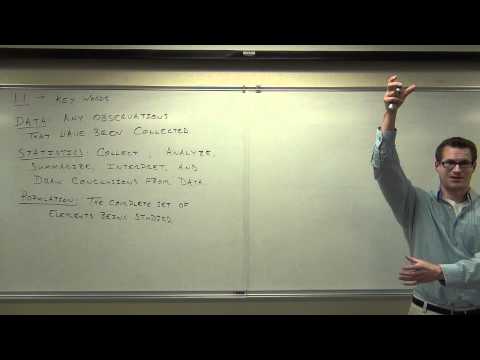
Statistics Lecture 1.1: The Key Words and Definitions For Elementary Statistics
Introduction to Statistics
In this section, the instructor introduces the topic of statistics and explains the importance of understanding key vocabulary.
Vocabulary in Statistics
- The instructor mentions that they will cover Section 1.1 quickly as it mainly focuses on vocabulary.
- Data is defined as observations or information collected, including both qualitative and quantitative data.
- The purpose of statistics is to collect, analyze, summarize, interpret, and draw conclusions from data.
- The instructor emphasizes that data is useless unless it can be used in decision-making processes.
- Population refers to the complete set of elements to be studied. It can vary depending on the context (e.g., population of a classroom, population of a city).
Importance of Data Analysis and Interpretation
- The instructor highlights the importance of analyzing and summarizing data.
- Interpreting data and drawing conclusions are crucial aspects of statistics.
- Understanding how to use data effectively in decision-making processes is essential.
The transcript provided does not contain enough content for additional sections.
Understanding Polls and Samples
In this section, the speaker discusses the concept of polls and samples in relation to presidential elections. They explain that polls are used to gather opinions from a subset of people, known as a sample, rather than asking everyone in the population. The importance of random sampling is emphasized to avoid bias.
Polls and Samples
- Polls are conducted during presidential elections to gather opinions about potential winners.
- These polls do not ask every person in America but instead rely on a sample of people.
- A sample is a smaller subset of the population, while the population refers to everyone.
- Statistics primarily deal with samples because populations are usually too large for timely analysis.
- A census is when information is collected from every member of the population.
Introduction to Data and Statistics
This section introduces key terms related to data and statistics. The speaker explains that data refers to information being collected, while statistics involves analyzing, summarizing, interpreting, and drawing conclusions from that data. The difference between populations, samples, and censuses is also discussed.
Key Terms
- Data refers to information being collected.
- Statistics involves analyzing, summarizing, interpreting, and drawing conclusions from data.
- Populations refer to the entire group being studied.
- Samples are subsets of populations used for statistical analysis.
- Censuses involve collecting information from every member of a population.
Importance of Random Sampling
This section emphasizes the importance of random sampling when conducting surveys or polls. The speaker explains that biased sampling, such as only asking friends for their opinions, can lead to inaccurate results and a lack of diverse perspectives.
Random Sampling
- Random sampling is crucial to avoid bias in survey results.
- Biased sampling, such as only asking friends with similar interests, can skew the data.
- To obtain an appropriate sample, it is important not to selectively choose participants who align with one's own views.
[t=0:11:42] Avoiding Bias in Surveys
This section discusses the potential bias that can arise when conducting surveys and polls. The speaker highlights the importance of obtaining a diverse range of perspectives by using random sampling methods.
Avoiding Bias
- Conducting surveys among people who are likely to have similar opinions can introduce bias.
- Obtaining a diverse range of perspectives requires random sampling methods.
- Biased surveys can influence people's decisions and distort poll results.
Timestamps may vary slightly depending on the video source.
Do People Vote for the Winner?
In this section, the speaker discusses whether people are more likely to vote for a candidate they perceive as a winner.
People's Perception of Winners
- People tend to take the idea of a candidate winning seriously.
- The perception that a candidate is likely to win may influence people's decision to vote for them.
- This phenomenon can potentially manipulate people's decisions and is not desirable in data collection.
Importance of Random Sampling
- When collecting data, it is crucial to ensure randomness in the sample selection process.
- Random sampling helps avoid bias and unexpected results.
- The speaker will discuss how random sampling is done later in the lecture.
Collecting Data Randomly
This section emphasizes the importance of collecting data randomly and introduces some related vocabulary words.
Collecting Data Randomly
- Data must be collected randomly to avoid bias.
- Biased data may lead to unforeseen consequences or outcomes.
Vocabulary Words
- The speaker will cover more details on how random sampling is done in Section 1.4.
- Types of data collected depend on whether they pertain to characteristics of populations or samples.
Characteristics of Populations and Samples
This section explains the distinction between parameters (characteristics of populations) and statistics (characteristics of samples).
Parameters vs. Statistics
- Parameters refer to characteristics of populations, such as all individuals within a population sharing a specific trait.
- Parameters are denoted by population parameter (PVP).
- Statistics refer to characteristics observed from samples, representing subsets of populations.
- Statistics are denoted by sample statistic (SS).
- Parameters and statistics can refer to the same characteristic, depending on the group being referred to.
- For example, if hair color data is collected for the entire population of America, it would be a parameter. If hair color data is collected from a sample, it would be a statistic.
Understanding Parameters and Statistics
This section further clarifies the distinction between parameters and statistics.
Parameters vs. Statistics
- Population parameters are characteristics of an entire population.
- Sample statistics are characteristics observed from samples.
- The class will primarily focus on sample statistics.
Data Terminology Recap
- Data refers to information collected.
- Populations represent entire groups.
- Samples are smaller groups within populations.
By following this structure, you can create a comprehensive and informative markdown file that summarizes the transcript in a clear and concise manner.
Turn any video into a summary like this
YouTube links, meetings, lectures — with transcripts, search, and chat.