CDFA CANPA explained for Airline Interviews
Continuous Descent Final Approach (CDFA) Explained
Introduction to CDFA
- The Continuous Descent Final Approach (CDFA) is a technique aligned with stabilized approach procedures for executing the final segment of a non-precision approach.
- CDFA allows for a continuous descent from an altitude at or above the Final Approach Fix (FAF) down to approximately 50 feet above the runway threshold.
Comparison with Non-CDFA Approaches
- In a typical non-CDFA approach, pilots level off at Minimum Descent Height (MDH), increasing workload and fuel consumption due to multiple level-off segments.
- For example, in a non-CDFA procedure, after reaching FAF, pilots descend until MDH, then level off until the Missed Approach Point (MAP).
Visualizing the Difference
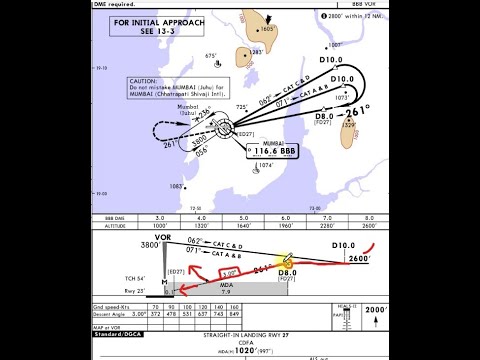
- A diagram illustrates that in a non-CDFA approach (blue line), there are multiple level-offs compared to the continuous descent depicted by the red line in CDFA.
- The CDFA method involves maintaining a constant descent angle from FAF directly to MDH without leveling off.
Execution of CDFA
- When executing a CDFA on charts like those for Mumbai V Runway 27, pilots maintain a continuous descent angle of 3° from their platform altitude of 2,600 feet.
- This smooth descent continues until touchdown unless visibility requires initiating a go-around.
Key Considerations for CDFA
- The CDFA is specifically designed for non-precision approaches where ILS signals are unavailable; it must be executed using stabilized approach techniques.
- Pilots must ensure landing gear and flaps are configured before descending on the final approach fix.
Safety Margins and Regulatory Requirements
- Regulatory authorities mandate adding an additional safety margin of 50 feet to minimum altitudes during CDFA approaches.
Understanding CDFA Approach Procedures
Regulatory Requirements for Altitude
- A minimum altitude increment of 50 ft above the published Minimum Descent Altitude (MDA) is prescribed to determine when to initiate the approach, ensuring safety by preventing descent below MDA or Minimum Decision Height (MDH).
- This requirement is specific to India and regulated by the Directorate General of Civil Aviation (DGCA), which oversees aviation standards in the country.
Aircraft Configuration and Approach Execution
- The speaker is piloting an Airbus A320, positioned 10.4 miles from Mumbai's runway (Bravo Bravo Bravo), fully configured for landing with flaps extended and landing gear down.
- As part of the approach procedure, a continuous descent will commence at 8 miles from the Final Approach Fix (FAF).
Descent Procedure Monitoring
- Upon reaching 8 miles from FAF, a Constant Descent Final Approach (CDFA) technique is initiated with a selected final descent angle of -3° for Mumbai's runway.
- The aircraft begins its descent from an altitude of 2600 ft as it approaches the FAF, continuously monitored against Jeppesen charts.
Cross-checking Altitudes During Descent
- At 7 miles out, an altitude cross-check confirms that at approximately 2300 ft, it aligns with expected values on the chart.
- Continuing to monitor altitudes, at 6 miles out, the aircraft descends to 1960 ft while remaining on profile.
Decision Making at Minimum Altitude
- The decision altitude has been set at 1070 ft (1020 + 50 ft); if the runway isn't visible by this point, a go-around would be necessary.