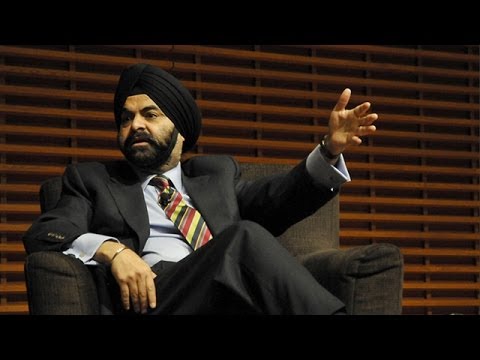
MasterCard CEO Ajay Banga on Taking Risks in Your Life and Career
Interview Introduction
The interviewer introduces the conversation roadmap, starting with the guest's career trajectory and moving on to global perspectives and personal aspects like work-life balance.
Career Trajectory
- Nestle, Pepsi-Co, Citi, and now MasterCard are key points in the guest's 30-year career journey.
- The transition from Citi to MasterCard allowed for a global perspective development.
Choosing Nestle as First Job
- Graduating during India's opening up to multinationals led to Nestle being an attractive learning place due to its business culture and high-quality products.
- The competitive nature of job applications at Nestle highlighted its appeal for learning opportunities.
Learning Experience at Nestle
Reflecting on the valuable lessons learned during a 13-year tenure at Nestle that laid the foundation for future success.
Learning Opportunities at Nestle
- Multinational corporations like Nestle provided a platform for learning business intricacies, company culture, product quality, and ethical work practices.
- Rotation across different company departments facilitated broad knowledge acquisition.
Key Lessons from Barry Rhine
- Barry Rhine's impactful leadership emphasized never accepting no for an answer and the importance of individual contribution through energy, passion, and effective communication.
- Emphasizing the significance of people over companies in driving success.
Enduring Lessons from Early Career
Reflecting on how early experiences at Nestle shaped crucial skills and mindsets that continue to influence career growth.
Impactful Insights
- Early exposure to diverse roles within a company fostered comprehensive knowledge acquisition and geographical exploration within India.
- Individual mentorship played a pivotal role in instilling perseverance and belief in making a difference through determination.
Career Transitions and Decision Making
The speaker reflects on his career transitions from Nestle to Pepsi Co, Citi, and MasterCard, emphasizing the importance of learning from everyone and making timely moves to avoid stagnation.
Career Growth and Learning
- Reflects on starting as a sales rep to becoming a leader in various companies.
- Emphasizes the value of learning from everyone rather than resenting younger colleagues.
- Stresses the significance of continuous learning from diverse sources for personal growth.
Timing in Career Moves
- Discusses leaving companies when feeling stagnant or ready for new challenges.
- Mentions joining Pepsi Co due to organizational changes and seeking global exposure.
Strategic Career Transitions
The speaker elaborates on his varied roles at Nestle and Citi, highlighting the decision-making process behind transitioning to different companies like Pepsi Co and MasterCard.
Varied Roles in Companies
- Details diverse roles held at Nestle and Citi before transitioning to other organizations.
- Describes moving through different positions based on feeling capable of contributing more elsewhere.
Transition to MasterCard
- Explains the shift from Citi to MasterCard post-financial crisis for new challenges.
- Justifies choosing MasterCard over staying at Citi due to industry trends favoring innovation.
Leadership Dynamics and Organizational Impact
The speaker contrasts the impact of leading large teams at Citibank with smaller teams at MasterCard, emphasizing the ability to drive change effectively in smaller settings.
Leading Large vs. Small Teams
- Compares leading 200,000 employees at Citibank with a smaller team size at MasterCard for greater influence.
- Illustrates how smaller teams allow for more direct impact on individuals compared to larger organizations.
Business Strategy and Success Metrics
The speaker discusses business strategy execution, stock market performance correlation with millennials' involvement, and factors contributing to stock value growth.
Business Strategy Execution
- Emphasizes executing clear strategies consistently for stock market success over time.
Stock Performance & Millennials' Involvement
- Highlights correlation between stock value increase and involving millennials in company operations.
Interview with MasterCard CEO on Success and Global Economy
In this interview, the CEO of MasterCard discusses personal traits contributing to success, the importance of humility, taking risks in career and life, and the exciting aspects of the global economy.
Personal Traits for Success
- Humility is crucial for success as it enables learning from others and adapting to progress.
- Observing figures like Barry Rhine and Sandy Rime taught the significance of treating all individuals with equal interest and purpose.
Taking Risks in Career and Life
- Success is enhanced by being willing to take risks in both career choices and personal life.
- Taking risks extends beyond changing jobs to encompass lifestyle choices such as moving frequently.
Development of Traits
- The CEO believes that traits like humility and risk-taking are not innate but acquired through experiences, values, and continuous learning.
- Emphasizes that individuals can evolve over time by picking up traits along their journey.
Insights on Global Economy
The discussion shifts towards insights on the global economy focusing on innovation in the United States post-financial crisis and emerging opportunities in South East Asia.
Innovation in the United States
- Despite challenges post-financial crisis, the U.S. remains a hub for innovation with strong balance sheets across sectors.
- Companies like Apple showcase high levels of productivity and cash reserves, making the U.S. an exciting economic landscape for future growth.
Emerging Opportunities in South East Asia
Asian Economic Growth Potential
The discussion focuses on the potential growth in the Asian economic community and the opportunities it presents for development and investment.
Asian Economic Community Expansion
- Asia is projected to drive significant global growth in the next five to eight years, with countries like Laos, Cambodia, Vietnam, Singapore, Malaysia, Philippines, and Thailand coming together to form a $3 trillion economy with 600 billion people.
- Infrastructure investments of $500 billion are planned over the next five years to enhance connectivity through rail links and bridges across nations like China and various Asian countries.
Career Decisions for MBA Graduates
- MBA students often face dilemmas post-graduation regarding whether to return to their home country or pursue opportunities in regions like the U.S., considering factors such as personal aspirations and career goals.
- Personal considerations play a crucial role in deciding whether to establish a business in one's home country where unique advantages may exist or explore opportunities in countries like the U.S. based on individual capabilities and ambitions.
Global Business Environment Comparison
A comparison between establishing businesses in India versus the U.S. is discussed, highlighting challenges related to infrastructure, bureaucracy, and business environment differences.
Establishing Businesses: India vs. U.S.
- While returning to India may offer standout opportunities due to lesser competition compared to the U.S., challenges such as infrastructural issues, bureaucratic hurdles, power availability constraints, and permit complexities can pose obstacles for business operations.
- The conducive environment of the U.S. provides greater scope for expansion and growth on a global scale due to factors like ease of doing business, infrastructure support, and market openness compared to regions with more bureaucratic challenges.
Financial Inclusion Imperative
The importance of financial inclusion globally is emphasized as a means of empowering individuals without access to basic banking services while addressing disparities between developed and developing nations.
Financial Inclusion Impact
- Approximately 2.5 billion individuals lack fundamental banking services worldwide; enhancing financial inclusion not only fosters economic empowerment but also contributes towards reducing inequalities by providing access to essential financial tools.
Cash and Society
In this section, the speaker discusses the role of cash in society, focusing on the impact of cash usage by the wealthy and the potential for growth in transitioning to a cashless society.
The Misconception of Cash Usage
- The rich often use cash to suit their needs and avoid paying correct taxes.
- Emphasizes the vision of moving towards a world beyond cash.
Addressing Cash Challenges
- Examples from Nigeria and South Africa highlight efforts to reduce theft in social programs through biometric identification.
- Discusses combating theft in government transactions through technology, data, and differentiated products.
Challenges of Cash Handling
This segment delves into the challenges associated with handling cash, including costs, inefficiencies, and opportunities for innovation.
Competing with Technology
- Emphasizes competition through technology investment and consumer-focused analytics.
Collaboration for Financial Inclusion
- Acknowledges collaboration with competitors to drive financial inclusion initiatives for the unbanked population.
Costs Associated with Cash Usage
Here, the speaker explores hidden costs related to cash usage, such as printing expenses, security measures, tax evasion implications, and societal impacts.
Hidden Costs of Cash
- Highlights that cash production costs can amount to a significant percentage of a country's GDP.
Societal Implications
- Discusses tax evasion facilitated by cash usage and its impact on economies worldwide.
Innovation at MasterCard
This part focuses on fostering innovation within MasterCard through dedicated initiatives like MasterCard Labs to drive technological advancements.
Innovation Initiatives
- Establishment of MasterCard Labs in various global locations to promote innovation flow into company operations.
Ensuring Innovation Continuity
Interview Insights
In this section, the speaker discusses project management and decision-making processes within a company.
Project Management and Decision-Making
- The speaker emphasizes that detailed spreadsheets are unnecessary for projects. Instead, he delegates the task to others, providing them with autonomy in decision-making.
- Decisions are made based on commercial viability rather than micromanagement. The speaker trusts his team to select two commercially viable products after two years.
- Empowering employees is crucial; the speaker mentions firing and rehiring as a strategy to ensure productivity and innovation.
Innovation and Culture
This part delves into fostering innovation through culture and risk-taking.
Fostering Innovation
- Encouraging risk-taking is essential for innovation; failure is accepted as part of the learning process.
- Building a culture that supports experimentation and new ideas is more critical than just providing financial resources.
Work-Life Balance
The discussion shifts towards work-life balance and personal reflections on balancing career demands.
Work-Life Balance Perspectives
- Work-life balance is a personal matter; individuals perceive balance differently based on their preferences and commitments.
- Enjoying what you do is fundamental for achieving work-life balance; passion drives commitment even during extensive travel schedules.
Balancing Personal Life
Insights into managing personal time amidst professional commitments.
Managing Personal Time
- Balancing work commitments with personal life involves dedicating quality time to loved ones without distractions like technology devices.
Comfort in Your Own Skin
In this segment, the speaker emphasizes the importance of self-confidence and being comfortable in one's own skin, rather than worrying about others' perceptions.
Embracing Confidence
- Encourages individuals to be comfortable in their skin and have confidence in themselves.
- Shares a humorous incident where his photograph was displayed on every table, highlighting the value of using unique traits as conversation starters.
- Discusses how personal conversations about his appearance led to meaningful friendships, emphasizing the significance of authenticity in building relationships.
Navigating Challenges
The speaker reflects on facing adversity post-9/11 and navigating through difficult situations with resilience and support from caring individuals.
Resilience Amid Adversity
- Recounts experiences of verbal abuse post-9/11 but highlights that a majority of people are supportive, underscoring the importance of inner strength.
- Shares an anecdote about being frequently checked at TSA, showcasing acceptance and perseverance in challenging circumstances.
Leadership and Support
The speaker discusses leadership qualities demonstrated by a superior during tough times and the impact of genuine care from colleagues.
Leadership and Supportive Environment
- Describes how a senior leader provided practical support during challenging times, emphasizing the value of empathy and assistance.
- Highlights the significance of dealing with challenges openly rather than avoiding them, noting that supportive colleagues can make a substantial difference.
Empathy and Sensitivity
The speaker underscores the importance of empathy and sensitivity in human interactions while addressing questions from classmates.
Importance of Empathy
- Stresses that most people are sensitive and caring, cautioning against negative influences.
Business Perspectives
The discussion shifts towards business-related queries regarding competition and partnerships within the industry.
Business Insights
- Responding humorously to competition concerns, highlighting collaborative opportunities with various companies for mutual growth.
Global Business Approach
Exploring lessons learned from diverse experiences shaping business perspectives for global ventures.
Learning from Diverse Experiences
Plan B, Plan C, and Plan D
In this segment, the speaker emphasizes the importance of having contingency plans in a rapidly changing environment to navigate opportunities and risks effectively.
Importance of Contingency Planning
- Having backup plans like Plan B, Plan C, and Plan D is crucial for adapting to fast-paced environments.
- Reflecting on experiences in India where diversity was taken for granted, highlighting the need for preparedness in different scenarios.
- Expressing resentment towards being labeled solely based on appearance and emphasizing the value of true diversity beyond checkboxes.
- Defining diversity as surrounding oneself with individuals who think differently, stressing the significance of varied perspectives and backgrounds.
- Acknowledging a newfound appreciation for diversity and actively seeking out diverse perspectives to enhance personal growth.
Perception vs. Reality: Mastercard's Role
The discussion shifts towards addressing misconceptions about Mastercard's role in the financial industry and efforts to change public perception.
Misconceptions About Mastercard
- Addressing misperceptions about Mastercard being solely a credit card company when it functions as a technology infrastructure for electronic payments.
- Clarifying that Mastercard does not have access to personal data but operates through anonymized transaction information.
- Highlighting misconceptions stemming from past ownership by banks despite evolving into a technology-driven company with diversified ownership.
- Emphasizing efforts to reshape public perception through actions and communication strategies focused on showcasing technological innovation and social impact initiatives.
- Revealing the establishment of a foundation with stock proceeds to support charitable causes, aiming to demonstrate corporate responsibility beyond profit-making.