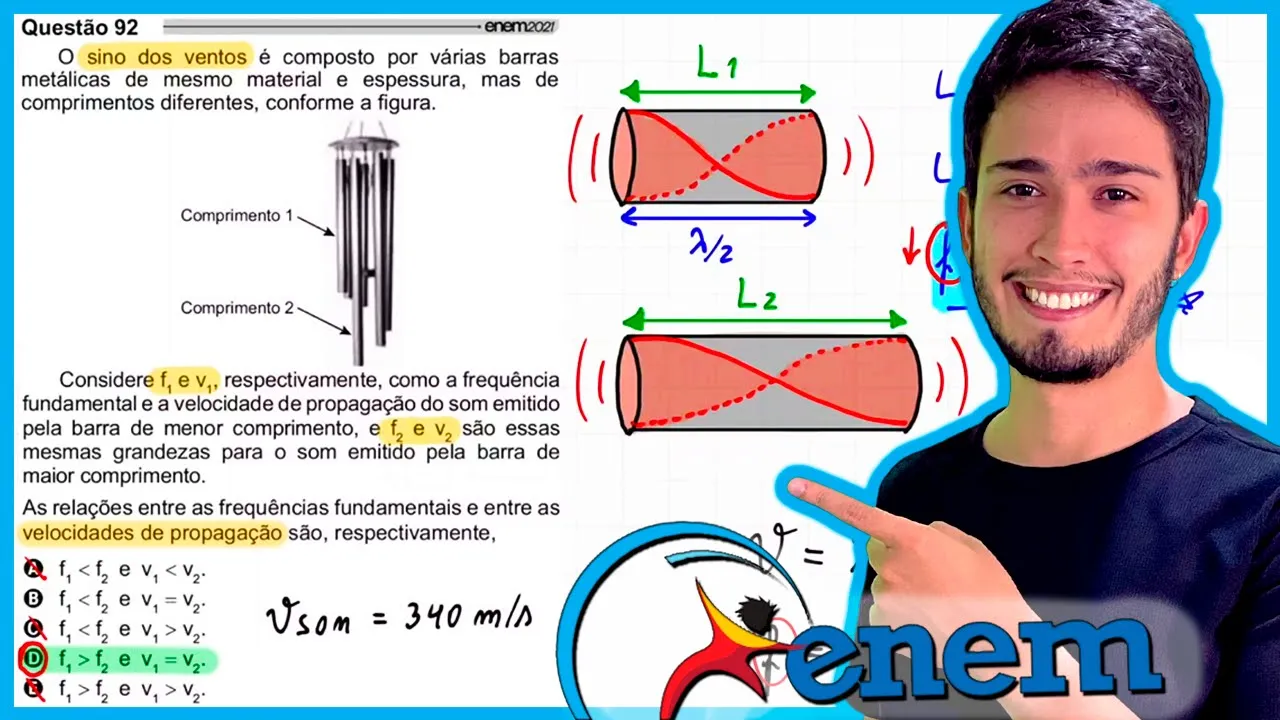
ENEM 2021 - O sino dos ventos é composto por várias barras metálicas de mesmo material e espessura,
Physics Problem Solving: Wind Chimes Frequency and Sound Velocity
In this physics problem-solving session, Professor Thales tackles question 92 from the 2021 blue notebook. The problem involves wind chimes, specifically focusing on the frequency and speed of sound emitted by different lengths of tubes.
Understanding Sound Production in Wind Chimes
- The velocity of sound produced by different tubes is the same as it depends on the medium through which sound propagates, which in this case is air.
- The speed of sound in air is typically 340 meters per second, leading to the elimination of certain answer choices based on this constant value.
Analysis of Sound Waves in Open Tubes
- Open tubes like those in wind chimes create standing waves with nodes (points of destructive interference) at their centers and antinodes (points of maximum amplitude) at their ends.
- Visualizing these waves helps understand harmonics or modes of vibration, with each harmonic having a corresponding frequency related to tube length.
Determining Frequencies and Harmonics
- The first harmonic (fundamental mode) emits the most intense sound and determines the overall pitch. Longer tubes produce lower frequencies (graver sounds), while shorter tubes produce higher frequencies (shriller sounds).
- By analyzing wavelengths within the tube length, one can determine how frequency relates inversely to tube length, following the fundamental equation for wave frequency.
Mathematical Analysis for Frequency Calculation
- In the first harmonic, half a wavelength fits within the tube length, providing a basis for calculating frequencies using wave properties.
- Altering parameters allows for determining frequencies beyond the fundamental mode by adjusting wavelength multiples within tube lengths.