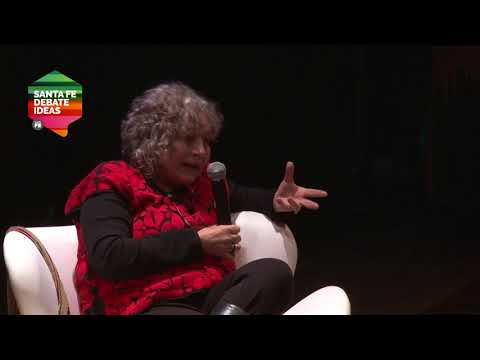
Rita Segato / Eva Illouz - El impacto del capitalismo en la vida del siglo XXI
Impact of Capitalism on Women's Lives in the 21st Century
Introduction and Context
- The speaker expresses gratitude to the government of Santa Fe for the opportunity to participate in a discussion that is often absent from political agendas, emphasizing the urgency of diversifying voices in important debates.
- The focus is on deepening discussions about urgent issues, particularly regarding women's situations in Argentina and globally, highlighting existing inequalities and violence against women.
Key Themes Addressed
- The discussion centers around capitalism's impact on women's lives, noting significant asymmetries and forms of violence faced by women in Argentina and beyond.
- Two prominent intellectuals will contribute insights into these urgent topics, challenging simplistic responses with informed sociological and anthropological perspectives.
Paradoxes in Women's Situations
- A paradox exists where increasing violence against women coexists with a strong civil society movement advocating for women's rights, such as "Ni Una Menos," which aims to elevate women's issues within social agendas.
- This movement is seen as having potential positive effects on societal attitudes towards women’s issues moving forward.
Format of Discussion
- The format includes presentations from Rita Segato followed by Eba Luz, each lasting approximately 20 minutes. There will be time allocated for dialogue among them and audience questions afterward.
Speaker Introductions
- Rita Segato is introduced as an expert in anthropology focusing on gender issues within indigenous communities. Her work addresses power dynamics between genders.
- Eba Luz is noted for her research on emotional life history and critical theory applied to art and popular culture, exploring capitalism's cultural impacts.
Rita Segato's Insights on Patriarchy
Addressing Violence Against Women
- Segato emphasizes the importance of bringing discussions about patriarchy from the margins to the center, advocating against minimizing violence against women.
- She describes current levels of violence as unprecedented, indicating a rise in physical, moral, and sexual violence against women that has become more visible through media coverage.
Understanding Violence Trends
- Segato notes that while violence has always existed, recent trends indicate a new level of regularity and frequency that she terms a "pedagogy of cruelty."
Understanding the Normalization of Cruelty
The Process of Historical Normalization
- Discussion on how society is becoming desensitized to cruelty, leading to a perception that such behaviors are natural.
- Examination of specific instances of cruelty in Latin America, including violence against women and the impact of drug cartels.
Societal Control and Media Influence
- Analysis of the role of media in shaping societal perceptions and normalizing violence as part of daily life.
- Emphasis on the importance of language and vocabulary in reflecting societal realities; words serve as tools for self-reflection.
The Role of Media in Perpetuating Violence
- Critique of Argentine television's portrayal of violence, described as barbaric and detrimental to public intelligence.
- Reference to actor Gérard Depardieu’s comments on Argentine television, reinforcing the idea that it contributes negatively to cultural discourse.
The Impact on Public Consciousness
- Discussion about how media representation leads audiences to identify with perpetrators rather than victims, creating a false consciousness.
- Exploration of how this misrepresentation fosters insensitivity within society towards acts of violence.
Pedagogy of Cruelty
- Introduction to the concept that exposure to cruelty diminishes empathy among individuals, making them less capable of understanding others' suffering.
- Call for new methods or legal frameworks to combat this normalization and protect societal sensitivity.
The Intersectionality Between Sexuality and Violence
Understanding Sexuality Beyond Intimacy
- Argument that sexual access is often misconstrued as inherently damaging; calls for a reevaluation within societal contexts.
Case Studies Highlighting Societal Issues
- Mentioning specific cases (e.g., Micaela, Lucía), illustrating how violent acts are increasingly public spectacles rather than private crimes.
Broader Implications for Society
Analysis of Masculinity and Institutional Failures
The Spectacle of Impunity in Ciudad Juárez
- The speaker discusses the issue of impunity in Ciudad Juárez, emphasizing that it is not just a problem but a spectacle that highlights institutional failures.
Critique of Masculinity Mandates
- There has been significant questioning regarding the concept of masculinity as a mandate of power and its role within patriarchal structures, which are foundational to various forms of oppression.
Gender-Based Violence and Victimhood
- The speaker argues that men are often the first victims of masculinity mandates, which strip them of happiness and emotional connection. This perspective challenges traditional views on gender-based violence.
Cruelty as a Learned Behavior
- The discussion includes how societal expectations lead men to embrace cruelty and insensitivity, diminishing their empathy towards others' suffering. This is linked to the normalization found in spaces like brothels.
Economic Inequality and Power Dynamics
Understanding Gender Violence and Societal Control
The Duality of Power and Gender Violence
- Discussion on the ownership dynamics in countries, highlighting how powerful entities exert control over territories, leading to gender-based violence.
- Reference to Lucía, a symbol of societal loss, illustrating how men’s adherence to masculinity mandates results in violence against women.
The Nature of Conflict in Colombia
- Examination of the unique nature of conflict in Colombia, emphasizing that it cannot be resolved through traditional agreements like those with FARC.
- Description of violent tactics used by corporations to expropriate land from local populations under the guise of development projects.
Masculinity and Cruelty
- Proposal that dismantling the mandate of masculinity could be a solution to ongoing violence; this mandate often leads to cruelty.
- Observations on men seeking dignity without conforming to harmful masculine norms.
Importance of Truth and Dialogue
- Acknowledgment of the significance of public discourse and truth-seeking initiatives during challenging times.
Cultural Reflections: Disney's Influence
The Impact of Disney's "Beauty and the Beast"
- Introduction to Disney's "Beauty and the Beast," noting its massive viewership upon release as indicative of cultural resonance.
Cultural Narratives and Political Context
- Analysis on how fairy tales reflect deeper societal issues, linking them back to contemporary political figures like Donald Trump.
Women's Choices in Politics
- Exploration into why women supported Trump despite his derogatory remarks about them; suggests complex motivations tied to economic independence.
Racial Dynamics in Voting Behavior
Exploring the Themes of "Beauty and the Beast"
The Cultural Significance of Timeless Stories
- The popularity of stories like "Beauty and the Beast" suggests they encapsulate fundamental social experiences, reflecting and abstracting human emotions over centuries.
- "Beauty and the Beast" is not an ideological story; it draws from a tale written in the 18th century, utilizing themes that resonate from ancient times to today.
Historical Context and Adaptations
- The modern version of "Beauty and the Beast," penned by a French woman in 1740, incorporates elements from ancient myths such as Eros and Psyche, highlighting its deep-rooted cultural connections.
- The narrative also finds inspiration in an Italian tale called "The King Pig," which illustrates moral lessons through the transformation of characters based on their behavior towards others.
Plot Overview and Character Dynamics
- In "Beauty and the Beast," a father brings gifts to his three daughters; when he picks a rose for his youngest, he faces dire consequences from a beast who demands one daughter take his place.
- Belle, the youngest daughter, willingly sacrifices herself for her father's safety. Her journey into captivity leads her to develop feelings for the beast despite initial fear.
Transformation Through Love
- Belle's love ultimately breaks the curse on the beast, transforming him back into a prince. This resolution symbolizes overcoming fears associated with male dominance in relationships.
Gender Dynamics and Power Structures
- The story addresses fundamental anxieties women face regarding male power dynamics while presenting fantasies of overcoming these challenges within heterosexual relationships.
- Heterosexual relationships are characterized by significant power imbalances where men typically hold political, economic authority, shaping societal norms around masculinity and femininity.
Understanding Power Dynamics in Heterosexual Relationships
The Nature of Heterosexual Relationships
- The discussion highlights the inherent power asymmetries in heterosexual relationships, where men and women struggle to overcome these differences without fully recognizing them.
- Examples from romantic fiction, such as "Beauty and the Beast," illustrate how these narratives often obscure the true nature of male-female dynamics, portraying cold and cruel male characters who eventually become loving partners.
Literary Examples of Male Characters
- The analysis includes various literary examples like "Pride and Prejudice" and "Jane Eyre," where male figures are depicted as distant or cruel, causing anxiety for female protagonists.
- In popular works like "Fifty Shades of Grey," the male lead is portrayed as sadistic but ultimately transforms into a devoted lover, mirroring themes found in other romantic stories.
Transformation Through Love
- Both narratives suggest that love can transcend initial cruelty and unattractiveness, leading women to forget their initial fears about controlling men.
- The character Belle sacrifices herself for her father, challenging traditional gender roles by ultimately saving the beast through her tears rather than being saved by a prince.
Gender Roles and Sacrifice
- These stories reinforce patriarchal messages that women must learn to love flawed men while sacrificing their own needs; unconditional love is portrayed as essential for overcoming male cruelty.
- Women are expected to maintain beauty while accepting men's flaws; this dynamic places responsibility on women to redeem their partners from perceived monstrosity.
Historical Context of Female Virtue
- Historical perspectives reveal that women's suffering at the hands of men has been normalized; societal expectations dictate that women endure cruelty as part of their virtue.
- In tales like "Beauty and the Beast," virtuous female characters sacrifice themselves for selfish males, reinforcing harmful stereotypes about female selflessness.
Economic Dependency and Power Negotiation
- The narrative suggests that women's lack of economic power forces them into negotiating their sexuality for security within patriarchal structures.
- Wealthy male characters provide material comforts to female leads, highlighting how economic dependency complicates romantic relationships.
Confusion Surrounding Love
- Women's experiences with love are often fraught with confusion due to underlying power struggles; love becomes a means for seeking equality amidst inequality.
Cultural Narratives of Love and Power
The Confusion in Heterosexual Love
- The blending of care and captivity, love and power, self-sacrifice and submission creates a confusing narrative within heterosexual love.
- This confusion is rooted in inequality, often masked by the promise of love, as seen in stories like "Beauty and the Beast."
- The portrayal of cruelty as something that can hide a beautiful soul reflects societal acceptance of toxic masculinity.
Resistance Against Modern Beasts
- Many women protested against modern manifestations of patriarchal power on January 21, 2017, seeking to confront this 'beast' openly.
- There is a call for Hollywood to create successful narratives about love between equals rather than traditional prince-princess dynamics.
Masculinity vs. Femininity
- Discussions around masculinity have been prevalent; however, there is a need to explore femininity's representation amidst care attributes and independence mandates.
- The tension between emotional care (feminine traits) and assertiveness (independence) raises questions about how these elements coexist today.
Changing Historical Narratives
- Feminism has historically sought to change affective relationships but struggles with altering deep-seated cultural norms surrounding femininity.
- Efforts to shift affection through formal declarations often backfire; changing societal structures requires more than just policy changes.
Institutional Challenges
- Patriarchal structures remain entrenched within state institutions, complicating efforts toward equality and freedom.
- Feminists argue that until historical narratives are shifted away from patriarchal frameworks, true progress will be elusive.
Reclaiming Women's Political Agency
- There’s an urgent need for women to reclaim their political agency lost during the transition into colonial modernity.
- New forms of politicization must emerge outside bureaucratic language to address issues related to both masculinity and femininity effectively.
Integrating Care with Feminism
- The relationship between care roles in feminism remains complex; there are no straightforward solutions or recipes for integration.
Understanding Gender and Race in Society
The Complexity of Brain Structure
- The discussion begins with the observation that brain scans do not reveal clear distinctions between male and female brains, suggesting they are mosaics of diverse elements. Only extreme cases can be classified as distinctly masculine or feminine.
Feminism Beyond Binary Definitions
- The speaker emphasizes the importance of relating to one another as human beings rather than through a binary lens of gender, advocating for a more inclusive perspective similar to past racial struggles.
Historical Context of Racial Perceptions
- A historical analogy is drawn where some white individuals viewed black people as lesser humans, paralleling current gender discussions. This highlights the need to move beyond binary categorizations in understanding humanity.
Moving Towards Humanity
- The speaker suggests that humanity's next step involves transcending binary analyses and recognizing everyone as human beings. This includes reclaiming political agency outside traditional state structures.
Addressing Systemic Issues
- Questions arise about where to begin addressing systemic issues like violence and inequality—whether within families or broader societal structures—and how to effectively challenge these norms.
Racism and Gender Inequality
- The speaker reflects on Brazil's struggle for affirmative action for black students, noting that while race may be socially constructed, it has real implications for people's lives akin to gender constructs.
Social Representation and Policy Making
- There is a call for careful naming practices in policy-making that acknowledge social realities without reinforcing existing inequalities. Naming issues like race is essential for creating effective public policies.
Nature vs. Patriarchy
- The discussion shifts towards the idea that nature exhibits more democratic traits than human society, challenging patriarchal views by highlighting examples from the animal kingdom where roles are not strictly defined by gender.
Political Implications of Gender Constructs
- It’s noted that while gender may be seen as a social fiction, its implications are deeply rooted in historical power dynamics, particularly within politics which have predominantly been male-dominated spaces.
Challenging Patriarchal Structures
Understanding Masculinity and Family Dynamics
The Role of Skin Color and Genitalia in Identity
- The speaker emphasizes that skin color is an obvious marker of difference, but genitalia also plays a significant role in defining identity and capabilities.
- There is a call to shift perspectives on these differences, suggesting that societal change must begin with those in power.
Transforming Masculinity for Social Change
- A key argument is that transforming the concept of masculinity is crucial for societal change, as it affects both men and women negatively within patriarchal structures.
- The speaker highlights alarming statistics regarding men's issues such as drug abuse, suicide, and educational dropout rates, indicating a need for change.
- Emphasizing shared responsibility, the speaker argues that caregiving should not solely fall on women; instead, men must also engage in family care.
Family Structure and Its Evolution
- Discussion shifts to family dynamics, questioning how traditional family structures have remained relatively unchanged despite broader gender transformations.
- The speaker reflects on historical changes in domestic spaces and their impact on women's vulnerability within nuclear families.
Community vs. Private Spaces
- There's a critique of the privatization of domestic spaces which increases violence against women; community-oriented living may offer solutions.
- Observations from indigenous communities suggest that non-nuclear family structures can provide safety and support compared to privatized homes.
Changing Definitions of Family
- Over the past 50 years, family definitions have evolved significantly due to factors like divorce rates and blended families.
- The emergence of same-sex families challenges traditional notions while single-person households are becoming more common globally.
Implications for Society's Future
- Advances in reproductive technology allow women to have children independently from men, altering familial roles dramatically.
- New forms of familial bonds based on affection rather than biology are emerging as central to modern society's structure.
Conclusion: Families as Central Units in Civilization
- Families historically served political functions; understanding gender relations within them is vital for societal progress.
Feminism and Its Evolving Landscape
The Inclusion of Diverse Feminist Perspectives
- The feminist movement is increasingly embracing various forms of activism related to gender issues, leading to discussions within traditional feminist circles about these new approaches.
- There is a growing awareness that the struggle for gender equality occurs both within state structures and in broader societal contexts, emphasizing the need for mechanisms beyond just legal frameworks.
Challenges with State-Centric Approaches
- While institutional reforms and laws are crucial, they have not fully addressed the underlying issues faced by women in society; there is a call to focus on everyday life transformations.
- Recent debates in Argentina highlight concerns over using women's suffering from femicides as justification for harsher punitive measures rather than addressing root causes of violence against women.
Limitations of Legal Systems
- Despite the existence of laws and sentences, many crimes against life—including those affecting women—remain underreported or inadequately prosecuted across Latin America.
- In Mexico, less than 1% of crimes result in convictions, indicating systemic failures in delivering justice for victims.
The Symbolic Role of Law
- The effectiveness of law often lies more in its symbolic power rather than its material impact; it shapes societal norms but does not always translate into tangible justice.
- Punitive measures signal which crimes deserve punishment but fail to address the pervasive nature of gender-based violence that exists outside legal definitions.
Gendered Violence and Societal Norms
- Many forms of aggression against women are part of daily life and cannot be easily categorized legally; this creates an environment where women's morality is constantly scrutinized.
- Women live with their moral integrity questioned daily while men do not face similar scrutiny, highlighting systemic gender biases ingrained in society.
Debates Within Feminism: A Historical Overview
Divergent Feminist Ideologies
- Over the past 30 years, feminism has been characterized by multiple debates rather than a singular ideology or strategy; key discussions include economic inequality versus sexual politics.
- Debates around defining womanhood have led to differing views on whether there is an essential female identity worth defending or if such notions are socially constructed.
Sexuality and Feminism
- Discussions regarding sexual liberation reveal contrasting beliefs: some feminists argue that sexual objectification harms women while others believe increased sexual freedom equates to greater equality with men.
Evolution of Legal Frameworks
Debate on Transgender Issues and Feminism
The Significance of Gender Identity
- The discussion highlights the emergence of multiple sexual identities, with individuals advocating strongly for their chosen gender. This reflects a significant cultural shift in contemporary society.
Challenges Facing Feminism in Europe
- A critical challenge identified is the intersection of religion and feminism, particularly regarding cultural differences. This creates tension between respecting cultural diversity and the feminist demand for equality between men and women.
Historical Context of Feminist Challenges