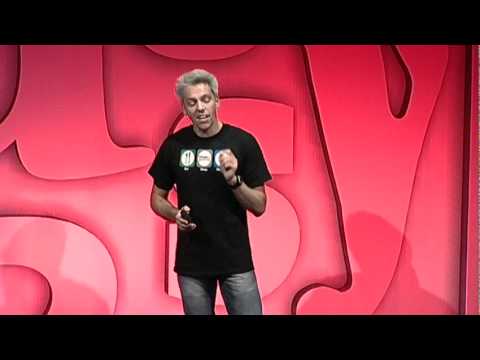
Dan Cobley: What physics taught me about marketing
Understanding the Intersection of Physics and Marketing
Introduction to the Speaker's Background
- The speaker expresses a passion for physics, initially inspired by a school teacher.
- They currently work in marketing and aim to connect principles of physics with marketing strategies.
Newton's Law and Brand Positioning
- Introduces Newton's Law: "The force equals mass times acceleration," relating it to brand positioning.
- Larger brands (greater mass) require more force to change their direction or positioning, similar to physical objects.
- Examples include Arthur Andersen launching Accenture instead of rebranding itself, and why companies like Unilever keep brands separate.
Heisenberg's Uncertainty Principle in Consumer Behavior
- Discusses Heisenberg’s principle: measuring a particle changes its state, paralleling consumer behavior observation in marketing.
- Observing consumers can alter their behavior; examples include focus groups and shopping habits that differ from actual purchasing patterns.
- Emphasizes the importance of measuring actual consumer actions rather than self-reported behaviors due to discrepancies.
Scientific Method and Hypothesis Testing in Marketing
- Explains that hypotheses cannot be proven through observation but can only be disproven, highlighting the fragility of brand perceptions.
- Uses historical examples like Ptolemy vs Copernicus to illustrate how one contrary data point can invalidate long-held beliefs about brands.
- Cites BP’s environmental branding efforts undermined by an accident as well as Toyota’s reliability damaged by recalls as modern parallels.
Entropy and Brand Control in Modern Marketing
- Introduces entropy from thermodynamics: disorder increases over time, reflecting challenges marketers face today with brand messaging control.
- Highlights how digital tools allow consumers to shape brand narratives beyond marketer control, leading to chaotic brand representation online.
- Suggests this democratization of brand energy is ultimately beneficial for connecting brands with people more authentically despite potential chaos.
Turn any video into a summary like this
YouTube links, meetings, lectures. With transcripts, search, and chat.