La Investigación en Educación como punto de partida para la Innovación Educativa.
Introduction and University Overview
The speaker introduces the topic of research in education for educational innovation. She provides an overview of the university and her background.
University Overview
- The university is official, environmental, flexible, and emphasizes continuous assessment to support students closely.
- The speaker, Rocío Garrido Martos, is a mathematics graduate with expertise in educational quality improvement. She is currently pursuing her doctorate in mathematical education.
- The institution offers 17 degrees, 33 master's programs, a doctoral program, an English and Spanish language institute, and over 50 proprietary titles.
Innovation in Education
Rocío discusses innovation in education beyond just technology integration.
Understanding Innovation
- Innovation in education involves more than just using technology like blogs or tablets; it also includes diverse teaching methods such as hands-on activities and experimentation.
- While technology can be innovative, true innovation may involve utilizing different materials or approaches to enhance learning experiences.
Research and Innovation in Education
The importance of research in education to drive innovation that meets the real needs of students is discussed. The role of interpretation, innovation, and improvement through educational research is highlighted.
Understanding Educational Research
- Educational research involves investigating, interpreting, innovating, and improving to understand classroom realities and student needs.
- Teachers are not just consumers but also potential researchers who can drive innovation within their classrooms.
Types of Educational Research
- Definitions and classifications of educational research vary widely among authors.
- Educational research can be categorized based on its purpose as basic, applied, or evaluative.
Purposes and Objectives of Research
- Different purposes of research include basic (theoretical exploration), applied (practical solutions), and evaluative (analyzing practices).
- Evaluative research focuses on analyzing specific situations to improve programs or educational systems.
Approaches to Research Design
- Research design can be longitudinal (studying subjects over time), transversal (studying specific aspects at a moment), or sequential (combining longitudinal and transversal approaches).
- Research objectives may include exploratory (understanding a context), descriptive (studying a phenomenon), or explanatory (providing reasons behind phenomena).
Implementing Educational Change
Problem Statement and Research Design
In this section, the speaker discusses the problem statement related to students' mathematical competencies and introduces the need for research design to investigate hypotheses.
Problem Identification and Hypothesis Formulation
- Students lack proficiency in problem-solving skills, particularly in mathematics.
- Formulating a hypothesis to explore the lack of mathematical competence among students.
Research Design Process
- Designing an investigation to validate formulated hypotheses through data collection and analysis.
- Highlighting the importance of a structured research process involving clear steps from data collection to interpretation.
Research Paradigms and Methodologies
This part delves into research paradigms, methodologies, and methods used in educational research, emphasizing different approaches for framing investigations.
Understanding Research Paradigms
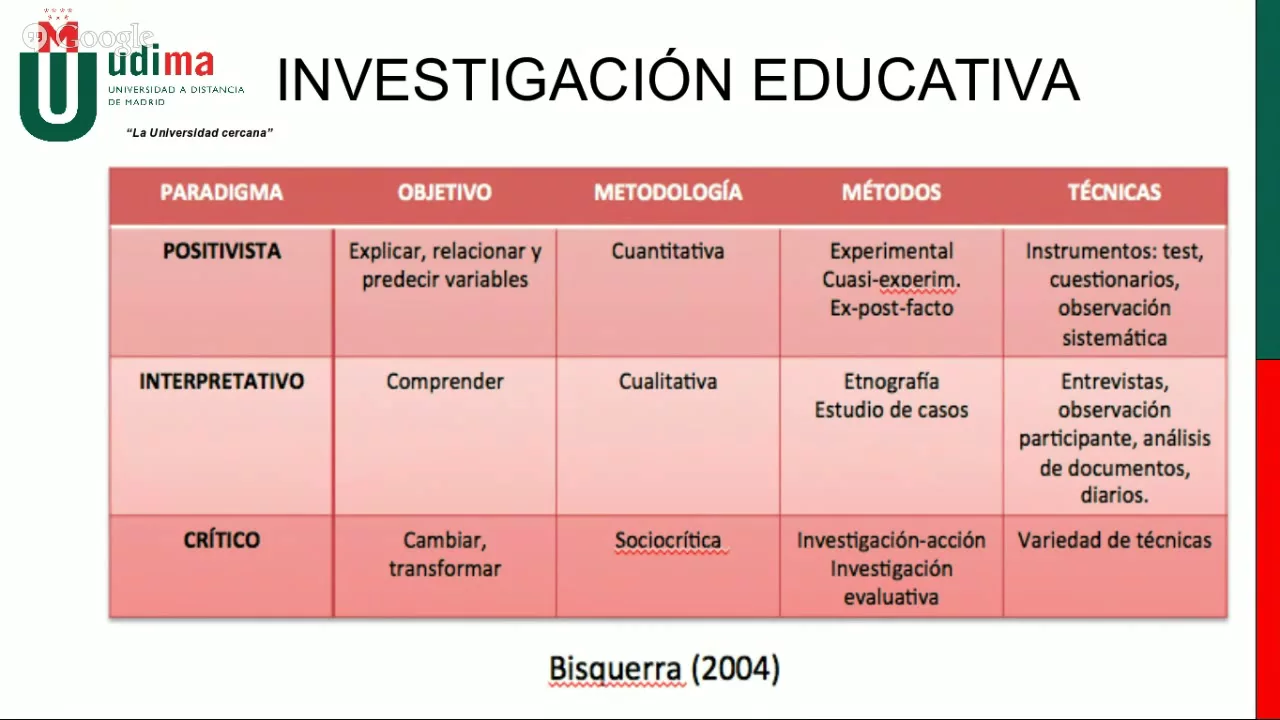
- Exploring various paradigms such as positivist, interpretative, and critical within educational research.
Paradigm Significance
- Defining paradigm as the contextual framework guiding research endeavors towards specific objectives.
Objectives of Different Paradigms
- Outlining objectives of positivist (explain, relate, predict), interpretative (comprehend reality), and critical (change reality) paradigms.
Methodologies in Educational Research
This segment focuses on methodologies like quantitative, qualitative, and socio-critical approaches used in educational research for data analysis.
Methodological Options
- Distinguishing between quantitative (numeric-focused), qualitative (non-numeric aspects), and socio-critical (blending both approaches).
Methodology vs. Methods
- Clarifying the distinction between methodology (approach framework) and methods (specific techniques).
Research Methods: Experimental vs. Qualitative
The discussion shifts towards contrasting experimental methods with qualitative approaches commonly employed in educational research settings.
Experimental Methodology Insights
- Explaining the limited use of experimental methods in education due to practical challenges.
Qualitative Methodology Applications
- Detailing how qualitative methods like case studies or ethnography offer rich insights into specific contexts for deeper understanding.
Socio-Critical Methodology: Action Research
The speaker elaborates on socio-critical methodology focusing on action research as a transformative approach beneficial for educators seeking change.
Socio-Critical Approach Benefits
Research Methodologies in Education
In this section, the speaker discusses research methodologies in education, focusing on quantitative and qualitative approaches, as well as the importance of evaluative research to drive change in educational systems.
Quantitative vs. Qualitative Approaches
- Quantitative methods include tests and questionnaires, while qualitative methods involve interviews, participant observation, and document analysis.
- Qualitative methodologies offer richer insights through techniques like interviews and participant observation compared to the more structured nature of quantitative methods.
Socio-Critical Methodology
- Socio-critical methodology combines various techniques such as surveys, questionnaires, interviews, and observations to delve into social issues within education.
- Research-action tends to lean towards qualitative aspects over evaluative research.
Role of Teachers in Action Research
The speaker emphasizes the significance of teachers engaging in action research within their classrooms to foster a culture of inquiry and improvement.
Empowering Teachers Through Research
- Action research positions teachers as researchers within their classrooms, encouraging them to investigate and enhance their teaching practices.
- Encourages participants to develop a curiosity for conducting research within their own educational settings.
Importance of Evaluative Research
This segment delves into evaluative research's role in assessing educational practices and its impact on driving positive changes within the education system.
Evaluating Educational Practices
- Evaluative research involves assessing existing educational practices to identify areas for improvement.
- Introduction to the National Institute for Educational Evaluation (INEE), highlighting its crucial role in providing evaluation data for educators and policymakers.
INEE Functions
- INEE's portal offers access to evaluations on education policies, results, and international studies related to educational assessments.
New Section
In this section, the speaker introduces PISA (Programme for International Student Assessment) as an organization focused on economic development. They discuss the evaluation of students' competencies in reading, mathematics, and science in both public and private schools.
Understanding PISA
- PISA evaluates 15-year-old students' competencies in reading, mathematics, and science over three years with a focus on different subjects each year.
- The assessment began in 2000 with a focus on reading, gradually incorporating mathematics and science questions over subsequent years.
- Spain's participation includes assessing problem-solving skills and financial literacy alongside traditional competencies.
New Section
This part delves into the evolution of PISA assessments over time, emphasizing the inclusion of computer-based problem-solving tasks to evaluate collaborative skills.
Evolution of Assessments
- Recent assessments have shifted focus to include math while introducing collaborative problem-solving tasks to assess real-world competencies.
- The speaker provides an example of a math question from PISA that emphasizes practical application rather than theoretical concepts.
- Different levels within PISA assessments progress from routine procedures to complex problem-solving involving reasoning and generalization.
New Section
This segment explores the contextual elements and levels within PISA assessments that aim to gauge students' mathematical competencies at varying depths.
Contextual Elements and Levels
- Various contexts like personal, scientific, educational, or workplace settings are used in exercises to provide practical relevance.
- Six levels of progression exist within PISA assessments ranging from basic reproduction to advanced reasoning for original problem-solving.
- The evaluations go beyond mere content knowledge by assessing collaboration skills through computer-based tasks.
New Section
This part illustrates a sample collaborative problem-solving task from PISA assessments, highlighting the importance of teamwork and decision-making skills.
Collaborative Problem-Solving Task Example
- A scenario involving planning a class visit is presented where students must collaborate effectively using digital tools provided during the assessment.
Detailed Discussion on Education and Research
In this section, the speaker delves into the importance of critical thinking in decision-making processes, the significance of local interests in educational visits, and the development of competencies through group work.
Importance of Critical Thinking and Decision-Making
- Emphasizes that students should evaluate all options before making decisions rather than voting or thinking without prior reasoning.
- Discusses how students develop competencies by analyzing, engaging with others, and reaching agreements in group work.
Significance of Local Interests in Educational Visits
- Highlights the necessity to consider local interests when planning educational visits to other locations.
Evaluation and Legislation in Education
This part focuses on the evaluation aspects within education, referencing legislative frameworks such as AL 11 and external assessments like PISA.
Importance of Evaluation in Education
- Points out that evaluations are crucial components highlighted within AL 11 legislation.
- Mentions how national evaluations align with OECD criteria from PISA for comprehensive assessment practices.
Educational Assessment and Research Insights
The speaker shares insights on educational assessment practices, research norms, and emphasizes the role of individual investigation for innovation.
Educational Assessment Practices
- Concludes with a quote emphasizing the need for proactive problem-solving rather than passive observation.
Role of Individual Investigation for Innovation
- Stresses that innovation requires individual research efforts beyond following trends blindly.
Resources for Further Learning
Recommendations are provided for resources related to research methodologies and educational investigations.
Recommended Resources
- Suggests foundational books like "Fundamentos Básicos de Metodología de Investigación Educativa" by José Quintana et al. for an introduction to research methodologies.
- Recommends "Metodología de la Investigación Educativa" by Rafael Bisquerra Alzina for a deeper dive into educational research methods.
Closing Remarks and Q&A Session
The session concludes with expressions of gratitude towards participants followed by a brief Q&A segment addressing questions regarding education policies.
Gratitude Towards Participants
- Expresses gratitude to attendees for their participation in the summer course on education and research.
Addressing Questions on Education Policies
Desafíos en la Educación Actual
In this section, the speaker discusses challenges faced in current education systems, particularly regarding competency-based teaching and the lack of training for educators in implementing such methodologies effectively.
Challenges in Implementing Competency-Based Teaching
- Educators express interest in competency-based teaching but lack training on how to execute it effectively.
- Emphasizes the need for a shift in how teaching and learning are approached, moving away from traditional methods that may not engage students effectively.
- Advocates for a focus on enjoyment in learning, highlighting the importance of students finding pleasure in their educational experiences.
Evaluation Conflicts and Educational Innovations
This part delves into conflicts between external evaluations and classroom innovations, emphasizing the struggle teachers face when trying to introduce new approaches while aligning with standardized assessments.
Balancing External Evaluations and Classroom Innovation
- External evaluations sometimes conflict with innovative practices within classrooms, creating dilemmas for teachers seeking to improve their teaching methods.
- Teachers aiming to innovate may find discrepancies between their classroom reality and external assessment requirements.
Promoting Educational Research
The discussion shifts towards collaboration in educational research, highlighting ways educators can engage in research activities to enhance their teaching practices.
Collaborating in Educational Research
- Encourages collaboration in educational research by engaging with universities or existing research groups to broaden perspectives and insights.
- Suggests that active participation in educational research can offer valuable insights from diverse viewpoints, including university professors, teachers, and students.
Accessing Educational Resources
Addressing the availability of educational resources for teachers seeking information or publications related to educational research.
Accessing Educational Publications
- Highlights various platforms where educators can access educational publications and research articles to stay informed about current trends and studies.
Desarrollo de Investigación Educativa
In this section, the speaker discusses the importance of collaborative research in educational settings and emphasizes the value of identifying needs within students or educational contexts to drive meaningful investigations.
Collaborative Research in Education
- Collaborating with like-minded educators is essential for conducting impactful research.
- Detecting needs within students or educational environments serves as a crucial starting point for research initiatives.
- Emphasizes the significance of willingness to engage in research, followed by seeking training and forming research groups for effective outcomes.
Impact of External Evaluations on Competency-Based Learning
This segment delves into how external evaluations may potentially hinder competency-based learning within classrooms due to the focus shifting towards exam preparation rather than fostering competencies.
Challenges Posed by External Evaluations
- Questioning whether external evaluation pressures might counteract the promotion of competency-based learning.
- Highlighting concerns that excessive focus on preparing for external exams could detract from authentic competency development.
- Drawing parallels between exam-oriented instruction and potential loss of true competency-building experiences for students.
Closure and Gratitude
The conclusion expresses gratitude to participants while acknowledging the impact of excessive evaluation practices on genuine competency development in education.
Conclusion and Appreciation
- Expresses gratitude towards participants for their engagement and interest throughout the session.