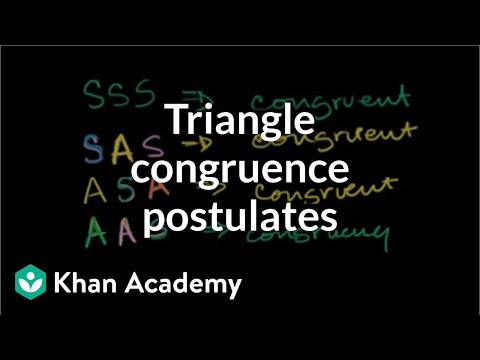
Other triangle congruence postulates | Congruence | Geometry | Khan Academy
Understanding Triangle Congruency
Side-Side-Side (SSS) Congruence
- The SSS postulate states that if two triangles have all three corresponding sides equal, then the triangles are congruent.
Angle-Angle-Angle (AAA) and Similarity
- AAA does not imply congruency; it only indicates similarity. Two triangles can have the same angles but different sizes.
- Similar triangles share the same shape but not necessarily the same size. All congruent triangles are similar, but not all similar triangles are congruent.
Side-Angle-Side (SAS) Congruence
- The SAS postulate asserts that if two sides of one triangle are equal to two sides of another triangle, and the angle between those sides is also equal, then the triangles are congruent.
- This means there is only one way to position the third side when two sides and their included angle are known, confirming triangle congruency.
Exploring Other Combinations
- The discussion will continue with other combinations like Angle-Side-Angle (ASA), indicating a thorough exploration of triangle congruency criteria in future segments.
Triangle Congruence: Understanding Angle-Side-Angle (ASA)
Exploring Angle-Side-Angle (ASA) Congruence
- The discussion begins with the concept of triangle congruence, specifically focusing on the angle-side-angle (ASA) configuration. A triangle is drawn to illustrate this concept.
- The speaker poses a question about whether two triangles with one equal side and two equal angles at either end are necessarily congruent, emphasizing reasoning over formal proofs.
- It is noted that while the lengths of certain sides can vary, they must still form specific angles to maintain congruency in the triangles being compared.
- The speaker explains that despite potential variations in side lengths, only one unique triangle can be formed under these conditions due to angle constraints.
- Conclusively, it is reasoned that ASA does imply triangle congruence, establishing a foundational understanding for further exploration.
Angle-Angle-Side (AAS): Does It Imply Congruence?
Investigating Angle-Angle-Side (AAS)
- Transitioning to angle-angle-side (AAS), the speaker reflects on memorization techniques for various congruency postulates but prefers logical reasoning instead.
- A new triangle is introduced with two angles and one side; this setup will be analyzed for its implications on congruency.
- The construction of another triangle with an equal side and corresponding angles illustrates how varying lengths do not affect overall congruency when specific measures are maintained.
- The importance of maintaining angle measures while allowing flexibility in side lengths is reiterated as crucial for determining if triangles remain congruent.
- Ultimately, it’s concluded that AAS also implies triangle congruence based on the established relationships between angles and sides.
Side-Side-Angle: Analyzing Its Validity
Evaluating Side-Side-Angle (SSA)
- The focus shifts to examining whether the side-side-angle (SSA) configuration leads to triangle congruence by drawing a new triangle setup.
- In this scenario, two sides are known to be equal along with an included angle; however, there’s no constraint placed on the opposite angle's measure.
Understanding Triangle Congruence and Angles
Exploring Triangle Properties
- The discussion begins with the introduction of two sides of a triangle: one blue and one magenta, which are stated to be equal in length. The speaker proposes altering the angle to explore congruence.
- A new angle is introduced, demonstrating that even with two sides of equal length, the angles can differ. This leads to the possibility of constructing a triangle that is not congruent despite having two equal sides.
- The speaker emphasizes that while two sides may be equal and an angle may also match, it does not guarantee triangle congruence. Specifically, they note that this configuration results in a shorter green side in one triangle compared to another.
- The conclusion drawn is significant: triangles formed under these conditions (side-side-angle) do not necessarily result in congruent or similar triangles, challenging common assumptions about triangle properties.