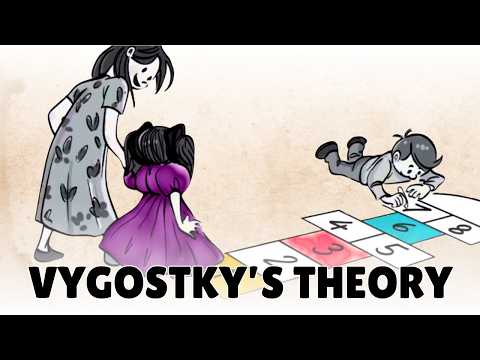
Vygotsky's Theory of Cognitive Development in Social Relationships
La teoría del desarrollo sociocultural de Vygotsky
The transcript introduces Vygotsky's sociocultural development theory, contrasting it with Piaget's cognitive development stages.
Vygotsky's Sociocultural Development Theory
- Vygotsky emphasizes the role of community and language in learning, rejecting Piaget's stage-based cognitive development. He believes children develop independently of specific stages through social interactions.
- Discusses the concept of the zone of proximal development (ZPD), where individuals can achieve tasks with assistance. Illustrates with an example of twins raised differently in terms of expected skills and support for standing up.
- In ZPD, learning precedes natural development; mentorship is crucial for reaching full potential. Mentions the link between speech and mental concepts, highlighting how internalized speech leads to independent thinking.
- Vygotsky's advice to educators emphasizes providing students with opportunities for dialogue to enhance independent thinking. Raises questions about learning prerequisites and socio-cultural contexts influencing learning outcomes.
Conclusion and Discussion
The transcript concludes by prompting viewers to reflect on whether children can learn without considering developmental prerequisites and the influence of socio-cultural contexts on learning outcomes.