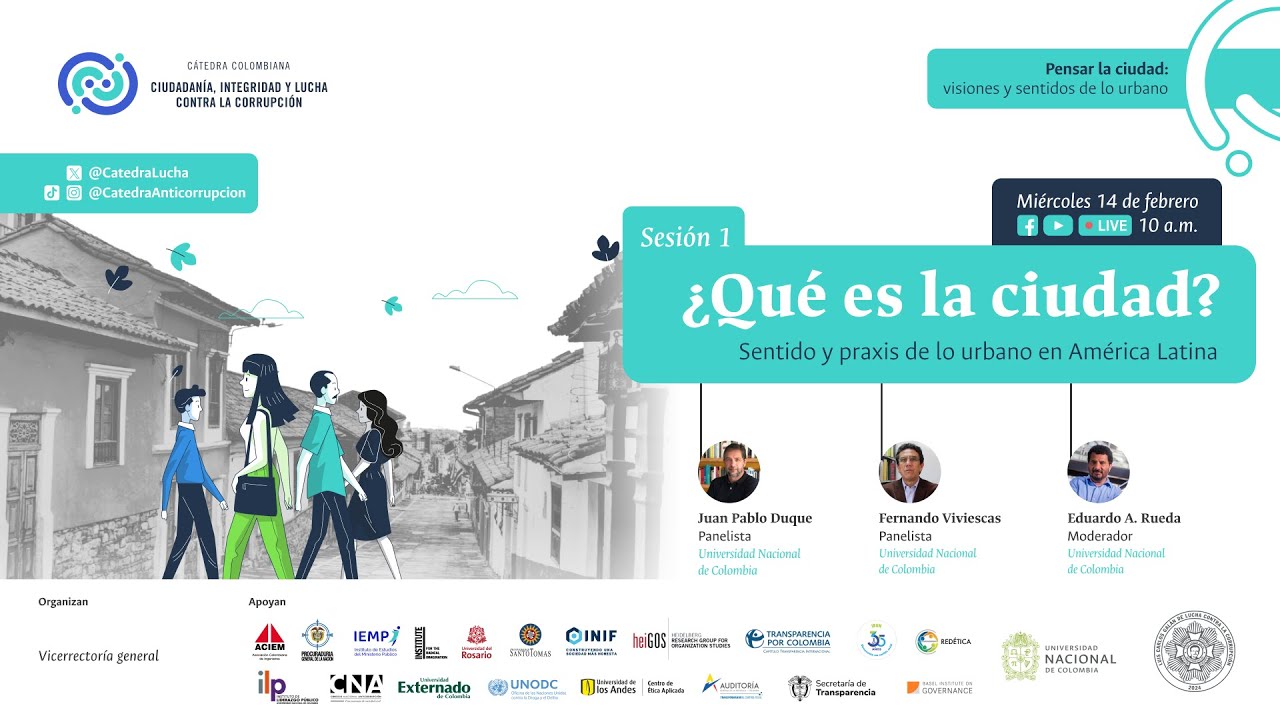
Sesión 1. ¿Qué es al ciudad? Sentido y praxis de lo urbano en América Latina
Buenos días y Bienvenida a la Cátedra Colombiana
The introduction to the thematic session on Colombian citizenship, integrity, and anti-corruption efforts focusing on good city governance. Welcoming participants from various locations.
Introducing the Session
- The session commences with an exploration of "What is the city? Senses and praxis of the urban in Latin America."
- Audience encouraged to engage actively by sharing questions through Facebook and YouTube chats for a rich dialogue.
Professor Juan Pablo Duque's Introduction
Professor Juan Pablo Duque's background, contributions, and involvement in civic education, integrity promotion, and anti-corruption initiatives.
Professor Juan Pablo Duque
- Prof. Duque expresses gratitude for the invitation and highlights the importance of values in civic education.
- Reflecting historically on cities like Troya and Atlantis to understand their significance in human culture.
Historical Perspectives on Cities
Delving into historical cities such as Troya and Atlantis to grasp their impact on ancient narratives and cultural development.
Historical City Insights
- Exploring how tales of Troya influenced Greco-Latin culture, leading to Rome's foundation.
- Discussing Plato's references to Atlantis as a mythical city that symbolizes community essence.
Plato's Philosophical Concepts
In this section, the speaker discusses Plato's philosophical concepts related to human interaction, societal norms, and the ideal state.
Plato's Views on Convivencia and Polis
- Plato emphasizes the importance of human interaction based on shared norms for peaceful coexistence in society.
- The Republic outlines essential elements for societal harmony in the polis, including a rejection of falsehoods to maintain democratic integrity.
- Critique of rhetoric in democracy as undermining truth-seeking efforts and leading to political failures.
Plato's Criticism of Art and Literature
- Plato distinguishes philosophy as truth-seeking from literature seen as fiction that deviates from reality.
- Critique of imitative art like painting for presenting mere appearances detached from true reality.
Plato's Atlantis and Ideal City
This part delves into Plato's description of Atlantis and his vision of an ideal planned city-state.
Description of Atlantis
- Discussion on the mythical city of Atlantis described by Plato in Critias, contrasting it with Athens.
- Verification through archaeological findings supports the existence of Troy but not Atlantis.
Characteristics of Atlantis
- Limited information available about Atlantis; its disappearance attributed to natural catastrophes.
- Detailed planning evident in Platonic description: concentric layout, social controls, family inheritance systems.
Societal Structure in Ideal City
- Speculation on the geographical location of Atlantis in the Mediterranean region based on Platonic dialogues.
The Development of Cities Through History
The discussion delves into the evolution of cities, focusing on ancient Greek and Roman civilizations, highlighting the significance of urban planning and societal structures in shaping communities.
Ancient Greek City Planning
- The city served as the foundation for democracy in ancient Greece, fostering debates and hierarchies that influenced power dynamics.
- Greek cities like Athens showcased a blend of planned architecture with chaotic urban layouts, contrasting ideal geometrical designs with practical realities.
Urban Evolution and Societal Structures
- Cities post-Greek era emphasized nucleation and communal living under hierarchical norms, evolving through Roman Empire to modern times.
- Fortified cities emerged globally, symbolizing protection but also entailing constraints on freedom and servitude within power structures.
City Configurations: From Medieval to Modern Times
The narrative transitions to medieval Europe's city growth driven by local powers, leading to fortified towns amidst constant conflicts impacting health conditions.
Medieval Urbanization
- Small fortified cities in medieval Europe reflected power struggles among princes, fostering security at the expense of liberty amid ongoing hostilities.
Cities and Their Development
The discussion delves into the historical context of cities, focusing on their planning, impact on trade, and interactions with different identities.
Cities in Historical Context
- Cities in the past had poor planning priorities due to limited scientific knowledge, leading to health issues and discrimination against certain populations.
- Interconnected cities facilitated trade and encounters with diverse identities, fostering a cosmopolitan view within Europe.
Impact of Diseases on Cities
- Disease outbreaks in cities highlighted spatial complexities, confinement effects, and hygiene challenges.
- The session transitions to discussing Latin American cities historically through the concept of "accesión" post-1492.
Historical Events Post 1492
Explores significant events post-1492 including the discovery of America, expulsion of Arabs and Jews from the Iberian Peninsula, and their impact on territorial reconfiguration.
Post 1492 Historical Events
- Besides discovering America in 1492, significant events like Arab expulsion southwards and Jewish transformation occurred in the Iberian Peninsula.
- The expulsion process reshaped Iberia by incorporating territories into Christian norms through religious transformations.
Territorial Reconfigurations
- The process of "accesión" involved reshaping territories according to new norms; this was crucial during the exploration era when new lands were discovered.
Understanding the Development of Cities in Latin America
In this segment, the speaker delves into the historical significance of cities in Latin America, focusing on Cartagena and Mexico City. The discussion extends to contemporary urban concepts and societal structures.
Importance of Cartagena in Latin American History
- Cartagena was a crucial city for Colombians due to its historical importance as one of the most significant cities on the continent. It played a pivotal role not only in local regions but also in terms of slave trade and wealth export to Europe.
Foundation of New Urban Centers
- With indigenous populations decimated by diseases, new urban centers were established without protective walls. These cities were founded based on hierarchical power structures from the church and monarchy, shaping their development.
Unique Urban Layouts: Mexico City
- Mexico City's layout differed from European-influenced cities, with its location near a large lake instead of protective walls. The city's expansion beyond its original boundaries has been revealed through archaeological excavations.
Contemporary Urban Concepts by Berman
- Berman's sociological perspective emphasizes how communities seek security in a hostile world, balancing safety through communal living while sacrificing personal freedom.
Evolution of Community Structures
- Communities are viewed as either naturally evolving entities or artificial constructs necessitated by human expansion. Berman argues that community formation is more about adapting to human migration than an inherent trait.
Impact of Security on Society
- Security measures like walled cities influenced spatial elements such as distance and mobility, shaping territorial centralization and regional identities through trade interactions.
Ethical Considerations in Communities
- Upholding community membership requires individuals to adhere to shared security criteria at the cost of personal freedoms. Norms, laws, and leadership decisions define acceptable behavior within communities.
The Impact of Urbanization on Communities
The speaker discusses the historical perspective of punishment through community exclusion and banishment, linking it to contemporary issues like urban displacement and migration.
Punishment in Ancient Societies
- Banishment was considered a severe punishment in ancient European societies, emphasizing community security over death.
Contemporary Relevance of Displacement
- Modern-day displacements echo the severity of ancient punishments, with urban populations being uprooted from city centers.
Literary Examples and Historical Context
- Literary works like Shakespeare's "The Merchant of Venice" depict the plight of marginalized communities, such as the Jewish population confined to ghettos.
Urbanization and Human Movement
The discussion delves into how urban structures impact human movement and societal dynamics, touching on modern interconnectedness and its implications.
Restriction within Cities
- Urban ghettos like that in Venice restricted Jewish populations, highlighting tensions between economic necessity and social exclusion.
Interconnected Modernity
- Global urbanization has led to a connected planet where human movement is pervasive but constrained by territorial boundaries.
Challenges of Contemporary Migration
The conversation shifts towards contemporary challenges related to migration, focusing on societal attitudes towards refugees and the concept of 'human drains.'
Shift in Drainage Metaphor
- Bauman critiques modern society's treatment of migrants as 'human drains,' emphasizing the shift from physical waste drainage to dehumanizing migrant populations.
Plight of Refugees
- Refugees face vulnerability and lack integration due to societal perceptions that view them as obstacles rather than individuals deserving compassion.
Ethical Considerations: Xenophobia
Exploring xenophobia as a contemporary ethical issue, examining biases against foreign individuals based on socioeconomic status.
Xenophobia Dynamics
- Xenophobia manifests as fear or aversion towards foreigners perceived as poor outsiders, contrasting with more favorable treatment towards affluent foreigners like tourists or investors.
New Section
In this section, the speaker introduces themselves, highlighting their academic background and current affiliations.
Introduction of the Speaker
- The speaker, Professor Viviescas, has a rich academic history including roles as a co-editor of various publications, vice-rector in Bogotá, and dean of the architecture faculty in Medellín.
- Currently serving as a professor emeritus at the National University of Colombia and part of the academic staff at the University of Guadalajara's doctoral program on city, territory, and sustainability.
New Section
The host welcomes Professor Viviescas to speak and acknowledges his contributions to various academic programs.
Acknowledgment and Invitation
- Professor Viviescas is commended for his presence and expertise in urban governance studies.
- The host appreciates the opportunity to learn from Professor Viviescas' insights during the lecture.
New Section
Discussion about time allocation for the presentation.
Time Allocation
- Permission granted for a 35-minute presentation duration by Diego Fernando.
- Professor Viviescas expresses gratitude for being able to share his perspective on urban development distinctively from previous discussions.
New Section
Introduction to key themes related to urban development.
Urban Development Themes
- Reference made to Twitter account "Pensar Ciudad" emphasizing contemporary urban reflections.
- Mention of collaborative work with Fabio Giraldo on a book titled "Pensar la Ciudad," showcasing strong engagement in urban discourse.
New Section
Emphasizing contemporary relevance in urban planning discussions.
Contemporary Urban Planning
- Urban landscapes are highlighted as metropolises reflecting human civilization's evolution over time.
The Demographic Transition
The speaker discusses the significant demographic changes that occurred between the late 15th century and the early 19th century, leading to a rapid increase in the human population.
The Population Explosion
- In just 130 years, from around 1800, the human population grew from one million to one billion due to advancements in medicine such as surgery and anesthesia.
- The period from 1800 onwards marked a drastic shift in population growth, with significantly fewer deaths compared to previous millennia, indicating a transformative demographic change.
Unprecedented Growth
- A crucial transformation occurred post-1800 where population growth accelerated rapidly. Subsequent billions were added at an increasingly faster pace - three billion in 30 years, followed by another billion in just 15 years.
- This exponential growth led to a vertical spike in population charts, signifying a monumental shift in human demographics towards unprecedented numbers.
Shifts in Demographic Patterns
The speaker delves into how demographic patterns shifted dramatically post-1800, altering the trajectory of human civilization.
Population Dynamics
- Post-1800, there was a notable deviation from historical population trends. The curve representing human population took on a steep incline rather than following its previous horizontal path.
- A gradual decline in annual growth rates starting around 1968 marked a pivotal moment. This transition signifies a critical juncture where humanity is undergoing profound changes in lifestyle and existence.
The Current Demographic Landscape
The speaker reflects on the contemporary demographic landscape and its implications for society's future development.
Momentous Shift
- The current era is characterized by significant demographic shifts that are reshaping societal structures and norms. Humanity is experiencing transformative changes that are redefining how people live and interact with each other.
- Notably, since 1938, global population has quadrupled to over eight billion individuals. This exponential rise poses challenges for urban areas and necessitates new approaches to address emerging issues effectively.
Future Projections and Challenges
Future projections indicate potential challenges arising from continued population growth and urbanization trends.
Projected Scenarios
- Forecasts suggest that while it took approximately 80 years to increase global population from two to eight billion individuals, adding another three billion may only take about 70 years. This projection underscores the need for sustainable planning amid rapid urbanization.
Problems of Overpopulation
The speaker discusses the challenges posed by overpopulation, emphasizing the need to address living conditions and distribution of resources for a growing global population.
Challenges of Overpopulation
- Overpopulation necessitates cohabitation, making migration a compulsion rather than an option.
- Exploring the complexity of positioning individuals in a crowded world using a cinema analogy.
- Contemplating how to accommodate 8 billion people in societal settings like cinemas.
Urban Governance and Complexity
The discussion shifts towards urban governance and the complexities associated with managing large populations within cities.
Urban Dynamics
- Showcasing images of cities like Bogotá and Quito to illustrate urban landscapes.
- Questioning how to govern not just cities but the abstract concept of 'the multitude' that lacks clear definitions.
Global Issues and Societal Evolution
Delving into global challenges such as COVID-19, climate change, and gender revolution while reflecting on societal beliefs and migrations.
Global Challenges
- Reflecting on societal transformations amidst issues like gender differences, social beliefs, migrations, and corruption.
Security Perspectives in Different Regions
Comparing security perspectives between regions like Latin America and England while questioning the notion of safety in diverse contexts.
Security Paradigms
- Contrasting security perceptions between Latin American cities' violence rates with English cities' security theories like 'care theory.'
Social Realities: United States Context
Discussing social realities in the United States concerning gun violence and societal dangers.
Social Commentary
- Critiquing American society's high levels of gun-related deaths annually compared to other nations.
Cultural Observations: Recent Events
Analyzing recent cultural events related to political discourse in Colombia and the United States.
Cultural Insights
The Impact of Urbanization on Society
The speaker discusses the influence of urbanization on societal norms and behaviors, particularly focusing on the United States and Colombia.
Urbanization and Gun Culture
- In the United States, it is common to gift girls guns when they turn 15 years old.
- This gun culture extends to boys as well, with instances of violence involving firearms at a young age.
Political Influence and Controversy
- Reflecting on past events, such as the Capitol riots in the U.S., where political leaders incited violence.
- Speculation about future leadership roles for those involved in controversial actions.
Challenges in City Living
The discussion shifts towards challenges faced by cities globally, touching upon governance issues and societal disparities.
Governance and Leadership
- Critique of world leaders as mere entertainers rather than effective policymakers.
Colombian Context
- Reflection on Colombian presidents adopting various personas, including police officers or TV hosts.
Evolution of Metropolises
Exploring the development of major cities over time and their impact on society.
Urban Development Trends
- Notable growth in major metropolises between the 20th century and present day.
Urban Planning Perspectives
The Evolution of Public Spaces and Free Time
In this section, the speaker discusses the evolution of public spaces and free time, particularly focusing on how these concepts have shaped societal perspectives and transformations.
The Significance of Public Spaces and Free Time
- The intersection of free time and public spaces leads to a new vision for communities, fostering critical discourse and reflection on past events.
- Colombia has undergone significant transitions in the last 10-15 years, prompting deep systemic reflections on historical events with a focus on truth commissions and peace processes.
- Communities not only build physical structures but also construct narratives, maintaining strong ties between urban areas and regions.
Reflections on Violence and Peace Movements
- The ability to revisit historical violence allows for a nuanced understanding of past events, challenging exaggerated narratives and emphasizing the importance of peacebuilding efforts globally.
- Historical movements like the Arab Spring highlight societal aspirations for liberation, especially concerning gender equality, despite facing repression.
Challenges in Societal Transformation
This section delves into the challenges faced by societies undergoing transformational phases, exploring political shifts, governance issues, and societal uncertainties.
Societal Transformations and Governance
- Movements from the 1920s onwards signify shifts in societal structures, symbolized by repurposing spaces like former palaces into libraries in Bogotá.
- Political uncertainties in Colombia are exemplified by opposition leaders expressing dismay over governance changes that challenge traditional power dynamics.
Rethinking Societal Narratives
- Scholars like Rancier prompt reflections on current actions regarding resource distribution to foster peacebuilding efforts grounded in environmental sustainability and gender equality.
Perspectives on Social Change
This segment explores diverse perspectives on social change through intellectual discourses that challenge conventional narratives.
Intellectual Discourses on Social Change
Perspectives on Democracy and Urban Development
In this section, the speaker discusses the concept of democracy in ancient times and its implications for contemporary urban development.
Democracy in Ancient Times
- Plato's perspective on democracy: Initially, democracy was restricted to certain groups such as the elderly, the wealthy, and men over women and youth.
- Limitations of ancient democracy: Only self-proclaimed citizens had democratic rights, excluding women, youth, and foreigners.
Urban Development Initiatives
- Importance of tracking processes for urban development: Emphasizes monitoring processes that lay the foundation for initiatives like autopoiesis.
- Proposal for libraries in Bogotá: Highlighting the need for more public libraries based on a comparison with library availability in Mexico City.
Scientific and Technological Progress
- Proposal for scientific park development: Advocating for a science-focused urban development approach to enhance knowledge dissemination.
- Historical significance of university centers: Discusses how universities historically influenced urban growth patterns.
Subjetivities in Cities
This part delves into the configuration of subjectivities within cities, particularly focusing on diversity and inclusion across different urban settings.
Reconfiguring Subjectivities
- Political reconfiguration of crowds: Examines how diverse populations mobilize politically around ethical causes within large cities like Bogotá.
- Diversity in large vs. small cities: Contrasts the acceptance of diversity and equality agendas between major Latin American cities like Bogotá and smaller towns.
Urban Identity
- Defining city characteristics: Considers whether differences between large and small cities warrant redefining what constitutes a city or if smaller towns may not qualify as true cities.
Establishing Perspectives on Urban Transformation
The discussion delves into the transformation of perspectives in urban settings, emphasizing the impact of migration and the dynamics of city life.
Dynamics of Urban Transformation
- "To be another, one must cease to be oneself." - Exploring the concept of transformation from a psychoanalytic and philosophical viewpoint.
- Cities evolve not just in size but in dynamics. Urban life involves struggles and challenges that shape individuals' existence.
City Living Realities
- Transition to city living is marked by new challenges like deciding what to eat for lunch, highlighting shifts in daily routines and self-reliance.
- Exposure to diverse food options challenges traditional eating habits, prompting individuals to question their culinary preferences.
Openness and Cultural Evolution
- Colombian society's advancement lies in openness to change, contrasting with intellectual stagnation seen in some circles.
- Challenging established norms disrupts societal structures, fostering creativity and innovation within communities.
Cultural Evolution Through Urban Development
The conversation explores how cultural evolution intertwines with urban development processes, shaping contemporary cities' identities.
Complex Dynamics of Urban Culture
- Migration patterns reflect a complex interplay between states, exemplified by Texan buses transporting migrants to New York for social experimentation.
- Daily observations reveal intricate dynamics fueling imaginative urban narratives and transformations.
Artistic Representation of City Building
- Literary works like "La Sombra de Orión" showcase how communities construct their cities, transforming them into global attractions.
- Integration of art, sports events, and media ownership empowers marginalized populations to redefine urban spaces creatively.
Conceptualizing Cities: Mesoamerican Context & Urban Boundaries
Delving into conceptual debates surrounding ancient cities and modern urban boundaries offers insights into redefining cityscapes.
Reimagining Ancient Cities
- Contemplating whether ancient indigenous settlements qualify as cities based on population density prompts conceptual reflections on historical urbanization.
Defining Modern Urban Boundaries
- Examining Bogotá's rural extensions underlines the complexity of defining urban-rural distinctions within metropolitan jurisdictions.
Discussion on Aztec and Mayan Civilizations
The speaker discusses the fascinating aspects of the Aztec and Mayan civilizations in Mexico, highlighting their scale, complexity, and impact on European explorers.
Insights on Aztec and Mayan Civilizations
- Cortés was amazed by the scale of cities like Teotitlán with 500,000 people and vast markets, contrasting with European experiences.
- The speaker emphasizes the impressive scale of these civilizations with populations of 500,000, noting their imperial nature despite being similar to humans in essence.
- Visiting Templo Mayor in Mexico reveals not only monumental construction but also showcases imaginative calendars reflecting extraordinary creativity.
- The discussion underscores how Aztec and Mayan artifacts demonstrate exceptional imagination, creativity, and understanding of cosmic concepts that are now being further explored.
Exploring Concepts of Democracy and Transformation
Delving into philosophical ideas around democracy and societal transformation over time.
Democracy Concepts and Societal Evolution
- Reflecting on the concept of "polis" in Athens as a distinct dimension from modern society's structures beyond mere city-states.
- Engaging with discussions on gender roles challenging traditional norms to adapt to evolving societal dynamics.
- Highlighting the need for new concepts to navigate societal changes as global population growth accelerates rapidly.
The Concept of City Governance
The discussion revolves around the concept of city governance, challenging the idea that only those who understand should govern.
Understanding City Governance
- There is a debate on who should govern cities, with a suggestion that it should be those who understand rather than those who know.
- The speaker mentions the issue of governance and how planners, urbanists, and architects are often seen as suitable for governing cities, highlighting a different perspective.
- It is noted that certain groups in society, such as intellectuals like university professors and newspaper writers, believe that others are incapable of governing due to lack of experience.
Rethinking City Concepts
- The concept of governance itself is questioned, emphasizing that the traditional understanding of cities may not encompass all current complexities effectively.
- The speaker suggests a reevaluation of the separation between urban and rural areas, indicating a shift towards understanding interconnectedness rather than distinct boundaries.
Challenges in Urban Planning
The conversation delves into challenges faced in urban planning regarding resource management and production dependencies.
Resource Management Issues
- Examples are provided where cities like New York rely on resources from distant locations, highlighting challenges in resource distribution and sustainability.
- The discussion extends to food production and media consumption, emphasizing how dependencies on external sources impact urban living.
Urban Expansion Realities
- Bogotá's expansion is used as an example to illustrate how urban areas extend beyond built regions, prompting a reevaluation of traditional city boundaries.
The Governance of Human Beings
The speaker discusses the concept of governance in relation to human beings, drawing parallels with experiences in Istanbul and emphasizing the importance of self-governance.
Governance and Self-Imposition
- Drawing a comparison to staying in Istanbul for more than two weeks, where one may struggle to leave, highlighting the challenge of self-imposed limitations.
Modernity and Self-Governance
- Exploring the central question of how humans govern themselves, referencing historical philosophical perspectives on establishing societal norms and structures.
Care and Culture
- Reflecting on human vulnerability at birth compared to other species, emphasizing the role of care, culture, and language in nurturing human survival.
Societal Aggressiveness and Conversation
- Discussing inherent human aggressiveness rooted in survival instincts and advocating for dialogue as a means to establish societal norms through conversation.
The Evolution of Governance
The discussion delves into the evolution of governance systems, emphasizing the need for continuous critical thinking and adaptability within established structures.
Establishing Norms Through Dialogue
- Tracing back to Aristotle and Plato's ideas on creating societal norms through dialogue and agreement among individuals.
Dynamic Nature of Governance
- Highlighting the necessity for ongoing critical thinking within governance frameworks, stressing that established norms should remain open to constant evaluation and revision.
Challenges in Urban Governance
The challenges faced in urban governance are explored, focusing on the complexities of city management amidst diverse populations.
Urban Infrastructure Development
- Illustrating challenges in urban infrastructure development by comparing advanced cities' progress over time with current urban planning dilemmas.
Societal Perceptions and Inequalities
- Critiquing societal biases towards marginalized communities based on superficial distinctions like appearance or grooming habits.
Constant Evaluation in City Living
The narrative shifts towards examining how cities constantly challenge individuals' awareness through everyday interactions.
City Dynamics Demanding Attention
- Describing cities as perpetual stimuli demanding constant attention from inhabitants to navigate daily activities safely.
Personal Growth Through Urban Experiences
The Evolution of Urban Planning
The speaker discusses the evolution of urban planning over time, highlighting the challenges and changes in city development.
Evolution of Governance and City Development
- The traditional governance methods have been in place for 200 years, showing their limitations and inefficiencies.
- Cities demand knowledge and care, reflected in the increasing attention to details like public restrooms for women.
- Urban planning lacks consideration for essential aspects like gender-specific facilities in public spaces.
- The idea of planned cities is debunked as impractical, emphasizing the organic growth and challenges faced by cities.
Challenges and Intelligence in City Development
- Cities pose continuous challenges that require intelligence and sensitivity for sustainable development.
- Urban areas challenge intellect and sensibility, reflecting a contemporary metropolis's complexity.
Closure of Lecture
The lecture concludes with announcements regarding future sessions and reminders for student participation.
Conclusion and Future Engagement
- The lecture wraps up, expressing gratitude for participation and inviting further engagement.
Turn any video into a summary like this
YouTube links, meetings, lectures. With transcripts, search, and chat.