Potencial de acción y de reposo de las neuronas
Understanding Action Potentials and Resting Potential
Introduction to Neurons
- The neuron, a fundamental cell of the nervous system, performs four primary functions: receiving information from internal and external sources, processing this information to generate an electrical signal, conducting the signal over considerable distances (up to 1 meter), and communicating with other cells such as neurons, muscles, or glands.
Structure of a Neuron
- A typical neuron consists of four regions: dendrites, cell body (soma), axon, and synaptic terminals. Dendrites are branched extensions that respond to stimuli from other neurons or the environment.
- Dendrites react to neurotransmitters—chemical signals released by other neurons. Electrical signals travel through dendrites and converge at the cell body.
- The cell body contains organelles like the nucleus and endoplasmic reticulum. It integrates incoming electrical signals; if these signals reach a sufficient positive magnitude, it generates an action potential.
Synapses and Communication
- The axon is a long fiber extending from the cell body to synaptic terminals where communication occurs between neurons at synapses. A synapse includes the presynaptic terminal (axon end), postsynaptic receptor site (dendrite or soma of another neuron), and a small gap known as the synaptic cleft.
Resting Potential
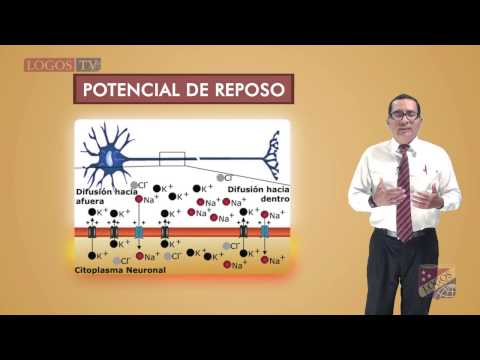
- Inactive neurons maintain a constant voltage difference across their membrane called resting potential, typically ranging from -40 mV to -90 mV. This negative potential is crucial for neuronal function.
Action Potential Generation
- When stimulated sufficiently, the neuron's internal potential can become less negative until it reaches a threshold level that triggers an action potential—a rapid increase in voltage up to approximately +50 mV within milliseconds before returning to resting potential.
Mechanisms Behind Action Potentials
- The speed at which action potentials travel varies among axons. Resting potential results from chemical gradients maintained by active transport mechanisms across selectively permeable membranes.
- Inside neurons are primarily positively charged ions and large negatively charged organic molecules like ATP; outside are sodium ions (Na+) and chloride ions (Cl−). These concentration differences are upheld by sodium-potassium pumps in the membrane.
Ion Movement During Action Potentials
- In unstimulated neurons, only potassium ions can cross the membrane via potassium channels due to higher intracellular concentrations. As potassium diffuses outwards while negatively charged organic molecules remain inside, this increases negativity within the cell.
Threshold Activation
- An action potential occurs when resting potential becomes less negative until reaching threshold voltage; this opens sodium channels allowing rapid influx of Na+ ions into the neuron.
Propagation of Action Potentials
- Once initiated at the axon hillock (where axon meets cell body), action potentials propagate along axons as waves of positive charge due to sequential opening of sodium channels along its length.
Understanding Action Potentials in Neurons
Mechanism of Action Potentials
- The restoration of the neuron's resting potential occurs through the flow of potassium ions (K+) moving outside the cell.
- Action potentials are described as "all-or-nothing" phenomena; if a neuron does not reach a certain threshold, an action potential will not occur.