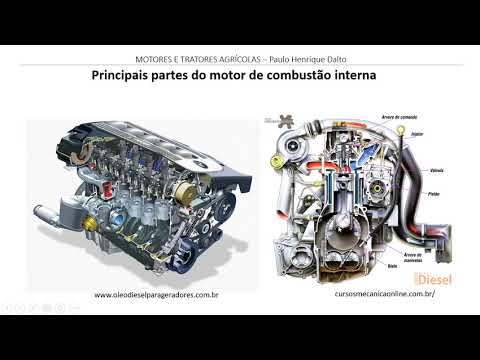
Principais partes do motor de combustão interna
Overview of Internal Combustion Engine Components
Introduction to Engine Parts
- Professor Paulo Henrique introduces the topic, focusing on the main parts of an internal combustion engine, highlighting both internal and external components.
- The discussion begins with a distinction between fixed and moving parts in diesel and Otto cycle engines.
Fixed vs. Moving Parts
- Fixed parts do not move during operation, while moving parts are those that actively engage during engine function.
- Diesel engines require more robust components due to higher compression ratios compared to Otto cycle engines.
Key Components of Diesel Engines
- In diesel engines, the connection between the crankshaft and camshaft is typically indirect, contrasting with Otto engines which often use a timing belt.
- The fixed parts of an engine can be categorized into three main groups: cylinder head, block, and oil pan (carter).
Detailed Breakdown of Engine Components
Cylinder Head
- The cylinder head is made from cast iron or aluminum and houses intake and exhaust valves.
- A gasket is essential for sealing connections between the cylinder head and block to prevent oil or water leaks.
Engine Block
- The engine block serves as the core structure where other components are mounted; it also contains passages for coolant and oil circulation.
- Features like sleeves within cylinders allow for easier replacement without needing to replace the entire block if issues arise.
Oil Pan (Carter)
- The oil pan closes off the bottom of the engine block, containing lubricating oil necessary for smooth operation.
Moving Parts in Internal Combustion Engines
Valves Overview
- Valves play a crucial role in controlling gas flow into (intake valves) and out of (exhaust valves) the engine.
- Valve sizes vary based on manufacturer specifications; configurations can include multiple intake or exhaust valves depending on design needs.
Importance of Valve Design
Understanding Engine Components: The Role of the Camshaft and Crankshaft
Camshaft Functionality
- The camshaft, visible in a real photo, features raised sections called "cames" that control the opening and closing of each valve. It is made from forged steel or cast iron for durability.
- These raised sections push against valves to open them at precise moments during engine operation, as illustrated in an animation.
- A belt connects the camshaft to other components; in diesel engines, mechanical links like tappets are used to synchronize movement between parts.
Crankshaft Overview
- The crankshaft (or "virabrequim") is robustly constructed from steel and supports various engine components. It withstands significant stress during operation.
- This component connects with gears that manage valve operations and also interfaces with the motor's flywheel, which will be discussed later.
Piston Mechanics
- The piston has a closed top but is hollow inside with grooves designed for sealing rings and lubrication rings. At least one of each type is necessary for proper function.
- The combustion chamber forms at the cylinder head where fuel ignites, generating power by converting linear motion from pistons into circular motion via the crankshaft.
Internal Components Interaction
- As pistons move linearly within cylinders, they connect to bearings (historically known as "bronze bearings") that reduce friction during rotation.
- If issues arise within the engine, only these bearings may need replacement rather than entire connecting rods unless they are damaged significantly.
Flywheel Functionality
- The flywheel stores kinetic energy generated by pistons when not all are firing simultaneously. This helps maintain smooth engine operation by releasing energy when needed.