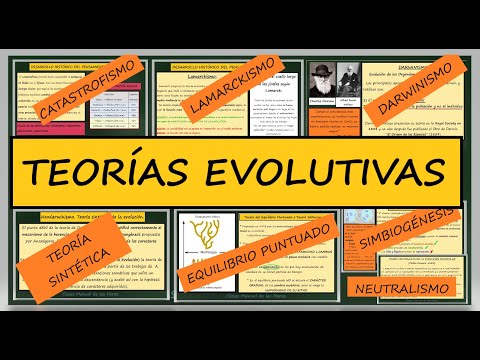
Teorías de la Evolución. Lamarckismo. Darwinismo. Neodarwinismo. Equilibrio Puntuado. Simbiogénesis.
Historical Development of Evolutionary Thought
Introduction to Evolutionary Thought
- The video introduces the historical development of evolutionary thought, emphasizing that species transform over time and that various theories have emerged throughout history.
- It highlights that ancient cultures often relied on myths and religious explanations for the origin of life.
Early Philosophical Approaches
- Greek philosophers were among the first to approach natural phenomena rationally; however, Aristotle's fixism dominated for centuries.
- Aristotle believed in the immutability of species, a view supported by creationist ideas based on biblical teachings.
Renaissance and Scientific Developments
- During the Renaissance, experimental sciences began to challenge creationist theories, although fixism remained prevalent into the 17th and 18th centuries.
- Notable figures like Linnaeus (father of taxonomy) and Cuvier (father of paleontology) adhered to fixist views while early modern evolutionists like Buffon and Erasmus Darwin proposed transformative ideas.
Catastrophism as an Early Theory
- Catastrophism was introduced by Cuvier to reconcile fossil evidence with fixism, suggesting species extinction followed by replacement from other regions due to catastrophic events.
- Although now largely dismissed as a general explanation for biodiversity, it acknowledged historical mass extinctions.
Mass Extinctions in Earth's History
- The video mentions five major mass extinctions in Earth's history, with the most notable being the Cretaceous extinction event caused by a meteor impact.
- The Permian extinction is highlighted as "The Great Dying," resulting in a staggering 96% loss of life forms on Earth.
Lamarckism: An Alternative Evolutionary Theory
- Lamarck proposed an early evolutionary theory before Darwin, suggesting all existence is in flux and diversity arises through environmental interaction.
- His concept included "inheritance of acquired characteristics," where traits developed during an organism's lifetime could be passed down—a notion rejected by modern genetics.
Example: Giraffe Neck Evolution
Understanding Evolution: From Lamarck to Darwin
The Concept of Inheritance and Adaptation
- Discussion on the inheritance of acquired characteristics, specifically the example of long necks being passed down through generations.
- Modern genetics rejects this idea, emphasizing that only genes from reproductive cells (not somatic modifications) are inherited by descendants.
- Acknowledgment of Lamarck's contribution to evolutionary theory, particularly his notion that adaptation drives evolution.
- Critique of Lamarckism: Variability arises from mutations rather than environmental interactions; function does not create organs.
- Transition to Darwinism, highlighting that both Charles Darwin and Alfred Russell Wallace independently reached similar conclusions about evolution.
Key Contributions of Darwinian Theory
- Overview of Darwin's five-year voyage on the Beagle, where he collected diverse geological and biological samples leading to his evolutionary theory.
- Notable collaboration between Darwin and Wallace in presenting their theories at the Royal Society in 1858.
- Publication of "On the Origin of Species" in 1859 marked a significant moment in scientific history due to its controversial implications.
Core Principles of Natural Selection
- Introduction to two main concepts: natural selection and population-level evolution rather than individual evolution.
- Summary of Darwin’s observations:
- Observation 1: High potential fertility rates among organisms lead to many offspring.
- Observation 2: Despite high fertility, populations do not grow indefinitely; they stabilize at constant sizes.
- Observation 3: Natural resources are limited, creating competition for survival.
Implications Derived from Observations
- Implication 1: Existence of a struggle for existence among organisms due to limited resources.
- Observation 4: Biological variability exists within species; individuals differ despite sharing common traits.
- Implication 2: Differential reproduction and survival occur based on adaptability; not all individuals survive or reproduce equally.
- Conclusion (Implication 3): Over generations, differential survival leads to accumulated changes resulting in new species emerging over time.
Evolutionary Theories and Their Development
Anatomical Similarities and Influences on Darwin's Theory
- There are anatomical similarities among different organisms, which also extend to their geographical distribution. This period saw numerous new findings in paleontology and geology.
- Thomas Robert Malthus, an economist, influenced Darwin with his book "Essay on the Principle of Population," where he argued that population grows faster than resources.
Natural Selection and Giraffe Evolution
- Using Darwin's theory of natural selection, the evolution of giraffes can be explained through variability in neck length within the population.
- Giraffes with longer necks have a survival advantage as they can access food higher up in trees, leading to better nutrition and more offspring.
- Over time, shorter-necked giraffes would reproduce less frequently and eventually disappear from the population.
Neodarwinism: A Synthesis of Genetics and Evolution
- Neodarwinism, or "new Darwinism," integrates modern genetic discoveries with Darwin's original theories.
- A key weakness in Darwin’s theory was his inability to identify the mechanism of inheritance; Mendel’s laws were not known during his time.
- Darwin accepted outdated hypotheses like pangensis (the idea that traits from various organs combine in gametes), which we now know to be incorrect.
Genetic Developments Post-Darwin
- In the 20th century, genetics advanced significantly, leading to what is now called neodarwinism or synthetic theory of evolution.
- This theory posits that new species arise gradually through natural selection acting on favorable mutations over time.
Contributions to Synthetic Theory
- Scientists like Weismann demonstrated that changes in somatic cells do not affect heredity, challenging earlier beliefs about acquired characteristics.
- The accumulation of beneficial mutations leads to speciation while harmful mutations are eliminated through natural selection.
Application Across Biological Fields
- As genetic knowledge expanded post-Mendelian rediscovery around 1900, neodarwinism began influencing various biological disciplines including zoology and paleontology.
Punctuated Equilibrium Theory
Evolutionary Theories: Gradualism vs. Punctuated Equilibrium
Gradualismo Filético y Equilibrio Puntuado
- El concepto de un árbol evolutivo se basa en una especie ancestral que origina diversas especies derivadas, lo que representa el gradualismo filético según la teoría de Darwin.
- La teoría del equilibrio puntuado sugiere que las especies experimentan períodos de estabilidad (éxtasis) donde hay pocos cambios morfológicos, intercalados con breves períodos de especiación donde ocurren cambios significativos.
- En el diagrama presentado, el tiempo avanza verticalmente mientras los cambios morfológicos se representan horizontalmente; durante los períodos de éxtasis, la morfología permanece casi inalterada.
- Durante los períodos de especiación, se observa un movimiento horizontal significativo en el diagrama, indicando una rápida acumulación de cambios evolutivos que pueden dar lugar a nuevas especies.
- La teoría del equilibrio puntuado no contradice a Darwin; más bien introduce matices al reconocer que los ritmos de cambio evolutivo no son uniformes.
Teoría de la Simbiogénesis
- Propuesta por Lynn Margulis, la simbiogénesis sugiere que gran parte de la novedad biológica surge a través de procesos simbióticos entre organismos.
- La simbiogénesis implica relaciones a largo plazo entre organismos donde todos obtienen beneficios; esto puede resultar en la fusión del material genético para crear nuevos individuos.
- Un ejemplo clave es la evolución de las células eucariotas mediante simbiosis entre procariotas, conocido como teoría endosimbiótica.
- Aunque algunos ejemplos como mitocondrias y cloroplastos son aceptados por la comunidad científica, otros aspectos más amplios propuestos por Margulis no tienen consenso generalizado.
- Margulis argumenta que las mutaciones son mayormente dañinas y considera a la simbiogénesis como un mecanismo principal en evolución, aunque esta idea es debatida.
Teoría Neutralista de Evolución Molecular
Evolutionary Theory and Genetic Drift
Overview of Evolutionary Change
- The theory discussed posits that most evolutionary changes observed at the molecular level, particularly in amino acid sequences of proteins and nucleotide sequences in nucleic acids, are significant.
Variability Among Organisms
- When comparing two organisms of the same species with minor genetic differences, these variations cannot be solely explained by natural selection. Instead, they highlight the role of genetic variability.
Mechanisms of Evolution
- The primary drivers of evolution are proposed to be a balance between mutation (which generates variability) and genetic drift (random changes in allele frequencies due to finite population sizes).
Neutral Mutations
- Most mutations are considered neutral; they are neither harmful nor beneficial. While natural selection plays an important role in evolution, it is not viewed as the main mechanism driving evolutionary change.
Historical Context and Ongoing Debate
- Since Darwin's initial theories, various contributions and theories have emerged regarding evolution. There is ongoing discussion about how evolutionary processes operate, akin to debates on how a car functions without questioning its movement.
Acceptance within Scientific Community