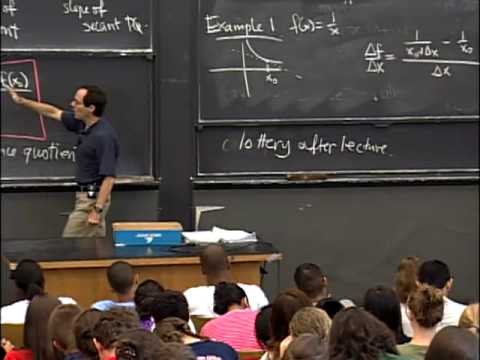
Lec 1 | MIT 18.01 Single Variable Calculus, Fall 2007
Introduction
The professor introduces the course and explains what will be covered in Unit One.
- The course is 18.01.
- Unit One is about differentiation.
- The main topic of today's lecture is what a derivative is.
- There are several different points of view to look at derivatives from, including geometric and physical interpretations.
- Derivatives are important in many fields, including science, engineering, economics, political science, polling, and commercial applications.
Geometric Interpretation of Derivatives
The professor explains how to find the tangent line to a graph of a function at some point using the geometric interpretation of derivatives.
- The problem is finding the tangent line to some graph of some function at some point (x_0,y_0).
- To perform this feat analytically we need two pieces of information: the point P (x_0,f(x_0)) and the slope m (f'(x_0)).
- A tangent line has an equation y - y_0 = m(x - x_0).
- We can visualize how to draw a tangent line but we need to figure out how to do it analytically.
- Calculus provides us with a way to find the slope m by taking the derivative f'(x).
Differentiating Any Function
The professor explains that he will teach how to differentiate any function you know.
- We will learn how to differentiate any function you know.
- This includes messy functions like e^x arctan x.
- Anything you can think of or write down can be differentiated using calculus.
Understanding Tangent Lines
In this section, the speaker explains how to calculate the slope of a tangent line and differentiate it from a secant line.
Calculating Slope of Tangent Line
- The slope of a tangent line is equal to the limit of so-called secant lines PQ as Q tends to P.
- The process applies not just to the whole line itself but also in particular to its slope.
- The formula for calculating the derivative is f'(x_0) = (f(x_0 + delta x) - f(x_0)) / delta x.
- Delta x represents horizontal distance, while delta f represents vertical distance.
Differentiating Secant and Tangent Lines
- A tangent line is distinguished from a secant line by taking an orange secant line and thinking of point Q as getting closer and closer to P.
- As Q approaches P, the slope of that secant line will get closer and closer to the slope of the red tangent line.
- The limit as delta x goes to 0 gives us the slope of the tangent line.
Basic Notations Used in Calculus
- Two basic notations used in calculus are delta x, which represents horizontal distance, and delta f, which represents vertical distance.
- The ratio between these two values gives us the slope of a secant or tangent line.
Introduction to Derivatives
In this section, the professor introduces derivatives and explains how to compute them using a difference quotient.
Computing Derivatives
- To compute the derivative of a function, we use a difference quotient.
- The difference quotient is defined as delta f / delta x = (f(x + delta x) - f(x)) / delta x.
- We simplify the difference quotient by putting it over a common denominator and canceling out terms.
- Taking the limit as delta x approaches 0 gives us the derivative of the function at that point.
Example: Derivative of Hyperbola
- We apply the above method to find the derivative of y = 1/x at a general point x_0 on the hyperbola.
- After simplifying and taking the limit, we get f'(x_0) = -1/x_0^2.
- This means that as x gets larger, the slope of the tangent line to y = 1/x at that point becomes less steep.
Checking Plausibility
- We can check our answer for plausibility by looking at the graph of y = 1/x.
- The slope is negative and becomes less steep as x gets larger, which is consistent with our answer.
Limiting Process
- The limiting process involves taking smaller and smaller values for delta x until it approaches 0.
- Once we have canceled out terms in our expression for delta f / delta x, we can take this limit to find the derivative.
Simplifying Fractions
In this section, the speaker explains how to simplify fractions by expressing the difference of two fractions with a common denominator.
Expressing Fractions with a Common Denominator
- To simplify fractions, express the difference of two fractions with a common denominator.
Calculus Made Harder
The speaker discusses why calculus has a bad reputation and introduces a word problem to demonstrate how calculus can be made harder.
Perception of Calculus
- Calculus gets a bad rap because it is perceived as harder than it actually is.
- People generally ask calculus problems in context, which makes them more complicated.
Word Problem Introduction
- The speaker introduces a word problem involving finding the areas of triangles enclosed by axes and the tangent to y = 1/x.
Solving the Word Problem
- The only bit of calculus involved in solving this problem is understanding what the tangent line is.
- Once we have figured out what the tangent line is, we need to find all other quantities so that we can figure out the area.
- To find this point, we need to find where this horizontal line meets that diagonal line and calculate its x-intercept.
Finding the x-value
In this section, the speaker explains how to find the x-value by plugging one equation into another.
Plugging in equations
- To find the x value, plug in one equation into the other.
- The simplified equation is -x/x_0^2 + 1/x_0 = x / x_0^2 is equal to 2 / x_0.
Solving for x
- Multiply through by x_0^2 and get x = 2x_0.
Using symmetry to find y-intercept
In this section, the speaker uses symmetry to find the y-intercept.
Symmetry of situation
- Use mirror symmetry around diagonal and exchange (x,y) with (y,x).
- Any formula that involves both variables can be switched by replacing all instances of "y" with "x" and vice versa.
Formula for y-intercept
- The formula for y-intercept is equal to 2y_0.
- This is because of symmetry explained above.
Calculus with multiple variables
In this section, the speaker discusses how calculus deals with multiple variables.
Multiple variables in calculus
- Calculus deals with multiple variables at a time even though it's called one-variable calculus.
- In this problem, there are four different variables that have various relationships between them.
Sloppiness in variable naming
- There is a deliberate sloppiness in the way we deal with variables because it's much more complicated not to do it.
- The same letter can mean two different things in the middle of a computation.
Calculating the Area of a Triangle
In this section, the speaker explains how to calculate the area of a triangle using base and height.
Calculating the Area of a Triangle
- The area of a triangle is equal to half the product of its base and height.
- The formula for calculating the area of a triangle is A = 1/2 (base * height).
- Using this formula, we can calculate that the area of any triangle with base 2x_0 and height 2y_0 is equal to 2x_0 y_0.
Notations for Derivatives
In this section, the speaker introduces different notations used to refer to derivatives.
Notations for Derivatives
- Delta y is equivalent to delta f when referring to derivatives.
- df/dx and dy/dx are both notations used for derivatives, meaning exactly the same thing.
- d/dx of f and d/dx of y are also notations used for derivatives. These notations were initiated by Leibniz and are used interchangeably.
Omitting Base Point in Derivative Notation
In this section, the speaker discusses how sometimes people leave out important information in derivative notation.
Omitting Base Point in Derivative Notation
- Sometimes derivative notation omits underlying base point x_0 which can be a nuisance.
- In such cases, one has to fill in the missing information from context.
Derivative of x^n
In this section, the speaker explains how to calculate the derivative of x^n.
Derivative of x^n
- The derivative of x^n is equal to nx^(n-1).
- To simplify the calculation, we use delta f / delta x and make some algebraic simplifications.
- We use the binomial theorem to understand algebraically what's going on when calculating the nth power of a sum.
- The binomial theorem says that if you take the sum of two guys and you take them to the nth power, then (x + delta x) multiplied by itself n times will give us our result.
- There are higher order terms that we won't have to worry about which are called big O of (delta x)^2.
Derivative of x^n
In this section, the professor explains how to take the derivative of x^n and extends it to polynomials.
Derivative of x^n
- The derivative of x^n is nx^(n-1).
- As delta x goes to 0, the term O(delta x) disappears.
- This rule extends to polynomials. For example, d/dx of (x^3 + 5x^10) is equal to 3x^2 + 50x^9.
Binomial Theorem
- The binomial theorem is a general formula that specifies what the junk is. It's much more detailed than what we needed in this case.
- We only needed the first two terms because they were sufficient for our purposes.
Overall, this section covers how to take the derivative of x^n and extend it to polynomials using an example. Additionally, it briefly touches on the binomial theorem and its relevance in this context.