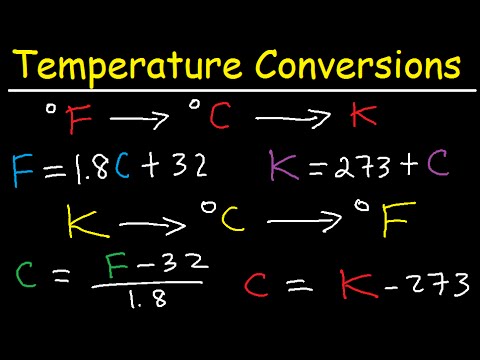
Celsius to Fahrenheit to Kelvin Formula Conversions - Temperature Units C to F to K
How to Convert Between Temperature Units: Fahrenheit, Celsius, and Kelvin
Introduction to Temperature Conversion
- The video explains how to convert between Fahrenheit, Celsius, and Kelvin.
- Converting from Fahrenheit to Celsius is a one-step process; however, converting from Fahrenheit to Kelvin requires an intermediate step of converting to Celsius first.
Converting Fahrenheit to Celsius
- The formula for converting Fahrenheit (F) to Celsius (C) is F = 1.8 times C + 32 .
- To find the Celsius temperature when given 212°F, rearrange the equation: subtract 32 from both sides leading to 180 = 1.8 times C .
- Dividing by 1.8 gives C = 100°C , which corresponds with the boiling point of water at this temperature.
Converting Celsius to Kelvin
- The conversion from Celsius (C) to Kelvin (K) is done using the formula K = C + 273.15 .
- For example, adding approximately 273 gives a result of K = 373K .
Example Problem: Converting -40°F
- To convert -40°F into Celsius using the same formula leads us through similar steps as before.
- After calculations, it turns out that -40°F equals -40°C.
Final Steps in Conversion
- Adding 273 results in a Kelvin temperature of K = 233K .
Working Backwards: From Kelvin to Other Units
- Starting with a temperature of 298K, we can find its equivalent in Celsius by subtracting 273.
- This results in C = 25°C, which can then be converted back into Fahrenheit using the earlier mentioned formula.
Additional Example Problems
- Another example involves converting a temperature of 400K into its corresponding values in degrees Celsius and Fahrenheit.
Absolute Zero Concept
- The video discusses absolute zero at K = 0, which translates mathematically into -273.15°C and approximately -459.67°F.