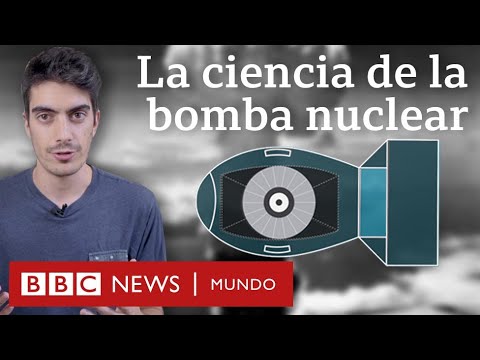
Hiroshima y Nagasaki: cómo funciona una bomba nuclear y por qué es tan destructiva | BBC Mundo
Atomic Bombs: The Mechanics of Destruction
Introduction to Atomic Bombs
- On August 6 and 9, 1945, the United States dropped two atomic bombs on Japan: Little Boy over Hiroshima and Fat Man over Nagasaki, resulting in approximately 80,000 and 40,000 immediate deaths respectively.
Understanding Atomic Structure
- Atoms consist of neutrons, protons (positive charge), and electrons. The nucleus holds energy that is released when it becomes unstable.
- Fission occurs when a nucleus splits into two parts, releasing stored energy. This process is fundamental to atomic bomb mechanics.
Mechanism of Fission
- Fission is initiated by firing a neutron at a nucleus; not all nuclei are equally fissionable—Uranium-235 is notably more so.
- A chain reaction occurs as split nuclei release additional neutrons that continue to collide with other nuclei, perpetuating the cycle rapidly.
Design Differences Between Little Boy and Fat Man
- Little Boy utilized Uranium-235 in a gun-type design where one mass was shot into another to initiate fission. Only about 1% of its 64 kg charge underwent fission but still produced an explosion equivalent to 15,000 tons of TNT.
- Fat Man operated on an implosion principle using conventional explosives around Plutonium-239. It compressed the plutonium sphere to achieve critical mass for fission.
Energy Release and Effects
- Fat Man had a yield of approximately 21,000 tons of TNT from just about 1 kg of fissioned material due to its efficient design.
Advancements in Nuclear Weapons
- Scientists discovered fusion could produce exponentially greater destructive power than fission by combining light nuclei (like hydrogen isotopes).
Fusion Process Explained
- Fusion requires extreme temperatures achieved through initial fission reactions; this process leads to thermonuclear explosions known as hydrogen bombs.
Aftermath and Long-term Effects
- Post-explosion radiation includes gamma rays and neutrons that can cause severe biological damage both immediately and long-term.
Health Consequences for Survivors
- Survivors experienced acute effects like burns and nausea; long-term health issues included increased cancer rates (e.g., leukemia, thyroid cancer).
Current Nuclear Arsenal Status