Unbiasedness vs consistency of estimators - an example
Understanding the Difference Between Unbiased and Consistent Estimators
Introduction to Estimation Concepts
- The video discusses the difference between an estimator being unbiased versus consistent, using a specific example related to population parameters.
- The focus is on estimating a population mean (denoted as μ), which could represent various metrics like average height or GDP.
Defining the Sample and Estimator
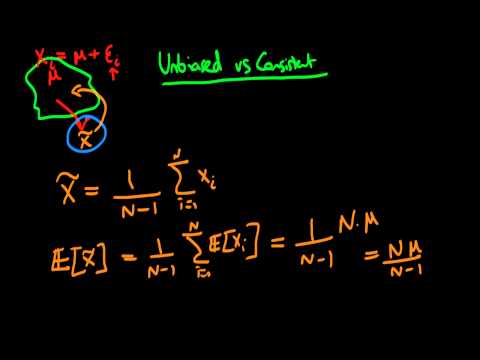
- A sample from the population is denoted as tildeX , which will be used to estimate the population parameter μ.
- For this example, tildeX is defined mathematically as 1/n - 1 sum_i=1^n X_i , where X_i represents individual data points in the sample.
Analyzing Bias in Estimation
- To determine if tildeX is biased, we consider that each individual's height can be expressed as the mean height plus an unpredictable error with a mean of zero.
- By applying the expectations operator, it’s shown that E[tildeX] = nmu/n - 1 , indicating that this estimator does not equal μ for finite samples, thus confirming bias.
Understanding Consistency of Estimators
- The discussion shifts to whether this estimator is consistent. As sample size n approaches infinity, we analyze how bias behaves.
Turn any video into a summary like this
YouTube links, meetings, lectures — with transcripts, search, and chat.