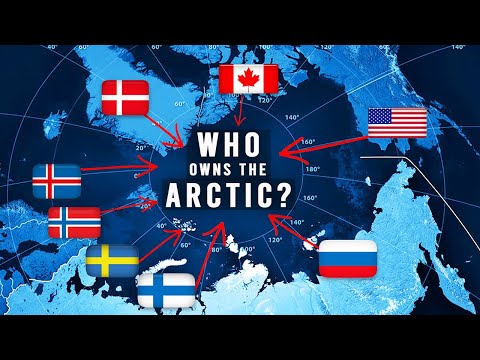
Who Owns the Arctic and Why it Matters
The Arctic: A New Frontier?
Overview of the Arctic Region
- The Arctic comprises nearly six percent of Earth's surface, comparable in size to the entire African continent. Most of it is an icy ocean that has been largely uninhabited by humans for millions of years.
Climate Change and Its Impact
- Due to climate change, ice in the Arctic Sea is retreating rapidly, with predictions suggesting it could be completely ice-free by 2050. This poses risks such as rising sea levels and adverse effects on marine ecosystems. However, it also opens up new opportunities for resource exploitation and shipping routes.
Geopolitical Implications
- The melting ice is leading to a "scramble for the Arctic," where nations are mobilizing to claim territory and resources. Experts predict a new transpolar shipping passage may open across the Arctic Ocean, providing significant advantages to controlling nations.
Military Movements in the Arctic
- Russia has been proactive since 2007 in establishing military presence in the region, reopening Soviet-era bases and enhancing military capabilities. Other countries like NATO members have also increased their military activities within the Arctic Circle, indicating heightened tensions reminiscent of a new Cold War.
Sovereignty Claims by Nations
- The United States, along with Canada, Denmark (via Greenland), Finland, Iceland, Norway, Russia, and Sweden—collectively known as the "Arctic 8"—are vying for sovereignty over parts of the Arctic seabed. Many have filed legal claims with a UN body regarding these territories.
Economic Advantages of Northern Shipping Routes
- Traditional shipping routes from Asia to Europe are lengthy (20,000 km) and take about 29 days; however, northern routes through Russian waters can reduce this distance significantly (by approximately 11,000 km) and cut travel time down to just 10 days due to thinning ice conditions. This shift could lead to substantial fuel savings as well as economic benefits for those utilizing these routes effectively.
Legal Framework Governing Claims
- The United Nations Convention on the Law of the Sea (UNCLOS) outlines how countries can assert sovereignty over maritime areas extending from their coastlines into exclusive economic zones (EEZ). Countries must provide scientific evidence if they wish to claim areas beyond their EEZ based on continental shelf extensions.
Creative Claim Strategies
- In 2007, Russia made headlines by sending submarines under polar ice to plant a flag at the North Pole—a symbolic act aimed at asserting territorial claims while also gathering scientific data about seabed connections relevant for future claims under UNCLOS guidelines. Canada responded critically to this action emphasizing modern diplomatic norms over historical practices like flag planting.
Resource Potential in the Arctic
- The Arctic is estimated to hold up to 22% of undiscovered oil and natural gas reserves globally; thus control over this region carries significant implications not only for national security but also for energy markets worldwide.
Arctic Sovereignty and Resource Claims
The Race for Arctic Ownership
- The Arctic is rich in resources worth trillions of dollars, leading to heightened competition for sovereignty over the region. Russia's extensive coastline accounts for over 50% of the Arctic Ocean's total coastline, which it frequently cites in its territorial claims.
- In August 2015, Russia intensified its claims by asserting a significant portion of the Arctic Ocean as adjacent to its continental shelf under UNCLOS (United Nations Convention on the Law of the Sea). However, this claim was dismissed by the UN due to insufficient scientific evidence.
- Russia made another claim in 2015 for approximately 463,000 square miles of territory, including the North Pole, citing new data. This claim remains unresolved as proving continental shelf connections is complex and requires extensive scientific expeditions.
Proposed Solutions and Ongoing Disputes
- Various solutions have been proposed to resolve disputes among nations claiming Arctic territories. These include extending national borders pie-shaped towards the pole or equidistant from coastlines and expanding exclusive economic zones (EEZ) an additional 200 nautical miles.
- Despite these proposals, no consensus has been reached among countries like Russia, Denmark, and Canada. Each nation is working to demonstrate that their continental shelves extend beyond the conventional 200 nautical mile EEZ boundary.
- The decision regarding ownership of the Arctic is crucial but unlikely to be resolved soon. It remains uncertain which nation will ultimately succeed in claiming rights over this resource-rich area.