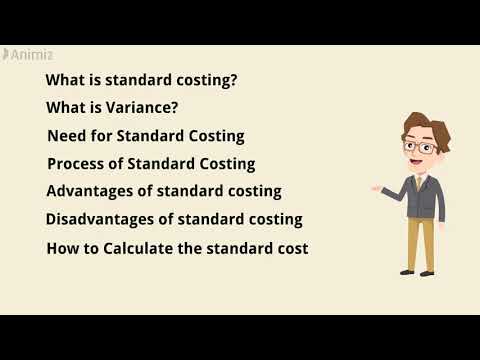
What is standard costing? What is Variance? Advantages, Disadvantages.
Introduction to Standard Costing
In this section, the video introduces the concept of standard costing and its importance in budgeting and cost management.
What is Standard Costing?
- Standard costing is the practice of estimating the expense of a production process.
- It is used by manufacturers to plan their costs for the coming year, including direct material, direct labor, and overhead expenses.
- The standard cost serves as a benchmark for comparing with actual costs.
Variance Analysis
- The difference between the standard cost and actual cost is known as variance.
- Variances indicate deviations from what was recorded in the profit plan.
- If actual costs are greater than standard costs, lower profits may be anticipated. If actual costs are less than standard costs, higher profits may be expected.
Need for Standard Costing
This section discusses the reasons why standard costing is needed in business operations.
Reasons for Standard Costing
- Future Cost Estimation:
- Standard costs help estimate future expenses and determine project profitability.
- Performance Check:
- Standard costs act as targets for cost centers to evaluate performance through comparison with actual results.
- Budgeting:
- Standard costs are used to prepare budgets and evaluate executive staff performance based on these budgets.
Process of Standard Costing
This section outlines the steps involved in implementing a standard costing system.
Steps in Implementing Standard Costing
- Establishing Standards:
- Set standards based on management's estimation, considering past data, current production plans, and future trends.
- Determination of Actual Costs:
- Determine actual costs for each element (material, labor, overheads) from invoices, wage sheets, and account books.
- Comparison of Actual Costs and Standard Cost:
- Compare actual costs with standard costs to identify variances.
- Determination of Causes:
- Analyze variances to find reasons for deviations, take corrective actions, and evaluate overall performance.
- Disposition of Variances:
- Transfer variances to the costing profit and loss account.
Advantages of Standard Costing
This section highlights the benefits of using standard costing in business operations.
Advantages
- Starting Point for Budgeting:
- Standard costing provides a starting point for creating budgets based on estimated costs rather than actual costs.
- Performance Evaluation:
- It provides information on the efficiency of performance within an organization.
- Decision Making:
- Helps management make important decisions to improve efficiency and cut costs.
- Pricing and Profit Margin Estimation:
- Assists in setting prices for products and estimating profit margins.
- Cost Awareness and Motivation:
- Makes employees more cost-aware and motivates them to improve task completion methods.
Disadvantages of Standard Costing
This section discusses the potential drawbacks or challenges associated with implementing a standard costing system.
Disadvantages
- Time-Consuming Estimate Process:
- Estimating standard costs can be time-consuming, involving data examination, interviews, process reviews, variance analysis, etc.
- Implementation Challenges for Small Businesses:
- Establishing a standard costing system may require significant time and skill resources that small businesses may not have.
Calculation of Standard Cost
This section explains how to calculate the standard cost using direct material cost, direct labor cost, and overheads.
Calculation of Standard Cost
- The standard cost is calculated by adding the direct material cost, direct labor cost, and overheads.
- For detailed information on direct material cost, direct labor cost, and overheads calculation, refer to another video mentioned in the description.
The transcript ends here.