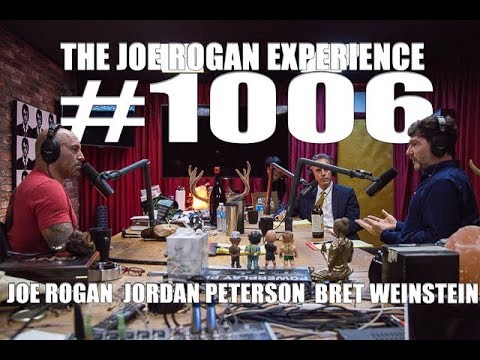
Joe Rogan Experience #1006 - Jordan Peterson & Bret Weinstein
Introduction
The video begins with the introduction of Jordan Peterson and Bret Weinstein. They discuss their excitement about the upcoming discussion.
Getting Started
- Jordan Peterson and Bret Weinstein express their excitement to be part of the discussion.
- The idea to have this discussion was initiated by Brett after seeing a tweet or YouTube clip from Jordan.
Evolutionary Perspective on Hitler
Bret Weinstein shares his interest in discussing Hitler's reputation from an evolutionary perspective, which relates to his previous project analyzing the Holocaust.
Analyzing Hitler's Reputation
- Bret Weinstein expresses his interest in understanding Hitler's reputation from an evolutionary perspective.
- He believes it is important not to dismiss someone like Hitler as crazy without fully understanding their motives and actions.
Evolutionary Perspective on Holocaust
Bret Weinstein discusses his undergraduate project with Bob Trevor, where they analyzed the Holocaust from an evolutionary perspective.
Analyzing the Holocaust
- Bret Weinstein explains that he worked on a project analyzing the Holocaust from an evolutionary perspective during his undergraduate studies.
- He wanted to challenge the common belief that Hitler was simply crazy and explore deeper motivations behind his actions.
Evergreen State College Controversy
The conversation shifts towards discussing Bret Weinstein's involvement in the controversy at Evergreen State College.
Background of Controversy
- Bret Weinstein briefly mentions being at the center of a controversy at Evergreen State College.
- He left the area but has not yet filed a lawsuit against the college.
- Despite attempts at negotiation, he feels that the college has not learned anything from the episode and continues to hold onto misguided beliefs and assumptions.
Post-Modernism and Social Justice Warriors
The discussion delves into the influence of post-modernism on social justice warriors and their belief in power dynamics.
Influence of Post-Modernism
- Jordan Peterson explains that post-modernists believe that power is the only means of expression and that hierarchical organizations are based solely on domination.
- He suggests that this belief justifies the arbitrary use of power by post-modernists.
- Bret Weinstein agrees, stating that this ideology leads to mob-like behavior among students who have been taught to view everything as a landscape of conflict between groups.
Evergreen State University Controversy
The conversation continues with further details about the controversy at Evergreen State University.
Extremes at Evergreen State University
- Bret Weinstein describes the extreme behavior witnessed at Evergreen State University, including students patrolling with baseball bats and demanding the president not use his hands while speaking due to microaggressions.
- He criticizes the students' lack of awareness regarding manipulation and their adherence to a distorted ideology.
Power Dynamics in Post-Modernism
The discussion focuses on how post-modernists view power dynamics and justify their actions through it.
Philosophy of Authority or Competence
- Jordan Peterson highlights that post-modernists reject any philosophy based on authority or competence, instead emphasizing power as the sole mediator in relationships.
- He suggests that this perspective allows them to justify their arbitrary use of power under any circumstances.
Punching Nazis and Charlottesville Incident
The conversation shifts towards discussing punching Nazis and the incident in Charlottesville.
Justification for Violence
- Bret Weinstein mentions the prevalent idea among social justice warriors to use any means necessary to combat what they perceive as the establishment.
- He criticizes the inconsistency in their actions, where they advocate for punching Nazis but fail to do so when actual white supremacists appear in Charlottesville.
Donald Trump's Reaction to Charlottesville
The discussion touches upon Donald Trump's reaction to the events in Charlottesville and his failure to take a strong stance against white supremacists.
Trump's Response
- Bret Weinstein expresses concern over Donald Trump's lack of condemnation towards white supremacists during the events in Charlottesville.
- He mentions that many conservatives distanced themselves from these groups and clarified their non-alliance with them.
The summary has been provided based on the given transcript. Some parts may be missing or incomplete due to limitations in the transcript provided.
The Suppression of Free Speech on University Campuses
In this section, the speaker discusses an incident in Canada where a panel discussion on the suppression of free speech on university campuses was cancelled due to pressure from protesters. The cancellation was prompted by the presence of a journalist who had covered the Charlottesville incident. The speaker reflects on the use of Nazi epithets and the lack of media coverage regarding counter-protesters using the hammer and sickle symbol.
Incident at Ryerson University
- A panel discussion on free speech at university campuses was cancelled by Ryerson University in Canada.
- The cancellation was influenced by protests against one of the panelists, Faith Goldie, who had covered the Charlottesville incident.
- Protesters used Nazi epithets and pressured the university to cancel the event.
- Counter-protesters rallied under the banner of the hammer and sickle symbol but received little media attention.
Symbolism and Perception
This section explores why symbols like swastikas are immediately associated with pathological personalities, while symbols like hammer and sickle do not have the same emotional impact. The speaker suggests that it may be due to historical ignorance or romanticization of certain figures.
Symbolic Associations
- Swastikas are seen as immediate identifiers of pathological personalities due to their association with Nazism.
- Hammer and sickle symbols, representing communism, do not produce the same emotional impact despite being associated with violence and oppression.
- Historical ignorance plays a role in people's perception of these symbols.
- Romanticization of figures like Che Guevara contributes to a lack of understanding about their true history.
Divisions between Right-Wing and Left-Wing Responses
This section discusses the different responses from right-wing and left-wing individuals when it comes to disassociating themselves from extremist ideologies. The speaker suggests that the right-wing is more effective at drawing boundaries, while the left-wing lacks a clear defining factor.
Responses to Extremist Ideologies
- Many conservatives quickly distance themselves from Nazis, while the right-wingers are better at drawing boundaries.
- Identifying radical leftists becomes more challenging as their defining beliefs, such as equity, lack the same emotional impact as symbols like swastikas.
- The danger lies in underestimating the potential reemergence of extremist ideologies due to a lack of understanding about their patterns and causes.
Understanding Tyranny and Prosperity
This section delves into the concept that tyranny is an endgame of prosperity. The speaker argues that there is a pattern where periods of prosperity can lead to complacency and allow for the reemergence of dangerous ideologies.
Tyranny and Prosperity
- Germany in the 1930s serves as a well-documented example of how certain patterns can emerge during periods of prosperity.
- These patterns can be driven by evolutionary factors and pose a constant danger if not understood.
- Tyranny often emerges after a period of apparent defeat or complacency.
- Recognizing these patterns is crucial in addressing and preventing dangerous ideologies from resurfacing.
Due to limitations on bullet points per section, some information may have been omitted.
The Nature of History and Polarization
In this section, the speaker discusses the nature of history and the process of polarization. They mention that they landed in political hot water due to their awareness of this polarization.
Recognizing the Nature of History
- The speaker emphasizes the importance of recognizing that polarization is a natural part of history.
- They believe it is highly probable that polarization will continue to occur.
- The speaker mentions that their own experience led them to be aware of this process.
Dangerous Counter Positions and Charlottesville
This section focuses on dangerous counter positions and their manifestation in events like Charlottesville. The speaker acknowledges the need to be cautious and not complacent about identifying extremist ideologies.
Manifestation of Dangerous Counter Positions
- The speaker warns against complacency in identifying extremist ideologies.
- They mention that there is weird activity in non-radical left spaces, which can contribute to dangerous counter positions.
- Events like Charlottesville demonstrate the presence of an unstable entity on both sides - radical left and far right.
Unstable Entities and Tribalism
This section explores the concept of unstable entities, tribalism, and its impact on political dynamics. The speaker highlights various elements contributing to instability.
Unstable Entities and Tribalism
- There are various elements contributing to instability, such as alt-left groups, kickass danny's, comedy, satire, serious discussions, inversion of identity politics.
- Identification with racial identity can be extraordinarily dangerous.
- On the far right, there is a stable version represented by white nationalism due to evolutionary cohesion.
- On the left, there is a new twist with a coalition of different tribal identities united but prone to internal dynamics ripping it apart.
Evolutionary Patterns and Pathological Traits
This section delves into evolutionary patterns, the naturalistic fallacy, and the potential for traits to become pathological when magnified beyond their proper limits.
Evolutionary Patterns and Pathological Traits
- The speaker clarifies that evolutionary patterns do not imply defense or endorsement.
- Evolution is an amoral process that produces both positive and negative human features.
- Some traits may have evolved as virtues in certain circumstances but can become pathological when exaggerated.
- The speaker shares a shocking discovery about Hitler's personality traits related to orderliness and disgust sensitivity.
Orderliness, Disgust Sensitivity, and Political Attitudes
This section explores the relationship between orderliness, disgust sensitivity, and political attitudes. The speaker discusses a study on the correlation between infectious diseases, authoritarianism, and right-wing political beliefs.
Orderliness, Disgust Sensitivity, and Political Attitudes
- Orderliness is associated with sensitivity to disgust.
- A study found a correlation between the prevalence of infectious diseases and authoritarian/right-wing political beliefs at both individual and regional levels.
- The discussed mechanism serves as an implicit racial/ethnic bias rooted in our evolutionary past.
- The need for order in society is linked to maintaining stability but can also be associated with dangerous ideologies.
Hitler's Table Talk and Disgust Sensitivity
In this section, the speaker discusses their findings while reading "Hitler's Table Talk" regarding conservatives' disgust sensitivity towards those who are different. They reflect on how this relates to orderliness in German civilization.
Hitler's Table Talk and Disgust Sensitivity
- Conservatives are not afraid of those who are different but rather disgusted by them.
- Disgust sensitivity is associated with orderliness, which is crucial for maintaining societal order.
- The Germans' strong sense of orderliness contributed to their civilization's greatness and power.
New Section
In this section, the speaker discusses the concept of a deeply rooted system that protects us from dangerous pathogens and how it manifests in the political realm. The speaker also expresses concern about dehumanizing others and the potential consequences of isolating certain populations.
The Danger of Meeting Populations
- There is an actual danger when populations meet, similar to a literal pathogen danger.
- This can generate an instinctive fear of the other, leading to a reluctance to meet.
- When populations go to war, there is a tendency to dehumanize the other population.
- Calling them subhuman or vermin is a common way of dehumanizing them.
- Concern about comforting ourselves by considering certain groups as subhuman justifies violence against them.
Isolating Contagion vs. Latent Program
- Treating certain groups as contagions that need to be isolated may lead to complacency.
- The actual hazard lies in recognizing that dehumanization is a latent program within human populations.
- This program can emerge when certain characteristics show up in the environment.
- Dehumanization cannot be isolated as something associated only with others.
Understanding Nazi Germany
- Teaching students about psychological understanding helps comprehend what happened in Nazi Germany.
- Rather than viewing Nazis as unlike oneself, it is important to recognize their humanity.
- Acknowledging that "the Nazi is us" challenges one's own potential behavior and limits.
New Section
In this section, the importance of uncensored discussions and taboo topics is highlighted. The speaker emphasizes the need for analyzing and discussing latent programs in human beings from an evolutionary perspective.
Importance of Uncensored Discussions
- Taboo topics and forbidden discussions can lead to the growth of certain ideas.
- Analyzing and discussing taboo topics helps understand their core components.
- Understanding latent programs in human beings is crucial from an evolutionary perspective.
Human Potential and Empathy
- Given different circumstances, anyone could have been part of a group with extreme ideologies.
- Recognizing one's own potential for such behavior is essential for empathy and understanding.
- The speaker reflects on personal considerations regarding the limits of their potential behavior.
New Section
This section explores the current state of sociological and psychological landscape, emphasizing radical instability. Small decisions made by individuals can have significant effects on the political landscape.
Radical Instability
- The sociological and psychological landscape is characterized by radical instability.
- Future outcomes can be significantly better or worse than the present situation.
- Small decisions made by individuals can have outsized effects on the overall dynamics.
Positive Feedback Loops
- Interactions between people often result in positive feedback loops, leading to polarization.
- Expressing opposing views can escalate tensions and lead to conflict.
- Pulling back from polarization requires open discussion and understanding of different perspectives.
Describing the Process of Demonization and Polarization
In this section, the speaker discusses the process of demonization and polarization in society, particularly within universities. They express concerns about the influence of radical Marxists in academia and the challenges of having discussions without contributing to polarization.
The Role of Personal Responsibility
- The speaker emphasizes the importance of personal responsibility instead of ideological identification.
- They suggest taking responsibility for one's capacity for evil and avoiding assumptions about others based on political disagreements.
- The speaker acknowledges that it is difficult to avoid becoming a participant in the process of polarization while trying to navigate personal responsibility.
Dangers of Polarization
- The speaker highlights how polarization can be a dangerous process, citing Germany's destabilization in the 1920s and 30s as an example.
- They mention that once organized, the radical right can become more powerful than the radical left due to their stability and access to firearms.
Fear of Civil War
- The speaker expresses concern over the possibility of civil war if ideological disagreements escalate into physical confrontations.
- They mention statements made by individuals suggesting that civil war may occur if certain political events take place.
- The speaker acknowledges that there are actions that can be taken to prevent such conflicts.
Challenges with Online Platforms and Censorship
This section focuses on challenges related to online platforms like Google and YouTube, specifically regarding censorship. The speaker discusses concerns about algorithms deciding what content is allowed, potential consequences of suppressing communication, and issues with manual video reviews.
Importance of Free Communication
- The speaker argues that free and open communication is crucial for defusing terrible ideas, identifying opportunities, and preventing descent into civil war.
- They believe that suppressing objectionable content has more dangerous consequences than allowing it to be discussed openly.
Concerns with Online Giants
- The speaker expresses concern about online giants like Google and YouTube deploying algorithms for pre-perceptual censorship.
- They mention the potential impact of these algorithms on communication, debate, and the ability to avoid conflicts like civil war.
Example of Censorship
- The speaker refers to a specific incident involving YouTube's demonetization of a video before it was even published.
- They question why certain videos are manually reviewed while others are not, highlighting the inconsistency in the process.
- The speaker mentions that the individual involved is an evolutionary biologist who questions what is happening but gets labeled as part of a right-wing hate group.
Biological Essentialism and Totalitarianism
In this section, the speaker discusses the concept of biological essentialism and its connection to totalitarian ideologies. They explain how radical constructionist claims deny biological essence and justify molding humanity according to ideological perfection.
Biological Essentialism vs. Radical Constructionism
- The speaker contrasts biological essentialism with radical constructionism.
- They explain that radical postmodern neo-Marxists believe human beings can be molded into anything, while biological essentialists recognize intrinsic human nature.
- The speaker argues that denying biological essence allows for justifying molding humanity based on ideology.
Totalitarian Motivations
- The speaker suggests that justifying radical constructionist claims aims to mold humanity according to an ideological agenda.
- They draw parallels between this motivation and historical events in communist Russia where wiping out past identities allowed for shaping humans based on ideology.
Timestamps have been associated with bullet points as requested.
The Opposite of Politically Correct in Biology
In this section, the speaker discusses how the study of biology often goes against political correctness. They argue that the truth in biology should not be suppressed for ideological reasons.
Biology and Political Incorrectness
- The speaker suggests that studying biology often leads to politically incorrect conclusions.
- They emphasize that the truth in biology should not be sidelined for ideological purposes.
Biology's Potential for Racism and Sexism
This section explores how biology can create entities with potential for racism and sexism due to genetic factors.
Genetic Potential for Racism
- The speaker explains that our genomes carry the potential for racism due to Darwinian reasons.
- They highlight that one population can gang up on another population, leading to historical instances of racism.
Genetic Potential for Sexism
- The speaker acknowledges that sexism is different from racism but still exists due to biological factors.
- They state that male genes cannot gang up on female genes because genes spend equal time in male and female bodies.
- However, they note that civilization may not always be fair with respect to sex and gender.
Understanding Biological Objectives and Patriarchy
Here, the speaker delves into understanding biological objectives and their implications on patriarchy.
Biological Objectives vs. Patriarchy
- The speaker argues that understanding our genes' objectives helps us recognize their irrationality.
- They assert that there is no biological basis for a patriarchal force subordinating women.
- Those who are part of a patriarchy suffer its consequences in subsequent generations.
Recognizing Genes' Objectives and Diffusing Racism
This section emphasizes the importance of understanding our genes' objectives to address and diffuse racism.
Understanding Genes' Objectives
- The speaker suggests that recognizing our genes' objectives allows us to free ourselves from their control.
- They state that what our genes want cannot be defended rationally, and we should not assume it excludes racism.
Social Constructionism and Transgender Rights in Canada
This section discusses the speaker's concerns about social constructionism and transgender rights in Canada.
Social Constructionism in Canadian Law
- The speaker criticizes a social constructionist version of human identity embedded in Canadian law.
- They highlight that it is now illegal to claim a causal connection between biological sex, gender identity, gender expression, and sexual proclivity.
Biological Essentialism and Freedom from Biology
Here, the speaker explores the concept of biological essentialism and the need for freedom from biology.
Dangers of Biological Essentialism
- The speaker acknowledges the dangers of biological essentialism leading to eugenics-like ideologies.
- They caution against denying biology as it hinders rational problem-solving regarding biological urges.
Rational Discussion on Biological Factors
- The speaker emphasizes the importance of discussing biological factors to mitigate issues related to our biological urges.
- They argue that humans have the ability to be rational about these matters and make informed choices for the future.
Biological Programming and Socialization in Boys
This section focuses on biological programming and socialization in boys, particularly regarding aggression.
Biologically Hyper-Aggressive Boys
- The speaker mentions that a small subset (about 5%) of males exhibit biologically hyper-aggressive behavior from an early age.
- However, most boys are socialized by age four to manage their aggression appropriately.
The Interplay Between Biological Circuitry and Socialization
In this section, the speaker discusses the interplay between biological circuitry and socialization. They refute the accusation that James de Maura took a biological essentialist route and explain that there is credible evidence of biologically mediated differences between men and women in temperament and interest.
Biological Differences Between Men and Women
- There is credible evidence of biologically mediated differences between men and women in temperament and interest.
- The science on these differences is sufficiently settled to be considered scientifically credible.
- However, it does not mean that these differences are inherently right or wrong.
Extracting Maximum Economic Value
- Society should aim to extract maximum useful economic value from talented individuals, regardless of their gender.
- Understanding the actual differences between men and women can help set up workplaces where both genders can contribute economically.
Agreeableness and Economic Success
- On average, women tend to be more agreeable than men due to their self-sacrificing nature, which may be wired for infant care.
- However, being more agreeable can hinder economic success as it may lead to less effective negotiation for higher salaries.
Maximizing Economic Contribution Across Genders
- Biologically speaking, certain kinds of wisdom may be biased towards manifesting in females due to their capacity for fewer offspring in a lifetime.
- Males, on the other hand, have high variance in reproductive success.
- Both types of wisdom can be democratized by encouraging individuals to tap into historically male-biased wisdom regardless of their gender.
Addressing Pay Differential
- Agreeable people overall tend to make less money due to their reluctance to negotiate on their own behalf.
- Intelligent public or corporate policies could be implemented to address this issue, such as reviewing male and female salaries at different intervals.
James d'amour's Case
- James d'amour, who summarized the literature on gender differences, was fired for expressing his opinion after being subject to mandatory diversity training.
- The discussion on gender differences is often hindered by the claim that men and women are exactly the same, which is not helpful.
- It is important to have a reasonable discussion about gender differences to maximize economic contribution across genders.
The transcript has been summarized in a clear and concise manner using timestamps when available.
The Role of Journalists and Ethical Lapses
In this section, the speaker discusses the potential impact of journalists' actions on the state of society. They highlight that journalists can either contribute to chaos due to incompetence or malicious intent. It is emphasized that journalists should be cautious about their reporting and motives.
Journalistic Responsibility and Consequences
- Journalists may play a causal role in bringing about negative outcomes if they act incompetently or maliciously.
- If things go badly in the future, journalists could reflect on their ethical lapses during previous coverage and acknowledge their contribution to societal collapse.
- The current situation is described as radically unstable, emphasizing the need for caution in what journalists write and say, as well as their motives for criticizing others.
Misuse of Accusations and Memes
This section focuses on the misuse of accusations, particularly labeling someone as racist without sufficient evidence. The speaker shares personal experiences with online trolling using Pepe the Frog memes and highlights how such accusations can be baseless.
Unjustified Accusations of Racism
- There is a growing trend of quickly labeling individuals as racists without proper justification. This phenomenon is described as strange and unprecedented.
- The speaker mentions trolling with Pepe the Frog memes to demonstrate how innocent content can be wrongly associated with racism. They express confusion over why harmless memes are considered racist by some people.
- Creating memes with Pepe the Frog does not imply coordination or endorsement of any particular ideology; anyone can make a meme using this character. Original Pepe memes often had no political connotations but were simply silly or humorous in nature.
Misrepresentation and Confusion Surrounding the Alt-Right
The speaker delves into their personal experiences with being associated with the alt-right due to misunderstandings surrounding Pepe the Frog. They discuss the confusion and lack of clarity regarding what the alt-right truly represents.
Personal Experiences and Misunderstandings
- The speaker shares their personal encounter with being associated with the alt-right due to wearing a frog hat in a video. They explain that this association was unintentional and unexpected.
- Exploring the concept of Kekistan, which is often linked to the alt-right, they found a story that seemed preposterous and designed to confuse readers. It highlights how misinformation can contribute to misconceptions about certain groups or ideologies.
- The speaker acknowledges that understanding the alt-right is challenging as it encompasses various manifestations, including satirical elements like Kekistan. They express their ongoing efforts to investigate and comprehend its complexities.
Individuality vs Ideological Identification
This section focuses on individuality as an alternative to ideological identification. The speaker emphasizes personal responsibility, avoiding ideological extremism, and finding one's own path instead of reacting solely against opposing ideologies.
Embracing Personal Responsibility
- The speaker advocates for adopting personal responsibility as an alternative to political ideology. They encourage individuals to take charge of their lives, think critically, avoid ideological simplifications, and strive for self-improvement.
- Western civilization's remarkable realization is seen as valuing well-developed individuals who can counteract societal and biological tyranny through personal sovereignty. Deviating from this path by reverting to ideological identification based on race or sex may lead to societal division and conflict.
- The speaker suggests that instead of seeking an opposite ideology, individuals should consider embracing different perspectives and finding their own unique path. Reacting solely against the opposing side can lead to further polarization and loss of personal sovereignty.
The Power of Individuality in Western Civilization
This section highlights the significance of individuality in Western civilization and its potential to counteract societal and biological constraints. The speaker emphasizes the importance of personal development over ideological identification.
Individuality as a Pillar of Western Civilization
- The speaker asserts that the well-developed individual is a crucial discovery of Western civilization, offering an antidote to societal and biological tyranny. This concept has been hyper-developed in the West compared to other cultures.
- When individuals abandon the pathway of divine individuality and succumb to ideological identification based on race or sex, it can lead to societal fragmentation and conflict. Upholding personal responsibility and avoiding ideological extremism is essential for maintaining social harmony.
Timestamps are approximate and may vary slightly depending on the source video's version or edits made after transcription.
The Connection Between Personal Auditing and Cultural Issues
In this section, the speaker discusses the connection between personal auditing programs and cultural issues. They emphasize that personal auditing is not separate from the cultural struggles we face today.
Personal Struggle and Understanding
- Lack of struggle and understanding of struggle in society.
- Importance of overcoming difficult issues to unlock true potential.
- Need to seek out voluntary challenges to grow mentally and physically.
Embracing Tragic State of Being
- Being a human being is a tragic state.
- Shrinking from this reality leads to increased suffering, resentment, and malevolence.
- Moving forward courageously is the pathway to growth and fulfillment.
Individual Thinking for Collective Progress
- Collectivist movements lack forward-thinking due to conformity.
- Discovering new ways requires individuals capable of independent thinking.
- Free speech plays a crucial role in allowing individuals to express unique ideas.
Innovation at the Fringes
- Innovations emerge from individuals who are not well situated or comfortable.
- Experimentation at the border between chaos and order leads to new discoveries.
- Both individual creativity and population evolution follow this pattern.
Torment as a Catalyst for Creativity
This section explores how tormenting problems can fuel creativity. The speaker discusses how losing a parent before the age of 10 can predict high levels of creative success. They also delve into the evolutionary landscape behind religious convictions.
Torment as Fuel for Creativity
- Creative individuals are often tormented by problems they seek to solve.
- Torment provides motivation, time investment, and risk-taking necessary for creativity.
Individual Innovation as Savior of the Collective
- Individuals play a crucial role in innovating new ideas within collectives.
- The lone voice challenging the status quo is a recurring theme in religious and historical contexts.
- Evolution shapes texts and beliefs through populations' bottleneck experiences.
Strengthening the Individual
- The speaker's interest lies in strengthening the individual.
- The first book, "Maps of Meaning," explores ideological conflict and alternatives to it.
The Role of Individuals in Innovation
This section further discusses the role of individuals in innovation. The speaker highlights how individual innovation aligns with essential Christian and Jewish principles.
Individual Innovation as Essential
- Individual innovation aligns with essential Christian and Jewish principles.
- Individuals are often the saviors of collectives due to their ability to innovate.
- Evolutionary processes shape beliefs and texts based on successful innovations.
Due to the limited content provided, this summary may not capture all aspects discussed in the full transcript.
The Emergence of the Divine Individual
In this section, the speaker discusses the importance of bringing one's unique qualities into the collective landscape and how it updates the collective. They mention their biblical lectures on Genesis and how they aim to make the stories accessible to both atheists and theists.
The Bible as Documentation of the Divine Individual
- The Bible is seen as a documentation of the emergence of the idea of the divine individual.
- There is an uneasy relationship with these texts because they are often interpreted as making claims about the objective nature of the world, which may conflict with scientific perspectives.
- However, the speaker believes that these claims were not intended to be taken literally from a scientific standpoint.
Making Biblical Stories Accessible
- The speaker has been lecturing on stories in Genesis to make them accessible to both atheists and believers.
- Many atheists have responded positively to these lectures, understanding them as describing an idea that consciousness mediates between chaos and order, akin to a divine category of existence.
Pathway for Manifesting as a Divine Individual
- The speaker explores how biblical stories lay out a pathway for individuals to manifest themselves in time as divine individuals.
- They specifically mention studying Abrahamic stories, where Abraham is called by God at an older age and embarks on a journey into unfamiliar territory.
- Despite encountering challenges such as famine and attempts to steal his wife, Abraham perseveres through moral orientation and sacrifices.
Reconciling Truth Perspectives
In this section, the speaker addresses their perspective on truth in relation to Sam Harris' views. They introduce the concept of "literally false metaphorically true" ideas that can provide advantages when acted upon.
Literally False Metaphorically True Ideas
- The speaker introduces the concept of "literally false metaphorically true" ideas, which are not factually true but can provide advantages when believed and acted upon.
- They give examples such as porcupines being able to throw their quills (not true) but believing so can lead to giving them space for safety.
- Another example is the belief that everything happens for a reason, which may help individuals find opportunities in difficult situations.
Religious Truths as Metaphorical
- The speaker argues that religious truths fall under the category of metaphorical truths rather than literal truths.
- They mention that while religious doctrines encode various truths related to individuals, families, and populations, it does not guarantee moral correctness.
- The speaker suggests that metaphorical truths in religious traditions can be effective yet potentially reprehensible.
Encoded Metaphorical Truths in Religious Traditions
In this section, the speaker discusses the encoded metaphorical truths found in religious traditions and addresses potential moral implications. They highlight the need to consider both individual and collective truths.
Encoded Metaphorical Truths
- The speaker acknowledges that religious doctrines carry encoded metaphorical truths related to individuals, families, and populations.
- However, they caution against assuming these encoded truths will always align with moral correctness.
Moral Implications of Metaphorical Truths
- The speaker points out that there is no inherent guarantee that metaphorical truths within religious traditions will be morally right.
- They argue that some metaphorical truths may be effective yet reprehensible from a moral standpoint.
Conclusion
The transcript covers topics such as the emergence of the divine individual in biblical stories, reconciling perspectives on truth through "literally false metaphorically true" ideas, and addressing potential moral implications of encoded metaphorical truths in religious traditions.
Understanding the Great Myths and Archetypes
In this section, the speaker discusses the archetypes present in great myths and how they relate to our understanding of Western society as patriarchal. The speaker also mentions the story of Pinocchio as an example of individualization.
Archetype of the Tyrannical Father
- The archetype of the tyrannical father is often associated with those who accuse Western society of being patriarchal.
- It is important to recognize that there can be both a tyrannical father and a wise king archetype.
- Some ancient representations depict the dead past.
Story of Pinocchio
- Pinocchio starts as a puppet, a marionette, who is pulled by forces he does not understand.
- His good father, Geppetto, wishes for him to become a real individual.
- Geppetto represents a good king.
- When Geppetto loses Pinocchio, he ends up stultified in the belly of a whale symbolizing chaos at the bottom of the ocean.
- Pinocchio has to rescue his father from the whale.
Evolutionarily Accumulated Wisdom
- The great stories from the past contain evolutionarily accumulated wisdom but are still considered dead.
- There is a need for an active force in updating and maintaining this wisdom in the present.
Role of Active Force
- The active force generated these stories across time and is alive in the present.
- Our moral duty is to rescue our dead fathers from their metaphorical whales by updating ancient wisdom.
Updating Ancient Wisdom
- The landscape has changed incrementally or even revolutionarily, making old truths partial or blind.
- Destroying or dismissing the past entirely would be detrimental; instead, we need to update and maintain it.
Navigating Ancestral Wisdom and Current Hazards
In this section, the speaker discusses the tripartite structure of the Godhead in Christian theology and the need to navigate ancestral wisdom that may not be up-to-date. The speaker emphasizes the importance of realizing archetypes within our own lives.
Tripartite Structure of the Godhead
- The Godhead in Christian theology has a tripartite structure: God the Father, Son (Christ), and Holy Spirit.
- The father represents ancient wisdom but is no longer alive to participate in updating processes.
Rescuing Dead Father from Whales
- Our moral duty is to rescue our dead fathers from metaphorical whales, symbolizing chaos or outdated beliefs.
- Biblical lectures aim to update ancient wisdom by navigating current hazards.
Religious Texts as Adaptations
- Religious texts and religions are adaptations to past environments.
- They contain metaphorical truths that may not be literal but still hold value.
- Ancient religions are not up-to-date for current hazards like Google's algorithms.
Erroneous Stories and Abstract Truths
In this section, the speaker discusses how mythological stories can be erroneous in detail but right in pattern. He explains how abstract entities in religious myths can be applicable across different contexts.
Mythological Hero Standing Against Tyranny
- One truth present in mythological stories is that heroes stand up against tyranny, without specifying its nature.
- These stories operate at an abstract level applicable across different contexts.
Phenomenology of Experience as Chaos and Order
- Representing one's experience as a domain of chaos and order is extremely useful.
- This abstraction applies universally to every person's experience.
Updating Ancient Wisdom with Abstractions
- Ancient religious myths operate at an abstract level, making their entities applicable universally.
- We can manifest archetypal truths within the confines of our own lives, updating ancient wisdom.
Navigating Ancestral Wisdom
- The challenge lies in navigating where ancestral wisdom is not up-to-date with current hazards.
- Stories contain errors in detail but hold abstract truths that can be applied across different contexts.
The Balance Between Chaos and Order
In this section, the speaker discusses the importance of finding a balance between chaos and order in various contexts. They mention how Daoists have a conceptualization of the phenomenological landscape that emphasizes the point of maximum being at the center of chaos and order.
Finding Stability in Chaos and Order
- The Daoists have a unique perspective on balancing chaos and order.
- Being stable and dynamic at the same point is desirable.
- The point of maximum being is believed to be at the border between chaos and order.
Legacy Code vs. Benefit
- There is a consideration of when legacy code becomes more harmful than beneficial.
- Taking outdated packages may hinder progress if they are not compatible with modern needs.
Recognizing Incomplete Wisdom
- Ancestral wisdom carried by traditions may be incomplete for addressing modern questions.
- It is important to honor traditions while recognizing the need for more up-to-date knowledge.
Ancient Wisdom and Modern Questions
This section explores whether ancient wisdom from religious texts can adequately address modern questions. The speaker raises concerns about certain concepts not being mentioned due to their absence during ancient times.
Enriching Uranium as a Commandment?
- The speaker suggests that if God were writing today, enriching uranium might be considered a top commandment.
- This highlights how some hazards were not recognized or emphasized in ancient times due to their absence as concepts.
Incomplete Ancestral Wisdom
- While ancestral wisdom carries value, it may be incomplete for addressing modern questions.
- Recognizing this allows for moving forward with more potent and up-to-date knowledge.
Challenges in Updating Traditions
- Rewriting ancient fairy tales or religious texts to suit modern times is challenging.
- Some traditions are thousands of years old, making it difficult to update them effectively.
The Universality and Differences in Religious Texts
This section delves into the universality and differences among religious texts. The speaker expresses uncertainty about whether all religious texts encode profound and evolutionarily determined truths.
Universal Truths or Unique Differences?
- While some claim that all religious texts contain universal truths, this may overlook important differences between traditions.
- The speaker questions whether Islam's totalizing nature makes it unique among religions.
The Challenge of Using the Term "Truth"
- Using the term "truth" can be problematic when discussing different contexts.
- Metaphorical truth and objective truth have distinct meanings and implications.
Porcupines as an Example
- The speaker uses porcupines as an example to illustrate different types of truth.
- Teaching children about porcupine quills being dangerous is a metaphorical truth for their safety.
Uncertainty and Multiple Definitions of Truth
This section explores the issue of using the term "truth" and how it can have multiple definitions. The speaker discusses how certain beliefs may be products of natural selection rather than objective truths.
Beliefs Shaped by Natural Selection
- Beliefs about porcupines throwing quills may be shaped by natural selection.
- Those who encoded this belief had an advantage in terms of survival.
Steering Children Wrong
- Providing incorrect models or beliefs about porcupines can lead to steering children in the wrong direction.
- It is crucial to consider the potential consequences of inaccurate information.
Terminology of Truth
- There are different definitions and interpretations of truth.
- Objective truth is not the only form; there are subjective, metaphorical, and other variations.
Objective and Subjective Truth
This section addresses the terminology of truth and clarifies the speaker's usage of the term. The distinction between objective truth and subjective truth is discussed, along with its historical context.
The Definition of Truth
- The original notion of truth was not solely objective but also included reliability.
- Christ's statement "I am the truth" had a different meaning than objective truth.
Misinterpretation of Truth
- Sam Harris misunderstood the speaker's utilization of truth.
- Objective truth is not the only valid interpretation; there are multiple definitions.
Commensurate Truths
- There may be two kinds of truths that can coexist or dissociate.
- These truths can be stacked on top of each other but may have separate interpretations.
The Accuracy of Wisdom and Facts
In this section, the speaker discusses the relationship between wisdom and facts, using examples from biblical stories and scientific knowledge. They explore how sometimes wisdom can be accurate even if it doesn't align with objective facts.
Wisdom vs. Objective Facts
- The speaker gives an example of malaria to illustrate how wisdom can be partially accurate even if it doesn't align with objective facts.
- There is a distinction between the truth of a description and the truth of a tool. People's fundamental truths are often used as tools to function in the world, even if they don't perfectly represent objective reality.
- Sometimes our truths about the world are limited by our lack of knowledge, but they can still be useful in practical terms.
- The speaker argues that there are different types of truth: tool truths and objective fact truths. While they ideally align, we may not always have enough knowledge to make them perfectly match.
Practical Wisdom and Health
- The speaker discusses how certain truths in ancient texts like the Old Testament were based on practical wisdom rather than scientific understanding. For example, dietary restrictions may have been implemented for hygienic reasons before germ theory was known.
- They argue that it is more important to act safely based on practical wisdom than to wait for a complete understanding of objective facts.
- Hygienic concerns and group identity may have influenced dietary restrictions in ancient texts.
Fact and Wisdom
- The speaker suggests categorizing truth into fact and wisdom. It is ideal when facts and wisdom align, but often they do not.
- Wisdom should not be dismissed just because it doesn't align with objective facts. The speaker criticizes the approach of some individuals like Dawkins and Harris who prioritize facts over wisdom without considering their interplay.
- Grounding wisdom solely in facts is questioned, as it may not necessarily lead to optimal actions or ethical considerations.
Mapping Facts onto Action
- The process of mapping facts onto action is complex and cannot be simplified by having all the relevant facts. There are infinite ways to interpret and act upon a set of facts.
- The speaker suggests that Sam Harris oversimplifies the relationship between facts and action, ignoring the complexity involved in determining appropriate paths based on aggregated facts.
This summary covers a portion of the transcript provided.
The Role of Wisdom and Ethics in Civilization
In this section, the speaker discusses the importance of wisdom and ethics in guiding civilization. They emphasize that while we may not have a complete understanding of everything, it is crucial to base our actions on what is true and beneficial for society.
Wisdom and its Constraints
- Wisdom should be based on our best understanding of truth, acknowledging that we don't have a complete map of knowledge.
- There is wisdom that has been passed down through generations which cannot be easily dismissed.
- Wisdom must work in the world and maintain relationships with others.
- Actions guided by wisdom should benefit both individuals and society without undermining the social structure.
The Postmodern Conundrum
- Postmodernists argue that there are infinite interpretations of facts, making it difficult to agree on a single interpretation.
- However, they fail to consider ethical constraints when evaluating interpretations.
- While there may be countless interpretations, only a few are applicable and functional in the real world.
- The landscape of applicable interpretation is constrained by ethical considerations.
The Limitations of Postmodernism and the Influence of Marxism
This section explores the limitations of postmodernism and its connection to Marxism. It highlights how postmodernism's focus on infinite interpretations leads to nihilism, while Marxism provides a structured alternative with socialist aspects.
Postmodernism's Dead End
- Postmodernism acknowledges the problem of perception hindering objective action but fails to provide practical solutions.
- Due to an infinite number of choices, postmodernists turn to Marxism as a predefined alternative.
- An unholy alliance between postmodernists and neo-Marxists emerges due to postmodernism's lack of applicable wisdom.
Marxism as an Alternative
- Marxism offers a clearly defined alternative that has been embraced in the past.
- It is romanticized and seen as having socialist and egalitarian aspects.
- Postmodernism historically grew out of Marxism, leading to their connection.
The Reasons Behind the Adoption of Marxism
This section delves into the reasons why postmodernists adopt Marxism. It suggests that capitalism's negative perception drives them towards an alternative, and Marxism provides a structure with socialist elements.
Perception of Capitalism
- Postmodernists view capitalism negatively and seek an alternative.
- They see socialism as an egalitarian approach that promotes equality.
Connection between Postmodernism and Marxism
- Historically, postmodernism emerged from Marxism.
- Postmodernism's infinite interpretation problem led to nihilism, prompting a turn towards Marxism for structure.
- An alliance between postmodernists and neo-Marxists arises due to the appeal of Marxist principles.
The transcript has been summarized based on the given timestamps.
The Motivations Behind Marxism and Postmodernism
In this section, the speaker discusses the motivations behind Marxism and postmodernism, highlighting the resentment-driven anti-capitalism as a fundamental motivator.
Resentment, Ideological Totality, and Security
- Marxism is driven by a sense of being on the side of the oppressed and fighting for what's right.
- Resentment plays a role in wanting to cut down those who have more.
- Postmodern philosophy emerged as a screening tactic to transform Marxism into identity politics.
- Being both a postmodernist and a Marxist is contradictory, raising questions about people's motivations.
- Resentment-driven anti-capitalism is one of the main motivators behind these ideologies.
The Appeal and Flaws of Marxism
This section explores why Marxism has appeal despite its flaws. It touches upon Marx's critique of capitalism, which resonates with some aspects of reality, but fails when it comes to practical implementation.
Marx's Critique and Toxic Prescription
- Marx's critique of capitalism contains elements that are accurate and resonate with certain realities.
- However, his prescription for an alternative system is toxic and not viable in practice.
- People are drawn to Marxism because of its compelling narrative, even though it lacks functional stability.
The Failure to Account for Human Nature
Here, the speaker explains how Marxism fails to account for human nature and what makes society function. He also addresses criticisms related to fascism.
Ignoring Human Nature
- A major flaw in Marxism is its failure to consider what it means to be human and how societies function.
- Society requires understanding human beings' inherent characteristics for any system to work effectively.
The Pareto Distribution and Inequitable Distribution
This section delves into the Pareto distribution, which explains the unequal distribution of success and wealth in various domains. It highlights how this phenomenon challenges Marxist ideas about capital accumulation.
The Pareto Distribution
- The Pareto distribution describes a pattern where a small minority achieves significant success while the majority experiences little to no success.
- Capital accumulation in the hands of a few is not unique to capitalism but occurs in all systems of production.
- Competition leads to disproportionate rewards for a tiny percentage of individuals, creating instability and dissatisfaction.
Diversification and Positive Correlation
This section explores how diversifying productive domains can address some issues with inequitable distribution. However, it also discusses the challenge of positive correlation among successful individuals.
Diversification as a Solution
- Diversifying productive domains allows for more opportunities for success outside traditional avenues.
- However, even with diversification, there can still be positive correlation among successful individuals.
- Useful and valuable resources tend to distribute inequitably across different domains due to their inherent properties.
Econo Physics and Money Distribution
Here, the speaker mentions econo physicists who study money distribution using mathematical equations similar to those used in physics.
Money Distribution as an Empirical Phenomenon
- Econo physicists study money distribution using mathematical equations borrowed from physics.
- Money distribution follows patterns similar to the propagation of molecules in gas or vacuum.
- Marx observed that capital tends to accumulate in fewer hands, but this is not exclusive to capitalism; it occurs universally.
The summary has been created based on the provided transcript.
The Distribution of Power and Success
This section discusses the distribution of power and success in society, particularly in relation to wealth and influence. It explores the argument that those who have more should share their resources with the less privileged.
Concentration of Power and Competence
- The Pareto distribution explains how some individuals accumulate vast amounts of wealth or influence.
- There is a debate about whether those who are successful should share their resources with the less privileged.
- Free marketers argue that they are not compelling anyone to download or consume their products; it is a matter of personal choice.
Maximizing Potential Output
- To maximize potential output, it is important to focus on what people are doing wrong rather than concentrating solely on what they are doing right.
- The Future Authoring program aims to identify factors that contribute to individual success.
Challenges Faced by Those at Zero
- Individuals who have no money face significant challenges in improving their situation.
- Lack of financial resources makes it difficult for them to participate in economic activities and escape poverty.
- Revolutionary movements often appeal to those stuck at zero, offering hope for change through radical means.
Motivation from Necessity
- Being driven by brute necessity can be highly motivating, especially for individuals facing extreme privation.
- First-generation immigrants often excel due to their drive and determination born out of necessity.
Levels of Absolute Privation
- While motivation from necessity can be powerful, there are levels of absolute privation where goodwill alone cannot lift individuals out of poverty.
- In certain third-world countries with limited opportunities, escaping poverty becomes extremely challenging.
The Zero Issue
This section delves deeper into the concept of being at zero and highlights the different levels of privation experienced by individuals. It also discusses the limitations of goodwill in addressing extreme poverty.
The Zero of Zero
- Some individuals face absolute privation with no means of escape, particularly in underdeveloped regions.
- Living in small villages with limited resources and opportunities can trap people in a cycle of poverty.
Motivation from Necessity
- Being driven by necessity can provide motivation for individuals to strive for a better future.
- First-generation immigrants often exhibit exceptional drive and determination due to their challenging circumstances.
Limitations of Goodwill
- While motivation from necessity is valuable, there are levels of privation where goodwill alone cannot alleviate extreme poverty.
- In certain third-world countries, systemic issues and lack of opportunities hinder upward mobility.
The transcript provided does not contain any timestamps beyond 1:40:53.
Focusing on What You're Doing Right vs. Wrong
The speaker discusses the importance of focusing on both what you're doing right and what you're doing wrong simultaneously to maximize progress. They highlight the problem of not understanding our evolutionary wiring to pursue new opportunities and turn them into more consumption, which perpetuates a state of privation.
Importance of Simultaneously Focusing on Right and Wrong
- It is crucial to concentrate on both what you're doing right and what you're doing wrong simultaneously.
- By doing so, you can maximize progress at a faster rate.
Understanding Our Evolutionary Wiring
- We are wired to discover opportunities that benefit our population and turn them into more consumption or more mouths to feed.
- This pursuit of new opportunities often leads us away from stabilizing the benefits for long-term satisfaction.
- To address the problems that communism fails to solve, we need to engineer around this feature of human beings.
Example: Ancient Farmer and Wheel Invention
- An ancient farmer with a piece of land discovers or invents the wheel.
- The wheel allows for more efficient farming, resulting in increased food production without additional labor.
- This surplus could be stabilized as a success by turning it into persistent luxury or using it for important investigations.
- However, if the surplus is turned into more mouths to feed, it restores the state of privation.
Balancing Innovation, Inequality, and Stability
- Innovation requires allowing individuals to compete in an untrammeled space but can lead to unequal distributions of spoils.
- Too much inequality destabilizes society, leading to potential upheaval.
- Intelligent discussions between left and right perspectives are necessary to find a balance between innovation and binding inequality.
Addressing Inequality through Redistribution
- Resources need to be funneled down from those at the top to those with zero to provide opportunities for innovation and prevent system instability.
- The issue of redistribution needs careful consideration, although a guaranteed annual income is seen as a solution that addresses the problem of hyper productivity and unequal distribution.
Cost of Inequality for Innovation
The speaker discusses the cost of inequality in relation to innovation. They emphasize the need for an intelligent conversation between left and right perspectives, acknowledging both the importance of innovation and the destabilizing effects of excessive inequality.
Balancing Innovation and Inequality
- Allowing individuals to compete in an untrammeled space fosters innovation but can result in unequal distributions.
- Too much inequality destabilizes society, leading to potential upheaval.
- An intelligent discussion between left and right perspectives is necessary to find a balance between innovation and binding inequality.
Empirical Evidence on Inequality and Crime
- Excessive inequality drives crime rates up, regardless of political ideology.
- While there may be debates about the reasons behind this correlation, it is undeniable that inequality contributes to increased crime.
Oversimplifications in Political Discussions
- Radical oversimplifications hinder meaningful political discussions.
- Viewing anyone with more than another person as an oppressor or anyone with less as virtuous victimized is non-productive.
- A real problem exists that requires thoughtful consideration from all sides.
The Importance of Social Responsibility and Cognitive Abilities
In this section, the speaker discusses the importance of providing individuals with a place where they can accept social and individual responsibility in an honorable manner. They also highlight the issue of cognitive abilities and its impact on employment opportunities.
Beasts of Burden and Social Responsibility
- Individuals need a place where they can accept social responsibility in an honorable manner.
- Without such a place, people degenerate and die.
- The current opiate crisis is a result of men not being able to fulfill their social responsibilities.
Cognitive Abilities and Employment
- It is illegal to induct anyone into the Armed Forces if they have an IQ below 83.
- The military believes that individuals with an IQ below 83 cannot be trained for any productive tasks.
- This restriction affects around ten percent of the population.
- In today's cognitively complex society, computer literacy is crucial for employment opportunities.
- Those who are not literate enough to use computers face significant challenges in finding jobs.
Motivation by Inequality and Technological Challenges
This section explores how people are motivated by inequality rather than absolute well-being. It also highlights the challenges posed by technology in perceiving inequality accurately.
Motivation by Inequality
- People are more motivated by the degree of inequality than their own level of well-being.
- Evolutionarily, individuals focus on what others are doing better to learn from them.
- In modern times, technology presents artificial portrayals of wealthier individuals, triggering feelings of inadequacy.
Technological Challenges
- Technology interfaces poorly with our brains, leading to distorted perceptions of massive economic inequality.
- Comparing oneself to others through technology may lead to false assumptions about personal shortcomings.
Austerity, Tribalism, and Triggering Population Conflict
This section discusses the role of austerity measures in maintaining inequality and how it can trigger population conflicts. The importance of avoiding signals that suggest limited opportunities is emphasized.
Austerity Measures and Inequality
- Austerity is used as a threat to prevent rebellion against inequality.
- This creates conditions that may lead to tribal conflicts between populations.
- When people feel their growth opportunities are limited, they may turn against those who are more powerful.
Avoiding Population Conflict
- To avoid population conflict, signals suggesting limited opportunities should be minimized.
- Providing sufficient well-being can reduce perceptions of inequality to a tolerable level.
The Importance of Fairness and Ethics
This section emphasizes the significance of fairness and ethics in maintaining social stability. The speaker highlights the need for a fair game where everyone has an equal chance at success.
Fairness and Ethics
- Fairness is crucial for social stability.
- People cannot play crooked games, and the rich should not fix the game in their favor.
- Some individuals are fixing the game, leading to dissatisfaction among others.
Universal Basic Income and Equality of Opportunity
This section explores the potential benefits of universal basic income (UBI) and equality of opportunity in addressing inequality. It also discusses how resentment arises when people perceive the game as fixed.
Universal Basic Income (UBI)
- UBI can address inequality by providing a baseline level of well-being for all individuals.
- Equality of opportunity reduces resentment towards others' success if people believe they have a fair chance at success too.
Rotten Game and Postmodernism
This section discusses the perception that the economic system disproportionately benefits the rich and how it contributes to dissatisfaction. The role of postmodernism in exacerbating inequality is also mentioned.
Disproportionate Benefits and Dissatisfaction
- The restabilization of the economic system after the 2008 collapse seemed to benefit the rich more.
- This indicates a fundamental flaw in the game, leading to dissatisfaction among others.
Postmodernism's Role
- Postmodernism and neo-Marxism contribute to increasing inequality.
- These ideologies perpetuate a sense of perniciousness in society.
The transcript provided does not cover the entire video, so these notes are based on the available content.
The Consequences of Failing to Distinguish Productive People from Criminals
In this section, the speaker discusses the potential consequences of failing to distinguish productive individuals from criminals. Drawing parallels with the Soviet Union in the 1920s, he warns against radical egalitarianism that could lead to the elimination of productive people and eventual starvation.
Potential Doom Scenario
- Failing to differentiate between productive individuals and criminals can have dire consequences.
- The speaker references the Soviet Union in the 1920s as an example of what can happen when radical egalitarianism is implemented.
- Radical egalitarianism can result in wiping out productive individuals, leading to starvation.
Universities' Role in Promoting Equality and Oppression Narrative
This section focuses on the role of universities in promoting a narrative that attributes all inequality to oppression and power. The speaker expresses his concern about this narrative being technically incorrect and criticizes universities for actively agitating to produce individuals who believe in this perspective.
Misconception about Inequality
- Universities are actively promoting a belief that all inequality is due to oppression and power.
- The speaker argues that this perspective is technically wrong.
- He criticizes universities for agitating towards producing individuals who hold this belief.
Lack of Study on Crooked Rent-seeking vs. Productivity
Here, the speaker highlights a lack of proper study on how much of the economy is driven by crooked rent-seeking rather than productivity. He expresses concerns that a significant portion may be involved in non-productive activities due to finite opportunities for wealth transfer.
Lack of Research on Non-Productive Economy
- No comprehensive study has been conducted on what fraction of the economy is driven by crooked rent-seeking.
- The speaker fears that a large portion of the economy may be involved in non-productive activities.
- Finite opportunities for wealth transfer lead to individuals finding mechanisms for transferring wealth without contributing productively.
Rent-seeking vs. Productivity
This section delves deeper into the concept of rent-seeking and its prevalence in the economy. The speaker emphasizes that while productive endeavors require time and effort, finding mechanisms for transferring wealth without contribution is more prevalent due to finite opportunities.
Rent-seeking vs. Productive Endeavors
- Rent-seeking involves transferring wealth from others without contributing productively.
- Opportunities for rent-seeking are more abundant compared to discovering the next big productive endeavor.
- Productive endeavors require time and effort, while rent-seeking can provide immediate gains.
Misconceptions about Markets and Corruption
Here, the speaker addresses misconceptions about markets and corruption. He argues against two extreme caricatures - one that believes markets are flawless with minimal corruption, and another that attributes all inequality to corruption. He highlights the importance of markets in efficiently achieving desired outcomes but acknowledges their limitations in determining what people should want or do.
Misconceptions about Markets
- Two extreme caricatures exist regarding markets' role in inequality.
- One caricature believes markets are wonderful and produce great outcomes with minimal corruption.
- The other caricature attributes all inequality to corruption, disregarding market efficiency.
- Markets excel at figuring out how to achieve desired outcomes efficiently but struggle with determining what people should want or do.
Viable System Combining Market Input with Desired Outcomes
In this section, the speaker proposes a viable system where markets receive input on desired outcomes, allowing them to determine the best approach. This system would avoid massive rent-seeking and the perception of a rigged game causing all misfortunes.
Viable System for Desired Outcomes
- A viable system involves individuals expressing their desired outcomes to markets.
- Markets can then determine the most efficient approach to achieve those outcomes.
- This system would prevent massive rent-seeking and the perception of a rigged game causing all misfortunes.
The Danger of Dismissing Markets Entirely
Here, the speaker warns against dismissing markets entirely as a response to perceived inequality and corruption. He argues that such a move would be a mistake, emphasizing the importance of markets while acknowledging the need to address issues related to rent-seeking.
Dismissing Markets as a Mistake
- Dismissing markets entirely in response to perceived inequality and corruption is a mistake.
- While addressing issues related to rent-seeking is crucial, completely rejecting markets would be detrimental.
Universities' Leftward Shift and Lack of Conservative Voices
This section focuses on universities' leftward shift over time and its impact on conservative voices. The speaker suggests that this shift may have been driven by positive feedback processes, resulting in fewer conservative perspectives in humanities and social sciences.
Leftward Shift in Universities
- Universities have progressively shifted towards the left since the 1960s.
- Positive feedback processes may have contributed to this shift, leading to fewer conservative voices.
- Humanities and social sciences are particularly affected by this lack of conservative representation.
Silencing Conservative Voices Driven by Postmodern Ethos
The speaker discusses attempts made within universities to silence conservative voices. He attributes this phenomenon partly to postmodern or neo-Marxist ethos, which perceives the moral right to be on the side of the left.
Silencing Conservative Voices
- Conscious attempts are made within universities to silence conservative voices.
- This silencing is driven by a postmodern or neo-Marxist ethos that aligns morality with the left.
- The combination of positive feedback processes and ideological bias contributes to this phenomenon.
Underpaid Academics and Bitterness
Here, the speaker explores the impact of underpayment on academics and their potential bitterness. He suggests that some academics may harbor resentment towards highly paid individuals in other fields, leading to anti-capitalist sentiments.
Underpayment and Bitterness
- Academics often feel underpaid relative to their intelligence.
- This underpayment can lead to bitterness and resentment towards highly paid individuals in other fields.
- Some academics may develop anti-capitalist sentiments due to perceived disparities in income.
Hypothetical Impact of Higher Salaries on Anti-Capitalism
The speaker presents a hypothetical scenario where higher salaries for sociology professors could potentially reduce anti-capitalist sentiments. He suggests that many smart individuals in academia may hold such views due to feeling undervalued financially.
Hypothetical Impact of Higher Salaries
- Increasing salaries for sociology professors could potentially decrease anti-capitalist sentiments.
- Many intelligent individuals in academia may hold these views due to feeling financially undervalued.
Questioning Ethics of Collaboration with Business School
In this section, the speaker discusses how some colleagues question his ethics when collaborating with a business school. He finds it dumbfounding that they would assume all businessmen are evil without considering any reasons or arguments presented against collaboration.
Questioning Ethics of Collaboration
- Some colleagues question the speaker's ethics for collaborating with a business school.
- The assumption that all businessmen are evil is prevalent among these colleagues.
- The speaker finds it surprising that they do not consider any reasons or arguments against this assumption.
Free Market and Moral Limits
Here, the speaker explores the dynamics between an absolutely free market and moral limits. He argues that in a completely free market, individuals without moral limits would outcompete those with moral boundaries over time.
Dynamics of Free Market and Moral Limits
- In an absolutely free market, individuals without moral limits would outcompete those with moral boundaries.
- Over time, individuals willing to do anything for profit would prevail in a completely free market environment.
Ethical Compromises in the Market
This section discusses how individuals can take advantage of unethical practices that are not being monitored in the market.
Unethical Practices and Market Advantage
- Individuals may stop using a service like Uber if they perceive it to be ethically compromised.
- The game in the market is to figure out which unethical practices are being monitored and avoid them, while taking advantage of those that aren't monitored.
- Psychopaths or amoral business actors have an advantage in this game as they are not constrained by ethical considerations.
- Ethically restrained individuals can only compete on an even playing field but cannot get ahead due to the freedom of amoral actors.
Tech Industry and Ethics
This section explores the relationship between tech companies, ethics, and market influence.
Tech Companies and Ethical Evolution
- Tech corporations often lean left politically, but they also face pressure from competition.
- Initially, tech companies like Google had ethical principles (e.g., "Don't be evil") before facing competition and market pressures.
- Over time, these companies may find advantages in questionable practices, forcing them to evolve their moral stance.
- For example, Google's expansion into China led to compromises such as accepting censorship.
Universities and Business Influence
This section discusses how universities have been influenced by business management practices.
Universities as Non-Business Entities
- Universities are not businesses; they serve a different purpose similar to churches or other non-business organizations.
- The increasing presence of profit-seeking MBAs as administrators has led to concerns about universities becoming more business-oriented.
- Colleagues who object to this transformation are not necessarily driven by simplistic anti-capitalist ideology but by the mismatch between business practices and the mission of academia.
Market Influence on Non-Business Organizations
This section explores how markets have affected non-business organizations like universities and journalism.
Negative Effects of Market Influence
- Markets have pushed universities in unhealthy directions that do not align with their academic mission.
- Journalism done in a market often prioritizes what people want to hear rather than what they need to know.
- While markets are beneficial, there are certain areas they should not touch or dictate, such as determining what people should desire.
Balancing State Intervention and Market Freedom
This section discusses the challenge of finding a balance between state intervention and market freedom.
Finding Balance Between Planning and Market Dynamics
- Directing the market requires state intervention, which can lead to potential pathologies.
- Leaving the market completely unregulated can result in random outcomes that may not be desirable.
- The challenge lies in balancing foresight, planning, and comprehensive market dynamics.
- Political discussions allow for adjusting the ratio between state intervention and market freedom as needed.
Censorship and Free Speech
This section highlights the issue of censorship within the marketplace of free speech.
Censorship as a Challenge
- Censorship poses a real issue within a marketplace that values free speech.
- Both excessive state regulation and unregulated markets have their own failures.
- Striking a proper balance is crucial to avoid overregulation or exploitation by market forces.
- Open discussions about these questions are necessary for finding an appropriate path forward.
The Relationship Between Freedom and Inequality
This section discusses how freedom can lead to inequality, as individuals have the freedom to put varying levels of effort into their pursuits, resulting in unequal outcomes.
Freedom and Inequality
- Freedom allows individuals to put different levels of effort into their endeavors, leading to unequal results.
- Some people may be more dedicated and focused than others, which can contribute to their success.
- Empirical literature supports the idea that intelligence and conscientiousness are the two best predictors of long-term success.
- Intelligence is related to the speed at which credible operations can be performed, while conscientiousness refers to the amount of effort devoted to a specific task.
- Good measures of conscientiousness and IQ can predict someone's success with a correlation of about 0.6 in a competitive landscape.
- This suggests that smarter and hard-working individuals tend to do better in society.
Factors Affecting IQ Differences
This section explores factors that contribute to differences in IQ, including environmental influences and potential for equal opportunity.
Environmental Factors and Equal Opportunity
- Differences in IQ may be influenced by environmental factors such as lack of enrichment or exposure to harmful substances like lead.
- It is believed that a significant portion of IQ differences could potentially be attributed to environmental factors.
- Equal opportunity plays a role in minimizing IQ differences by providing access to enriching environments and resources.
- Efforts towards ameliorating differences in intelligence are challenging due to limited success in cognitive training programs.
- While some interventions like ensuring basic needs are met have been successful, other initiatives like Head Start have not produced significant long-term cognitive improvements.
Biological Realities of Intelligence
This section delves into the biological aspects of intelligence and discusses the potential limitations in eliminating individual differences in IQ.
Malleability of IQ and Biological Research
- The availability of central heating, air-conditioning, sufficient food, and access to information may have reached a point of diminishing returns in terms of eliminating individual differences in IQ.
- Biological research on IQ suggests that identical twins raised in different adoptive families still exhibit closer resemblance to their biological parents' IQ than their adoptive parents'.
- The correlation between separated twins' IQ increases as they age, indicating a lack of malleability.
- While there are some hopeful findings regarding environmental influences on intelligence, certain biological realities may limit the extent to which individual differences can be eliminated.
The transcript provided does not include timestamps for all sections.
The IQ Scores of Twins Raised Apart
This section discusses the IQ scores of twins raised apart and whether their scores should diverge due to different experiences. It acknowledges the limitations of the small sample size and highlights the potential impact of prenatal environment on IQ scores.
Twins Raised Apart and IQ Scores
- There are few identical twins raised apart, making it a small sample size.
- The effects from before birth can influence their IQ scores.
- If twins were exposed to an unhealthy environment during pregnancy, it could affect their IQ later in life.
- The impact of prenatal environment needs further investigation.
Environment, Equality of Opportunity, and Merit-based Systems
This section explores the importance of an environment that allows for open discussion and testing of ideas. It also emphasizes the benefits of equality of opportunity and discusses how merit-based systems can lead to inequality.
Importance of Environment and Equality of Opportunity
- An environment that encourages free expression and challenges any argument is crucial for progress.
- Equality of opportunity is beneficial for a fair game.
- Fair game with equality of opportunity is desirable.
- Freedom in a merit-based system can lead to inequality.
Universal Basic Income as a Solution
- Making people safe to fail by providing basic needs like food and shelter can encourage valuable pursuits.
- Universal basic income could support individuals in pursuing their ideas without being burdened by survival concerns.
- Evidence suggests that entrepreneurial activity increases when individuals have security through universal healthcare.
Healthcare Systems Comparison (Canada vs. United States)
This section compares the healthcare systems in Canada and the United States, highlighting differences in cost, accessibility, and outcomes.
Canadian Healthcare System
- The rate of entrepreneurial activity in Canada is higher than in the United States.
- The ability to quit a job and start a startup without losing healthcare coverage is an advantage.
- The Canadian healthcare system, while not perfect, has been managed for about 50 years.
- Artificial scarcity and longer wait times are drawbacks of the system.
American Healthcare System
- At the high end, the American healthcare system may be better than the Canadian system.
- However, at the middle and low ends, the Canadian system is preferable.
- Americans pay a higher proportion of their overall GDP to personal healthcare compared to Canadians.
Hitler and Controversial Topics
This section acknowledges that discussing Hitler is a charged subject due to his atrocities. It mentions Dan Carlin's perspective on how time can change perceptions of historical figures like Genghis Khan.
Charged Nature of Discussing Hitler
- Discussing Hitler is highly charged due to his actions and documentation.
- Society generally agrees on condemning Hitler's actions.
Perceptions of Historical Figures
- Dan Carlin suggests that over time, people may find positive attributes in figures like Genghis Khan despite their atrocities.
- Comparisons between Genghis Khan and Adolf Hitler are made regarding changing perceptions over time.
The transcript ends abruptly after this section.
The Danger of Imagining and Ignoring Impulses
In this section, the speaker discusses the danger of ignoring our primal impulses and assuming they no longer exist. They explain that when opportunities run out and populations grow, there is a tendency to identify weaker populations as a threat, leading to war or genocide.
The Danger of Ignoring Primal Impulses
- The program deployed by Hitler was not what he claimed it to be.
- There is a danger in assuming that primal impulses are no longer present in society.
- When opportunities run out and populations grow, there is a tendency to identify weaker populations as threats.
- This can lead to war if the population is across a border or genocide if it is within the same country.
Understanding Hitler's Actions
In this section, the speaker clarifies their position on Hitler's actions. They agree with the dangers of putting Hitler in a "monster box" and not critically examining his motives. They also acknowledge that Hitler had certain qualities such as intelligence, artistic talent, charisma, and economic impact.
Clarifying Misunderstandings about Hitler
- The speaker does not disagree with the previous points made about Hitler's actions.
- Their disagreement lies in stating that Hitler was even more evil than previously thought.
- It is important to critically examine Hitler's actions rather than dismissing him as a monster.
- Hitler possessed qualities such as intelligence, artistic talent, charisma, and economic impact.
Evolutionary Perspective on Enslavement
In this section, the speaker discusses how from an evolutionary perspective, enslaving certain populations can be seen as increasing resources for one's own group. They argue against the notion that evolution only functions at the level of close kin and suggest that homogenizing environments may be a survival strategy.
Evolutionary Perspective on Enslavement
- Hitler enslaved Jews who were fit to work for the German war machine.
- From an evolutionary perspective, this can be seen as increasing resources available to one's own group.
- The idea that evolution only functions at the level of close kin is an error.
- Homogenizing environments with regards to racial or ethnic differences may decrease the probability of harm to one's own group.
Hitler's Actions and Genetic Interests
In this section, the speaker discusses how Hitler targeted populations within and outside his borders. They highlight that while he did not succeed in achieving his goals, he still eliminated populations more distantly related to his constituents. The speaker emphasizes that genes are interested in replacing alternative spellings rather than determining superiority.
Hitler's Actions and Genetic Interests
- Hitler targeted populations within and outside Germany.
- He sought to eliminate populations more distantly related to his constituents.
- While he did not achieve all his goals, he increased resources available to Aryans by getting rid of these populations.
- Genes are interested in replacing alternative spellings rather than determining superiority.
Lurking Programs in Our Genome
In this section, the speaker warns about the presence of lurking programs in our genome that can be triggered under certain circumstances. They caution against assuming these programs no longer exist and emphasize the need to remain aware of their potential influence.
Lurking Programs in Our Genome
- Programs similar to those run by Hitler are present in our genome.
- These programs can be triggered under specific circumstances.
- It is important to remain aware of their existence and potential influence on our behavior.
- While not everyone may be susceptible to these programs, they still exist within our biological possibilities.
White Nationalist Response
The speaker discusses the response of white nationalists to Trump's comments on the Charlottesville incident.
White Nationalist Perspective
- A white nationalist paper praised Trump for not targeting them and considered it a positive outcome.
- The paper acknowledged that Trump's statement included all sides and did not specifically condemn white supremacists.
- The speaker reflects on the complexity of truth, considering the presence of reprehensible behavior on both extremes of the distribution.
- They mention the concept of "white lies" and "black truths," where truth can be misused to harm others.
Critique of Trump's Response
- The speaker argues that Trump failed to specify the time and place for his statement, which led to confusion and controversy.
- They suggest that Trump should have unequivocally denounced white supremacist racism in Charlottesville, then addressed other issues separately at a later time.
- The speaker speculates whether Trump's actions were due to ineptness or intentional manipulation based on his past behavior during the election.
Wink and Nod to Neo-Nazis
The discussion revolves around allegations of a "wink and nod" from Trump towards neo-Nazis and white supremacists.
White Nationalist Article
- A white nationalist article praised Trump for not attacking them directly but rather calling for national unity without specifying any group.
- Reporters questioned him about white nationalism, but he did not respond directly, leading some to interpret it as support or tolerance.
Support from Extremists
- It is suggested that there is an implicit understanding between neo-Nazis/white supremacists and Trump.
- The speaker quotes a comedian who states that while not all Trump supporters are racist, all racists are traitors. This highlights the political power associated with such support.
- The speaker mentions a Canadian journalist who was accused of being too cozy with white nationalist groups and subsequently fired.
Insufficient Denunciation
The discussion focuses on the insufficient denunciation of extremist groups and the consequences faced by a journalist.
Faith Goldie's Podcast
- Faith Goldie, a Canadian journalist, participated in a podcast with individuals associated with neo-Nazi groups.
- The speaker criticizes Goldie for not properly fulfilling her role as a critical journalist and failing to sufficiently criticize the villains she interviewed.
- This lack of criticism led to her dismissal from Rebel Media, which is known for its conservative stance.
Engaging with Extremists
The speaker discusses an example of engaging with extremists through interviews and questioning.
Louis Theroux's Approach
- Louis Theroux, a documentary filmmaker, embedded himself with the Westboro Baptist Church to understand their perspective without necessarily condemning them.
- He maintained congeniality and constantly asked questions to expose their true beliefs and agenda.
This summary provides an overview of the main points discussed in each section. For more detailed information, please refer to the corresponding timestamps provided.
The Importance of Asking Tough Questions
In this section, the speaker discusses the importance of asking tough questions and engaging in discussions about free speech.
Embedding Oneself for Justification
- The speaker mentions a panel discussion on campus about free speech that was shut down by a campus organization.
- They highlight the irony of people who claim to support free speech but silence others.
- The speaker reflects on their own experience with a podcast and concludes that the host failed to ask enough tough questions during the discussion.
Cordiality vs Confrontation
- The speaker suggests that discussions should be cordial but not without challenging ideas.
- They give an example of Kamau Bell's approach when interviewing members of the KKK, where he allowed them to be comfortable while still exposing their ugliness.
- The speaker acknowledges that being cordial does not mean agreeing with abhorrent views, but rather understanding them better through dialogue.
Ethical Pathway and Association Risk
- The speaker discusses the ethical considerations involved in engaging with individuals who hold extreme or controversial views.
- They mention their own willingness to talk to people on different ends of the political spectrum, even if it risks being associated with them.
- The speaker acknowledges the challenge of walking a fine line between engaging in conversation and avoiding endorsement or taint.
Addressing Misunderstandings around Memes
This section focuses on addressing misunderstandings related to memes, specifically Pepe the Frog, and how humor can be misinterpreted as supporting extremist ideologies.
Defensive Humor and Meme Misinterpretations
- The speaker shares an incident where they were accused of being a Nazi because someone created a meme featuring them as Pepe the Frog.
- They argue that humor is often used defensively and that most memes, including Pepe the Frog, are meant to taunt rather than promote extremist ideologies.
- The speaker highlights the problem of labeling people as Nazis or racists based on their use of humor without considering the context and intent behind it.
Pushback against Humorous Memes
- The speaker emphasizes the need to differentiate between humorous memes and genuinely abhorrent content.
- They express concern about the tendency to label individuals as extremists solely based on their use of certain memes.
- The speaker suggests that dismissing all meme usage as promoting hate can hinder productive discussions and understanding.
This summary is based on a small portion of the transcript.
The Slippery Slope of Labeling
In this section, the speaker discusses the issue of labeling and how it can lead to a slippery slope. They use the example of a cartoon frog called Pepe being labeled as racist, which then leads to further accusations of racism towards other innocent things.
Labeling and Racism
- The speaker mentions that labeling something as racist without proper evidence can be problematic.
- They give the example of Pepe, a cartoon frog, being labeled as racist, even though most memes featuring Pepe are humorous or silly.
- The Southern Poverty Law Center is mentioned for declaring Pepe as a symbol of hate, which the speaker finds absurd.
- The speaker argues that by labeling innocent things as hateful or racist, people are creating unnecessary divisions and conflicts.
The Lost Art of Discussion
In this section, the speaker reflects on how ideological arguments have led to a loss of meaningful discussions. They emphasize the importance of having open conversations and avoiding extreme positions.
Ideological Arguments and Discussion
- The speaker highlights that most people fall somewhere in between extreme ideological positions.
- They express concern about the inability to have productive discussions when ideologies clash.
- The speaker suggests that finding common ground and engaging in respectful dialogue is crucial for progress.
Conclusion and Farewell
In this final section, the speakers conclude their conversation and express gratitude for the opportunity to discuss various topics.
Wrapping Up
- Both speakers express appreciation for participating in the conversation.
- Jordan Peterson's Twitter handle is mentioned as @jordanbpeterson.
- Brett Weinstein's Twitter handle is mentioned as @BretWeinstein.
This summary provides an overview of the main points discussed in the transcript. It is important to refer to the original transcript or video for a complete understanding of the conversation.