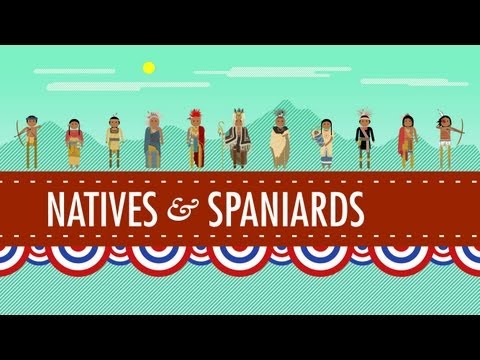
The Black Legend, Native Americans, and Spaniards: Crash Course US History #1
Introduction
The host introduces the topic of Crash Course U.S. History and mentions that the focus will be on the 16th century, before the United States existed. He also acknowledges that the show will cover other parts of the world.
Introducing Crash Course U.S. History
- The host, John Green, introduces himself and the show.
- He mentions that they will be discussing the 16th century and how it was not a time when there was a United States.
- The host expresses his belief that Alaskan statehood is illegitimate.
Pre-European Arrival in North America
- The host states that they will talk about the people who lived in North America before any Europeans arrived.
- He highlights two key points about Native North Americans: there were no classical-style civilizations like the Aztec or Incas, and they did not have certain technologies like metal work, gunpowder, wheels, written languages, or domesticated animals.
Complexity of Native North American Societies
- Although lacking certain technologies, Native North Americans had farming, complex social and political structures, and widespread trade networks.
- The host challenges the notion of labeling these societies as "primitive" or "backwards," emphasizing that human progress is not linear.
Population Estimates and Impact of Diseases
This section discusses population estimates of Native Americans before European arrival and how diseases brought by Europeans decimated their populations.
Uncertainty in Population Estimates
- There is uncertainty regarding the exact number of people living in North America before European arrival.
- Estimates range from as high as 75 million to between 2 and 10 million within present-day US borders.
Devastation from Diseases
- Native American populations were severely impacted by diseases such as smallpox and influenza.
- The host clarifies that the term "decimation" (meaning 1 in 10) does not accurately describe the scale of population loss. It was closer to 8 in 10, which he humorously refers to as "oct-icimation."
Civilizations in North America
This section explores the existence of civilizations in North America before European arrival and their decline.
Peak of Civilizations
- Some civilizations, like the Zuni and Hopi civilization, peaked around 1200 CE.
- These civilizations had large multiple-family dwellings but eventually faced challenges such as drought.
Complexity and Generalization
- Complex civilizations were not the norm in North America.
- Historians tend to generalize due to limited historical records and Eurocentric biases, but it is important to recognize the diversity and complexities of Native American experiences.
Tribal Organization and Beliefs
This section discusses tribal organization, religious beliefs, and land ownership among Native Americans.
Tribal Organization
- Most native groups organized as tribes, with their lives shaped by the natural resources available in their regions.
- Examples include west coast Indians who relied on fishing, gathering, and hunting sea mammals, while Great Plains Indians were often buffalo hunters.
Iroquois Confederacy
- The Iroquois Confederacy (also known as the Great League of Peace) was a notable loose confederacy or league formed by several tribes in upstate New York.
Religious Beliefs
- Native American religions involved ceremonies aligned with their tribe's lifestyle.
- While they believed in a single Creator-god above other deities, they did not have a monotheistic belief system like Christians who arrived later.
Land Ownership
- Native Americans viewed land as a common resource assigned by village leaders, rather than individual ownership.
- Most land was seen as common to everyone.
Class Distinctions in Native American Tribes
This section addresses the misconception that Native American societies were devoid of class distinctions.
Class Distinctions
- Contrary to romanticized notions, there were class distinctions within Native American tribes.
- Rulers often came from specific families, indicating a hierarchical structure.
These notes provide a comprehensive summary of the transcript, organized into meaningful sections. The bullet points are linked to timestamps when available, allowing for easy reference and study.
New Section
This section discusses the perception of Native Americans by Europeans and the Spanish exploration and colonization in America.
Native American Perception by Europeans
- Europeans saw Native Americans as paragons of physical beauty and innocent of European's worst characteristics. However, most Europeans viewed them as savages due to their lack of writing, different views on sexuality, and non-Christian beliefs.
Spanish Exploration and Colonization
- The Spanish were the first Europeans to explore America, with Juan Ponce de Leon arriving in Florida in 1513. They aimed to find gold and establish military bases to protect their silver-laden galleons from pirates.
- Other Spanish explorers like Alvar Nunez Cabeza de Vaca searched for gold but brought over microbes that caused devastation among native populations.
- Spain successfully colonized the American Southwest, establishing its first permanent settlement in Santa Fe, New Mexico in 1610. However, the population remained small.
New Section
This section focuses on the uprising by Native Americans against European colonization in New Mexico.
Uprising in New Mexico
- The arrival of Europeans led to a significant decline in fortunes for the native people known as Pueblos. Between 1600 and 1680, their population decreased from about 60,000 to about 17,000. Additionally, Franciscan friars became militant about eradicating native religion.
- In 1680, a religious leader named Pope organized an uprising against the Spaniards in New Mexico. Around 2,000 warriors killed hundreds of Spanish colonists and forced the rest to leave Santa Fe. The Spanish colony was effectively destroyed, and the Pueblos replaced Christian churches with their places of worship called "kivas."
- After the revolt, the Spanish became more tolerant of indigenous religion and abandoned forced labor practices.
New Section
This section introduces a primary source document that sheds light on the treatment of Native Americans by Spaniards.
Primary Source Document: Treatment of Native Americans
- The mystery document describes how Native Americans were deprived of freedom, subjected to harsh servitude, and considered perpetual slaves by the Spaniards. It highlights the mistreatment and lack of Christianity they received. The author is likely a sympathetic Spaniard who wrote about the destruction caused by Europeans in A History of the Indies.
The Black Legend and American Indians
This section discusses the concept of the Black Legend, which refers to the Spanish cruelty towards Native Americans. It also explores how later settlers, particularly the English, used this idea to justify their own settlements.
The Black Legend and its Influence
- The Black Legend is the tale that portrays the Spanish as inflicting unspeakable cruelty on Native Americans.
- This narrative was true, but it was later used by other settlers, especially the English, to justify their own expansion and portray themselves as saviors of the Indians.
- The English were not necessarily better than the Spanish in their treatment of Native Americans.
- Due to a lack of written records from Native Americans themselves, most Europeans considered them heathens who deserved any mistreatment they received.
Perspectives in American History
This section emphasizes the importance of considering different perspectives in American history. It highlights that while there are abundant written sources available for studying US history, it is crucial to remember who is speaking and whose voices may be unheard.
Considering Different Perspectives
- American history benefits from having numerous written sources due to its relatively late emergence on the historical stage.
- However, every story we hear comes from a specific point of view.
- It is essential to question who is speaking, why they are speaking, and which voices may be marginalized or ignored.
Conclusion
The conclusion expresses gratitude for watching and provides credits for Crash Course production.
Conclusion
- Thanks for watching!
- Crash Course is produced and directed by Stan Muller.
- Script supervision by Meredith Danko.
- Associate producer: Danica Johnson.
- Written by Raoul Meyer (high school history teacher) and myself (presumably John Green).
- Graphics team: Thought Bubble.
Timestamps were not available for the conclusion section.
Turn any video into a summary like this
YouTube links, meetings, lectures. With transcripts, search, and chat.