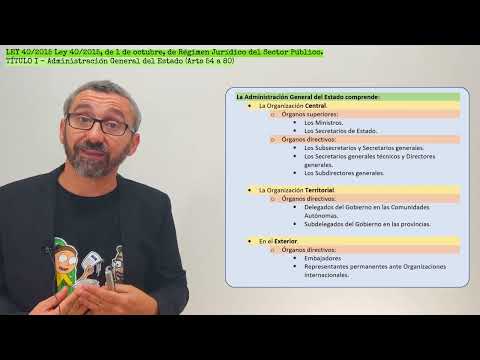
Ley 40/2015 - Organización de la Administración General del Estado
Introduction to the Organization of the General State Administration
In this video, we will explore the organization of the General State Administration as regulated in Title 1 of Law 40/2015, specifically Articles 54-80. We will discuss how the administration acts and organizes itself, highlighting key principles such as efficiency, hierarchy, decentralization, deconcentration, and coordination.
Principles of Organization
- The General State Administration operates based on principles such as efficiency, hierarchy, decentralization, deconcentration, and coordination.
- These principles are fully subject to compliance with the constitution, laws, and rights.
- The Law 40/2015 allows for additional expansion of these principles such as functional decentralization and functional deconcentration.
Decentralization vs. Deconcentration
- Decentralization involves transferring competencies from one public administration to another with a different legal personality.
- This transfer is done through legislation and can be territorial (to autonomous communities or local entities) or functional (to autonomous bodies or public enterprises).
- Deconcentration refers to the transfer of competencies within an administration but hierarchically dependent on higher organs.
- Unlike decentralization which is done by law, deconcentration is carried out by governing bodies.
Types of Decentralization and Deconcentration
- Territorial decentralization involves transferring competencies from the central state administration to a territorial entity like a delegated government or embassy.
- Functional decentralization occurs when competencies are transferred within an administration from higher-ranking officials to lower-ranking ones.
Structure of the General State Administration
The General State Administration is divided into three main parts: Central Organization, Territorial Organization, and External Organization. Each part has its own hierarchical structure and roles.
Central Organization
- The Central Organization consists of superior organs and executive organs.
- Superior organs are responsible for decision-making and policy formulation.
- Executive organs are responsible for implementing policies and managing specific areas.
Territorial Organization
- The Territorial Organization also has executive organs, but they operate at a regional or local level.
- These executive organs carry out the policies and directives set by the central organization.
External Organization
- The External Organization is responsible for representing the administration abroad.
- It also has executive organs that handle specific tasks related to external affairs.
Conclusion
The transcript provides an overview of the organization of the General State Administration. It explains key principles such as efficiency, hierarchy, decentralization, deconcentration, and coordination. Additionally, it outlines the structure of the administration into central, territorial, and external organizations.
Organization and Competence of Ministries and Secretaries of State
This section discusses the determination, denomination, and scope of competence for ministries and secretaries of state. The appointment is made by royal decree from the President of the Government. It also highlights that all senior officials in central administration have the status of high-ranking officials, except for subdirectors.
- Ministries and secretaries of state are determined by royal decree from the President of the Government.
- Article 55 states that all senior officials in central administration have the status of high-ranking officials, except for subdirectors.
- When holding administrative positions as high-ranking officials, career civil servants move to a special services situation.
- Ministers are appointed by royal decree from the King upon proposal from the President of the Government.
- Ministers are the highest authorities within their department and direct superiors to secretaries.
Role and Conditions of High-Ranking Officials
This section explains that all senior officials in central administration have the condition of high-ranking officials, except for subdirectors. It also mentions that when career civil servants hold positions as high-ranking officials, they move to a special services situation.
- All senior officials in central administration have the condition of high-ranking officials, except for subdirectors.
- Career civil servants holding positions as high-ranking officials move to a special services situation.
Situations for Career Civil Servants in High-Ranking Positions
This section clarifies that when career civil servants hold positions as high-ranking officials above a certain level (such as superior or director general), they enter into a special services situation called "iniciativa de servicios especiales."
- Career civil servants holding positions as high-ranking officials above subdirector general level enter into a special services situation called "iniciativa de servicios especiales."
Minister - Chief of Department
This section describes the role and appointment of a minister, who is the chief of a department. It also mentions some competencies of ministers, such as exercising regulatory power, setting objectives for their ministry, approving proposals, resolving conflicts, and signing contracts.
- The minister is appointed by royal decree from the King upon proposal from the President of the Government.
- Ministers are the highest authorities within their department and direct superiors to secretaries.
- Some competencies of ministers include exercising regulatory power, setting objectives for their ministry, approving proposals, resolving conflicts, and signing contracts.
Secretary of State - Second Highest Authority
This section explains that the secretary of state is the second-highest authority in central administration. It highlights that they have certain competencies such as coordinating and directing directorates general under their dependencies.
- The secretary of state is the second-highest authority in central administration.
- Some competencies of secretaries of state include coordinating and directing directorates general under their dependencies.
Organizational Hierarchy in Ministries
This section discusses the organizational hierarchy within ministries. It mentions that subsecretaries and secretaries-general are at the top level, followed by secretaries-general technicians and directors-general. Subdirectors-general are at a lower level.
- The organizational hierarchy within ministries includes subsecretaries and secretaries-general at the top level.
- Secretaries-general technicians and directors-general are at a middle level.
- Subdirectors-general are at a lower level.
Secretariat-General - Potential Existence
This section clarifies that according to Article 58(1) of Law 40, there may or may not be secretariats-general in ministries. It emphasizes the importance of understanding the literal interpretation of the law for exam purposes.
- According to Article 58(1) of Law 40, there may or may not be secretariats-general in ministries.
- The literal interpretation of the law is important for exam purposes.
Secretaries of State - Optional and Appointed by Royal Decree
This section explains that secretaries of state are optional positions and their appointment is made by royal decree from the Council of Ministers upon proposal from the minister. They have competencies such as coordinating and directing directorates general under their dependencies.
- Secretaries of state are optional positions appointed by royal decree from the Council of Ministers upon proposal from the minister.
- Some competencies of secretaries of state include coordinating and directing directorates general under their dependencies.
Organizational Hierarchy - Central, Territorial, and External Administrations
This section discusses the organizational hierarchy within central, territorial, and external administrations. It highlights that subsecretaries have a higher rank than secretaries-general technicians and directors-general.
- The organizational hierarchy within central, territorial, and external administrations includes subsecretaries at a higher rank than secretaries-general technicians and directors-general.
Subsecretary - Creation, Modification, Suppression
This section explains that subsecretaries have a lower rank than secretariats-general but hold a higher position than other officials. Their appointment is made by royal decree from the Council of Ministers upon proposal from the minister. The creation, modification, and suppression of subsecretariats are also done through royal decrees initiated by the minister's proposal.
- Subsecretaries have a lower rank than secretariats-general but hold a higher position than other officials.
- Their appointment is made by royal decree from the Council of Ministers upon proposal from the minister.
- The creation, modification, and suppression of subsecretariats are done through royal decrees initiated by the minister's proposal.
Roles and Responsibilities of Subsecretaries and Secretaries General
This section discusses the roles and responsibilities of subsecretaries and secretaries general in the administration.
Subsecretary (mandatory role)
- Subsecretaries are responsible for convening and resolving selective tests, competitions, etc.
- They exercise disciplinary authority over serious offenses, except for dismissal from service which is the responsibility of the minister.
Secretary General (optional role)
- The secretary general has a rank equivalent to that of a subsecretary.
- Their existence is optional, as stated in Article 60.
- They are appointed by royal decree of the council of ministers upon proposal by the ministry's head or the prime minister.
- They have similar powers as subsecretaries, including creating, modifying, and abolishing their respective departments.
Territorial Organization
- Each autonomous community will have a government delegation located where the regional government council is based.
- In pluriprovincial autonomous communities, there will be a mandatory government subdelegate.
- There will be directors on islands or other designated locations as determined by regulations.
Delegates of the Government
- Delegates of the government represent the national government in respective autonomous communities.
- They hold the rank of subsecretary according to Article 55(4) and 72(3).
- Their appointment and separation are done by royal decree of the council of ministers upon proposal by the prime minister.
- Delegates' competencies include directing and coordinating public agencies, ensuring citizen security through law enforcement agencies, among others.
Hierarchy within Central Administration: Secretaries General Technicians and Directors General
This section explains the hierarchy within central administration, focusing on secretaries general technicians and directors general.
Secretaries General Technicians
- Secretaries general technicians work directly under subsecretaries.
- They have the rank of director general, as stated in Article 60 and 65.
- Their appointment or separation is done by royal decree of the council of ministers upon proposal by the ministry's head.
- They have competencies related to their respective directorates and common services.
Directors General
- Directors general hold the rank of director general.
- Their appointment or separation is done by royal decree of the council of ministers upon proposal by the ministry's head or the prime minister, as stated in Article 66(2).
- They are responsible for proposing projects, achieving objectives, and carrying out competencies assigned to their directorate.
Roles and Appointments in External Administration
This section discusses roles and appointments in external administration, specifically ambassadors and permanent representatives.
Ambassadors and Permanent Representatives
- Ambassadors and permanent representatives hold the rank of ambassador or permanent representative.
- The specific appointment process is not mentioned in the transcript.
- The Constitution refers to representations in Article 63.
How are ambassadors appointed and what is found in the Official State Gazette regarding their appointment?
This section discusses the process of appointing ambassadors and provides information about what can be found in the Official State Gazette regarding their appointment.
Appointment of Ambassadors
- Ambassadors are appointed based on a proposal from the Minister of Foreign Affairs and European Union Cooperation.
- The appointment is made after deliberation by the Council of Ministers.
- The appointment is published in the Official State Gazette.
Official State Gazette Information
- The announcement in the Official State Gazette simply states that, upon proposal from the Minister of Foreign Affairs, a specific person has been designated as Spain's ambassador to a particular embassy.
What are subdirectors general and their role?
This section explains the role and position of subdirectors general within the organizational structure.
Subdirectors General
- Subdirectors general hold a position below directors general but above other lower-ranking officials.
- They do not have the status of "alto cargo" (high-ranking official).
- Their competencies are specific to their subdirector general role, including executing projects or activities under their respective superiors.
What is the difference between subdirectores generales and other high-ranking officials?
This section highlights the distinction between subdirectores generales and other high-ranking officials within central administration.
Distinction for Subdirectores Generales
- Unlike other high-ranking officials, subdirectores generales do not have "alto cargo" status.
- They are considered part of central administration rather than being classified as high-ranking officials.
- Their competencies include those specific to their subdirector general role, such as executing projects or activities under their respective superiors.
What are the roles and responsibilities of subdirectores generales?
This section outlines the roles and responsibilities of subdirectores generales within the central administration.
Roles and Responsibilities
- Subdirectores generales are responsible for the activities, objectives, and projects assigned to their specific subdirección general.
- They execute projects or activities under the supervision of their respective superiors, either within a dirección general or a higher-level organ.
What is the role of subdelegados del gobierno in territorial administration?
This section explains the role of subdelegados del gobierno in territorial administration.
Role of Subdelegados del Gobierno
- In each province, there is a subdelegado del gobierno who operates under the immediate authority of the delegado del gobierno.
- The appointment and separation of subdelegados del gobierno are done by real decreto (royal decree) through a procedure called "libre designación" (free appointment).
- Their competencies include communication, collaboration, cooperation with autonomous communities and local entities, as well as directing and coordinating civil protection in the province.
What are units administrativas in the General State Administration?
This section describes units administrativas within the General State Administration.
Units Administrativas
- Units administrativas are basic organizational elements within the General State Administration.
- They can exist as individual units or be grouped together into complex units.
- The creation, modification, and elimination of units administrativas are determined through relations between job positions.
Summary: Organizational Structure of General State Administration
This section provides a summary of the organizational structure within the General State Administration.
Organizational Structure
- The organizational structure includes superior officials such as ministers and secretaries of state at the central level.
- Directivos include subsecretarios and directores generales, who are considered high-ranking officials.
- Subdirectores generales hold a position below directivos and do not have "alto cargo" status.
- In territorial administration, there are delegados del gobierno and subdelegados del gobierno.
- Ambassadors and permanent representations exist in the external administration.
The transcript does not provide timestamps for the remaining content.
New Section Overview
The speaker concludes the video and discusses the organization of the General State Administration. They express hope that the video has been helpful and thanks viewers for their support.
Conclusion and Next Video
- The speaker wraps up the video and mentions that they will provide a summary of the most important points in the next video.
The transcript is already in English, so there is no need to translate it.